Banner
Object-Based Processing: Numbers Confuse How We Perceive Spaces

Researchers recently studied the relationship between numerical information in our vision, and...

Males Are Genetically Wired To Beg Females For Food

Bees have the reputation of being incredibly organized and spending their days making sure our...

The Scorched Cherry Twig And Other Christmas Miracles Get A Science Look

Bleeding hosts and stigmatizations are the best-known medieval miracles but less known ones, like ...

$0.50 Pantoprazole For Stomach Bleeding In ICU Patients Could Save Families Thousands Of Dollars

The inexpensive medication pantoprazole prevents potentially serious stomach bleeding in critically...

User picture.
News StaffRSS Feed of this column.

News Releases From All Over The World, Right To You... Read More »

Blogroll

Game over. Computer scientists at the University of Alberta have solved checkers, the popular board game with a history that dates back to 3,000 B.C.

After 18-and-a-half years and sifting through 500 billion billion (a five followed by 20 zeroes) checkers positions, Dr. Jonathan Schaeffer and colleagues have built a checkers-playing computer program that cannot be beaten. Completed in late April this year, the program, Chinook, may be played to a draw but will never be defeated.

"This is a tremendous achievement—a truly significant advance in artificial intelligence," said Dr.

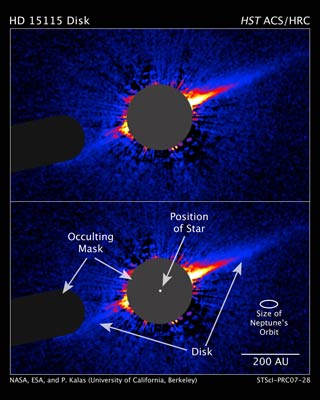
Astronomers have found a debris disk around HD 15115. As seen from Earth, the edge-on disk resembles a needle sticking out from the star.

Astronomers think the disk's odd imbalanced look is caused by dust following a highly elliptical orbit about the star. The lopsided disk may have been caused by the gravity of planets sweeping up debris in the disk or by the gravity of a nearby star.

The observations were made by Paul Kalas, James Graham, and Michael P. Fitzgerald, all from the University of California at Berkeley.


The disk, seen edge-on, is the dense blue line extending from the star to the upper right and lower left of the image.

A singing computer scientist wants to use cutting-edge technology to create Europe's first successful Internet choir.

Dr Barry Cheetham, a senior lecturer in The School of Computer Science at The University of Manchester, is seeking to combine his academic expertise in communications, networks and digital signal processing with his love of choral singing.

He is looking for funding to drive forward a project that will bring together amateur and semi-professional singers across Europe for seamless and polished live performances.


Credit: Barry Cheetham

A new National Science Foundation (NSF) report finds the number of U.S. science and engineering (S&E) articles in major peer-reviewed journals flattened in the 1990s, after more than two decades of growth, but U.S. influence in world science and technology remains strong.

The report, Changing U.S. Output of Scientific Articles: 1988 - 2003, finds changes occurred despite continued increases in funding and personnel for research and development. Flattening occurred in nearly all U.S. research disciplines and types of institutions.

In contrast, emerging Asian nations had large increases in publication numbers, reflecting their growing expertise in science and technology. European Union totals also went up.

Although the addition of nutrients to soil helps to maximize crop production, fertilizer can leech nutrients, polluting the water supply. A recent study by researchers at the University of Minnesota shows alternative cropping practices may help to protect the environment by reducing high nitrate levels in surface and ground water caused by conventional fertilizer use.

Nitrogen is one of the most important elements required in agricultural systems for plant and animal production. While treatment with the correct amount of nitrogen-based fertilizer optimizes crop yield and minimizes environmental damage, too much nitrogen can lead to nitrate loss.

Human cells function through the concerted action of thousands of proteins that control their growth and differentiation. Yet, the specific function of most human proteins remains either unknown or poorly characterized.

Diseases being often due to aberrations in the function of key cellular proteins, numerous large-scale research initiatives have been launched internationally to crack the function of all human proteins.

A research team led by Dr. Benoit Coulombe from the Institut de recherches cliniques de Montréal (IRCM) describes a powerful proteomics approach that promises to have a profound impact on our current understanding of the human proteome and the function of its individual proteins.