Banner
Pilot Study: Fibromyalgia Fatigue Improved By TENS Therapy

Fibromyalgia is the term for a poorly-understood condition where people experience pain and fatigue...

High Meat Consumption Linked To Lower Dementia Risk

Older people who eat large amounts of meat have a lower risk of dementia and cognitive decline...

Long Before The Inca Colonized Peru, Natives Had A Thriving Trade Network

A new DNA analysis reveals that long before the Incan Empire took over Peru, animals were...

Mesolithic People Had Meals With More Tradition Than You Thought

The common imagery of prehistoric people is either rooting through dirt for grubs and picking berries...

User picture.
News StaffRSS Feed of this column.

News Releases From All Over The World, Right To You... Read More »

Blogroll

A new report published in the prestigious New England Journal of Medicine (NEJM) shows that patients treated with bronchial thermoplasty, the first non-drug treatment for asthma, demonstrated an overall improvement in asthma control.

Co-Principal Investigators, Dr. Gerard Cox, respirologist at St. Joseph’s Healthcare Hamilton’s Firestone Institute for Respiratory Health, and Professor at McMaster University, and Dr. John Miller, Division Head of Thoracic Surgery at St. Joseph’s Healthcare Hamilton and McMaster University authored the study. The study revealed improved asthma control at one year following the bronchial thermoplasty procedure.

Picture the flow of water over a rock. At very low speeds, the water looks like a smooth sheet skimming the rock's surface. As the water rushes faster, the flow turns into turbulent, roiling whitewater that can overturn your raft.

Turbulence is important in virtually all phenomena involving fluid flow, such as air and gas mixing in an engine, ocean waves breaking on a cliff and air whipping across the surface of a vehicle. However, a comprehensive description of turbulent fluid motion remains one of physics' major unsolved problems.


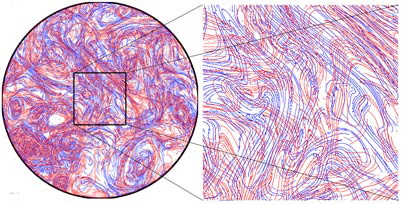
MIT visualization of the chaotic tangle underlying turbulence. Area in black box represents a blown-up portion of the fluid showing the self-similarity of the tangle.

Tidal marshes, which nurture marine life and reduce storm damage along many coastlines, should be able to adjust to rising sea levels and avoid being inundated and lost, if their vegetation isn't damaged and their supplies of upstream sediment aren't reduced, a new Duke University study suggests.

Such marshes "offer great value as buffers of coastal storms in cities such as New Orleans, which is separated from the Gulf of Mexico by marshlands," Matthew Kirwan and A.

New calculations show that sensitivity of Earth's climate to changes in the greenhouse gas carbon dioxide (CO2) has been consistent for the last 420 million years, according to an article in Nature by geologists at Yale and Wesleyan Universities.

A popular predictor of future climate sensitivity is the change in global temperature produced by each doubling of CO2 in the atmosphere. This study confirms that in the Earth's past 420 million years, each doubling of atmospheric CO2 translates to an average global temperature increase of about 3° Celsius, or 5° Fahrenheit.

It is a natural history tale that every third grader knows: The dinosaurs ruled the Earth for hundreds of millions of years, until an asteroid struck the Yucatan Peninsula and triggered a mass extinction that allowed the ancestors of today’s mammals to thrive.

The asteroid part of the story may still hold true, but a new study challenges the notion that a mass extinction of dinosaurs 65 million years ago played a major role in the dominance of today’s mammals.

A new, complete 'tree of life' tracing the history of all 4,500 mammals on Earth shows that they did not diversify as a result of the death of the dinosaurs, says new research published in Nature today.

The study was undertaken in the UK by scientists at Imperial College London and the Zoological Society of London (ZSL). It contradicts the previously accepted theory that the Mass Extinction Event (MEE) that wiped out the dinosaurs 65 million years ago prompted the rapid rise of the mammals we see on the earth today.