Caltech researchers have created a nanoscale crystal device that allows them to confine both light and sound vibrations in the same tiny space.
The interactions between sound and light in this optomechanical crysta can result in mechanical vibrations with frequencies as high as tens of gigahertz, or 10 billion cycles per second. Being able to achieve such frequencies gives these devices the ability to send large amounts of information, and opens up a wide array of potential applications—everything from lightwave communication systems to biosensors capable of detecting (or weighing) a single macromolecule.
Body builders will tell you that protein is key to bigger, stronger muscles. For the truly elite, that may be the case but for the all but 50 of you who are not elite muscle builders, a recent study by University of Texas Medical Branch at Galveston metabolism researchers provides evidence that a more normal eating pattern is going to get you the same results as wolfing down protein shakes; something your commission-based, fitness-center trainer does not want you to read.
The study's results, obtained by measuring muscle synthesis rates in volunteers who consumed different amounts of lean beef, show that only about the first 30 grams (just over one ounce) of dietary protein consumed in a meal actually produce muscle.
"Speciation is one of the most fascinating, unsolved problems in biology," says Harmit Malik, Ph.D., an associate member of the Hutchinson Center's Basic Sciences Division. The first appearance of new beings on Earth - the mystery of mysteries - is a great puzzle for scientists and philosophers alike.
Exercise makes cigarettes less attractive, says a new study from the University of Exeter.
Exercise can lessen the power of cigarettes and smoking-related images to grab the attention of smokers, the authors write in the journal Addiction. They did a study involving 20 moderately heavy smokers who had abstained from cigarettes for 15 hours before the trial. During two visits to the laboratory participants began by being shown smoking-related and neutral images, and then spent either 15 minutes sitting or exercising on a stationary bike at a moderate intensity. Afterwards, they were again shown the images.
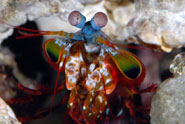
A marine crustacean could inspire the next generation of DVD and CD players, says a new study in Nature Photonics.
Mantis shrimps found on the Great Barrier Reef in Australia have the most complex vision systems known to science. They can see in twelve colors (humans see in only three) and can distinguish between different forms of polarized light.
Special light-sensitive cells in mantis shrimp eyes act as quarter-wave plates; they can rotate the plane of the oscillations (the polarization) of a light wave as it travels through it. This capability makes it possible for mantis shrimps to convert linearly polarized light to circularly polarized light and vice versa.
The great diversity of male sexual traits, ranging from peacock's elaborate train to formidable genitalia of male seed beetles, is the result of female choice, say researchers from Uppsala University, but why do females choose among males? In a new Current Biology study they found no support for the theory that the female choice is connected to "good genes".
There is no consensus among biologists over the key question why females choose among males but the heart of this debate has two preferred possibilities - that female choosiness is beneficial to the females themselves or that female choice traits are favored because of 'good genes' that males contribute to female's offspring.


 Males Are Genetically Wired To Beg Females For Food
 The Scorched Cherry Twig And Other Christmas Miracles Get A Science Look
 $0.50 Pantoprazole For Stomach Bleeding In ICU Patients Could Save Families Thousands Of Dollars
 Metformin Diabetes Drug Used Off-Label Also Reduces Irregular Heartbeats