Banner
Object-Based Processing: Numbers Confuse How We Perceive Spaces

Researchers recently studied the relationship between numerical information in our vision, and...

Males Are Genetically Wired To Beg Females For Food

Bees have the reputation of being incredibly organized and spending their days making sure our...

The Scorched Cherry Twig And Other Christmas Miracles Get A Science Look

Bleeding hosts and stigmatizations are the best-known medieval miracles but less known ones, like ...

$0.50 Pantoprazole For Stomach Bleeding In ICU Patients Could Save Families Thousands Of Dollars

The inexpensive medication pantoprazole prevents potentially serious stomach bleeding in critically...

User picture.
News StaffRSS Feed of this column.

News Releases From All Over The World, Right To You... Read More »

Blogroll
Meteorites discovered with known orbits are incredibly rare but researchers using cameras which capture fireballs streaking across the night sky have managed to find not only a tiny meteorite on the vast Nullarbor Plain, but also mathematically determine its orbit and the asteroid it came from.

The ability to track meteorites back to their asteroid home also means it is an incredibly cheap way of sampling that asteroid, rather than conducting an expensive space mission.

To find the meteorite, the team deployed three 'all sky cameras' on the Nullarbor Plain to form a fireball camera network.   The cameras take a single time lapse picture of the sky throughout the entire night to record any fireballs over the Plain.
Freedom of the press is integral to a functioning democracy and respect for human rights, it is said, and a new study tackles the effects of media freedom in countries that lack democratic institutions like fair elections. 

The findings?   By itself, freedom of the press doesn't accomplish much.   Media freedom in the absence of other institutional outlets for dissent is actually associated with greater oppression of human rights, Jenifer Whitten-Woodring, a doctoral candidate in political science and international relations at USC, found utilizing data from 93 countries for the years 1981-1995. 

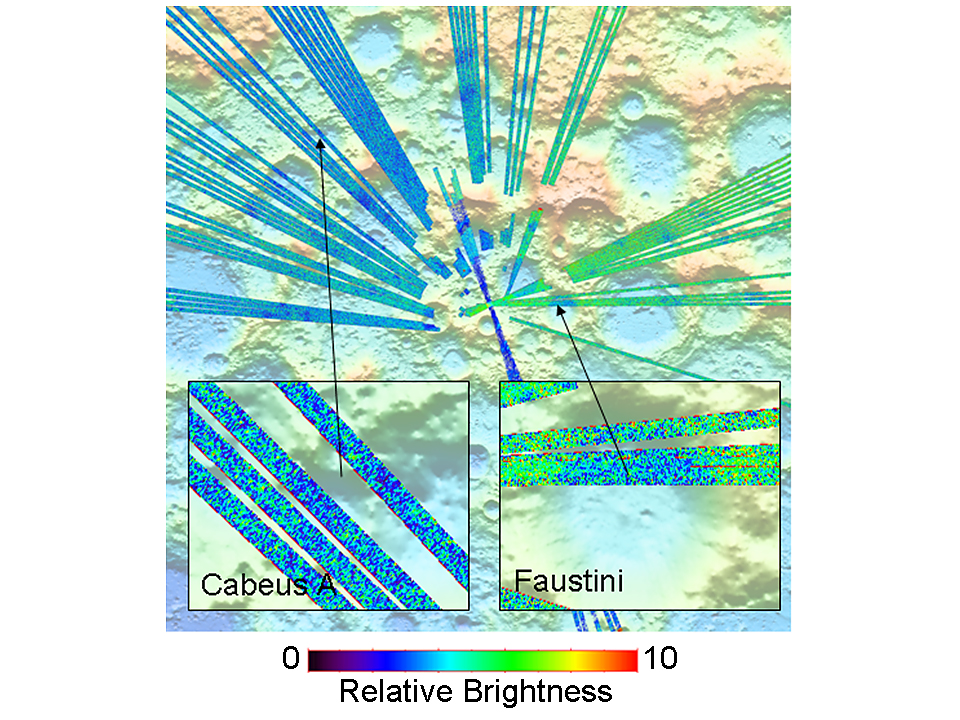
NASA's Lunar Reconnaissance Orbiter (LRO), launched on June 18th, 2009,  will return more data about the Moon than any previous mission. The Lyman-Alpha Mapping Project (LAMP), developed by Southwest Research Institute,  uses a novel method to peer into the perpetual darkness of the Moon's so-called permanently shadowed regions - the dark side of the moon.

A 9-foot dinosaur excavated illegally from northeastern China and purchased by a private collector who brought it to the attention of paleontologists (hey, they'll return it after they're done)  is about the same weight as a grown human yet had still evolved all the hallmark anatomical features of Tyrannosaurus rex - except 30 million years earlier, according to a study in Science.

Raptorex displays the hallmarks of its famous descendant, Tyrannosaurus rex, like an oversized head, tiny arms and feet well-suited for running. The Raptorex brain cast also shows enlarged olfactory bulbs, like T. rex, indicating a highly developed sense of smell.
If you want to create a micro-aircraft that flies with the maneuverability and energy efficiency of an insect (and you know you do) decoding the aerodynamic secrets of insect flight is key because optimization through evolutionary pressures over millions of years far outstrips what we can achieve artificially. 

But it's not that simple.  Consider the 'bumblebee paradox' that plagued researchers for decades.    It turned out not to be a paradox but rather an issue with what we could model aerodynamically.   Look at mister bee below:


Scientists have observed ferromagnetism in an atomic gas for the first time, addressing the decades-old question of whether gases could show properties similar to a magnet made of iron or nickel.

A team observed the ferromagnetic behavior in a gas of lithium atoms cooled to 150 billionth of 1 Kelvin above absolute zero (-273 degrees C or -459 degrees F). Team members used the lithium-6 isotope, which consists of three protons, three neutrons and three electrons. Since the number of constituents is odd, lithium-6 is a fermion — a class of exotic particles that have a half-integral spin — and has properties similar to an electron. Therefore, lithium atoms can be used to simulate the behavior of electrons.