Banner
Ousiometrics Analysis Says All Human Language Is Biased

A new tool drawing on billions of uses of more than 20,000 words and diverse real-world texts claims...

Wavelengths Of Light Are Why CO2 Cools The Upper Atmosphere But Warms Earth

There are concerns about projected warming on the Earth’s surface and in the lower atmosphere...

Here's Where Your Backyard Was 300 Million Years Ago

We may use terms like "grounded" and terra firma to mean stability and consistency but geology...

Convergent Evolution Cheat Sheet Now 120 Million Years Old

One tenet of natural selection is a random walk of genes but nature may be more predictable than...

User picture.
News StaffRSS Feed of this column.

News Releases From All Over The World, Right To You... Read More »

Blogroll

Young mice with the rodent equivalent of a rare autism spectrum disorder (ASD) called Rett syndrome that were fed a diet supplemented with the synthetic oil triheptanoin had physical and behavioral symptoms that were less severe after being on the diet - and they lived longer than mice on regular diets.

Researchers involved in the study think that triheptanoin improved the functioning of mitochondria, energy factories common to all cells. Since mitochondrial defects are seen in other ASDs, the researchers say, the experimental results offer hope that the oil could help not just people with Rett syndrome, but also patients with other, more common ASDs.

Cancer-driving genomic aberrations in localized lung cancer appear are so consistently present across tumors that a single biopsy of one region of the tumor is likely to identify most of them, according to a new paper.

The study addresses the challenge of what scientists call genomic heterogeneity, the presence of many different variations that drive tumor formation, growth and progression, and likely complicate the choice and potential efficacy of therapy.

A landmark study of renal cell cancer in 2012 found that most cancer-promoting variations were not present across all regions of those tumors, so biopsy of a single region would not provide a good representation of cancer genes important in the genesis of any given tumor.

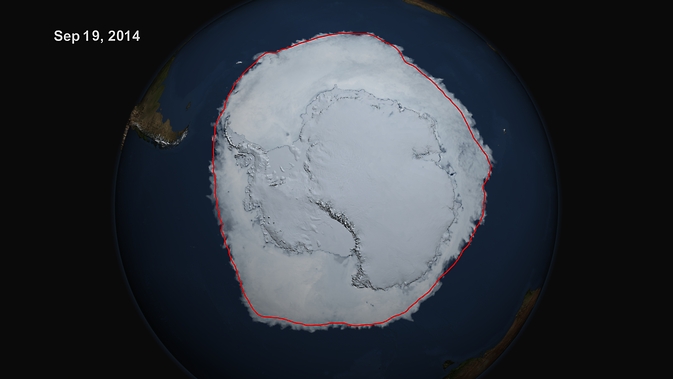
Antarctic sea ice reached a new record high extent this year, covering more of the southern oceans than it has since scientists began a long-term satellite record to map sea ice extent in the late 1970s.

The Antarctic sea ice extent exceeded 7.72 million square miles (20 million square kilometers) for the first time since 1979, according to the National Snow and Ice Data Center. The ice extent stayed above this benchmark extent for several days. The average maximum extent between 1981 and 2010 was 7.23 million square miles (18.72 million square kilometers). 

Tropical Storm Simon, once a hurricane, is expected to bring heavy rain to portions of the central Plains and Midwest on today and tomorrow. Since it is not hitting New York City during presidential election season, it won't be called a SuperStorm and get much national media attention.

Tropical Cyclone Hudhud formed on Oct. 8th and began moving from east to west across the Bay of Bengal in the Northern Indian Ocean. 

NASA's Aqua satellite flew over Hudhud today and took a picture of the storm that showed it was still somewhat elongated, but more organized than the previous day. The Moderate Resolution Imaging Spectroradiometer (MODIS) instrument aboard NASA's Aqua satellite provided the hint of a developing eye.

Warnings for winds, rain and surf are already in effect for the northern Andhra Pradesh coast and south Odisha coastline of eastern India as Hudhud approaches.

No matter what type of chemotherapy you attack a tumor with, many cancer cells resort to the same survival tactic: They start eating themselves. This autophagy process happens when two proteins pair up and switch it on this process, according to a new paper.

"This gives us a therapeutic avenue to target autophagy in tumors," says Brigham Young University chemistry professor Josh Andersen. "The idea would be to make tumors more chemo-sensitive. You could target these proteins and the mechanism of this switch to block autophagy, which would allow for lower doses of chemotherapy while hopefully improving patient outcomes."