Banner
Ousiometrics Analysis Says All Human Language Is Biased

A new tool drawing on billions of uses of more than 20,000 words and diverse real-world texts claims...

Wavelengths Of Light Are Why CO2 Cools The Upper Atmosphere But Warms Earth

There are concerns about projected warming on the Earth’s surface and in the lower atmosphere...

Here's Where Your Backyard Was 300 Million Years Ago

We may use terms like "grounded" and terra firma to mean stability and consistency but geology...

Convergent Evolution Cheat Sheet Now 120 Million Years Old

One tenet of natural selection is a random walk of genes but nature may be more predictable than...

User picture.
News StaffRSS Feed of this column.

News Releases From All Over The World, Right To You... Read More »

Blogroll

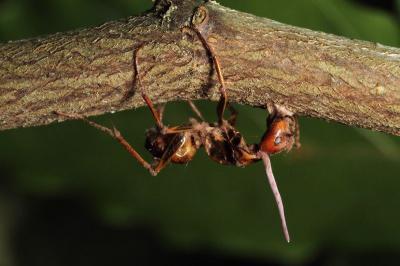
A parasitic fungus that reproduces by manipulating the behavior of ants emits a cocktail of behavior-controlling chemicals when encountering the brain of its natural target host, but not when infecting other ant species, a new study shows.

The findings, which suggest that the fungus "knows" its preferred host, provide new insights into the molecular mechanisms underlying this phenomenon, according to researchers.

"Fungi are well known for their ability to secrete chemicals that affect their environment," noted lead author Charissa de Bekker, a Marie Curie Fellow in Penn State's College of Agricultural Sciences, and Ludwig Maximilian of the University of Munich. "So we wanted to know what chemicals are employed to control so precisely the behavior of ants."

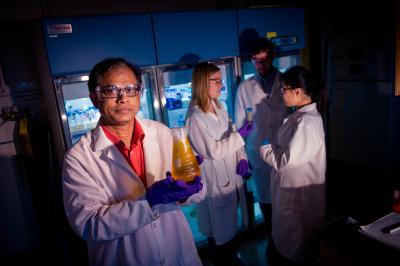
A certain type of biomolecule, called a glycoconjugate,  is built like a nano-Christmas tree. Its many branches are bedecked with sugary ornaments that get all the glory. That's because, according to conventional wisdom, the glycoconjugate's lowly "tree" basically holds the sugars in place as they do the important work of reacting with other molecules.

A chemist at Michigan Technological University has discovered that the tree itself — the scaffold — is a good deal more than a simple prop.

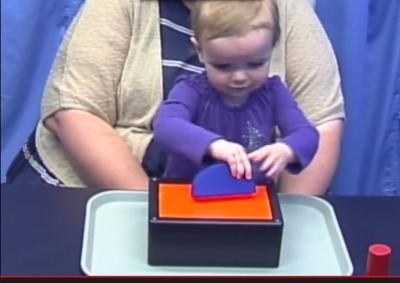
Children learn many skills simply by watching people around them. Without any explicit instructions, youngsters figure out how to do things like press a button to operate the television and twist a knob to open a door.

Scholars have taken this further and found that children as young as age 2 intuitively use mathematical concepts such as probability to help make sense of the world around them.

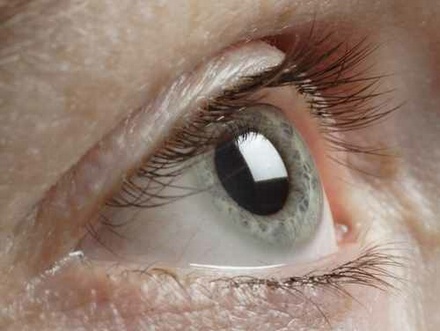
People with more yellow pigment in their eye may be better able to see distant objects in hazy conditions, according to a new paper in Optometry and Vision Science.

Increased macular pigment (MP) may help in filtering out "blue haze," thus making distant objects more visible, according to an experimental study by Laura M. Fletcher, MS, and colleagues of University of Georgia, Athens. "The results suggest that people with high levels of yellow macular pigment may have some slight advantage in hazy and glare conditions," comments Anthony Adams, OD, PhD, Editor-in-Chief of Optometry and Vision Science.

Macular Pigment Affects Vision through 'Blue Haze'

For 'credence' services such as auto-repair, health care, and legal services, when more service providers care about the customer's well-being, society as whole may actually be worse off.   

Why? Because the benefit to the customers for the service is difficult to assess before and even after the service. For example, when an auto mechanic tells a customer to make some repairs, the average customer is unable to discern the veracity of the recommendation. The risk of not doing repairs is unknown until a breakdown, if any, occurs. But if repairs are undertaken, their value may never be known.  

Exercising to improve our cardiovascular strength may protect us from cognitive impairment as we age, according to a new study by researchers at the University of Montreal and its affiliated Institut universitaire de gératrie de Montréal Research Centre.

The researchers worked with 31 young people between the ages of 18 and 30 and 54 older participants aged between 55 and 75. This enabled the team to compare the older participants within their peer group and against the younger group who obviously have not begun the aging processes in question. None of the participants had physical or mental health issues that might influence the study outcome.