Banner
Ousiometrics Analysis Says All Human Language Is Biased

A new tool drawing on billions of uses of more than 20,000 words and diverse real-world texts claims...

Wavelengths Of Light Are Why CO2 Cools The Upper Atmosphere But Warms Earth

There are concerns about projected warming on the Earth’s surface and in the lower atmosphere...

Here's Where Your Backyard Was 300 Million Years Ago

We may use terms like "grounded" and terra firma to mean stability and consistency but geology...

Convergent Evolution Cheat Sheet Now 120 Million Years Old

One tenet of natural selection is a random walk of genes but nature may be more predictable than...

User picture.
News StaffRSS Feed of this column.

News Releases From All Over The World, Right To You... Read More »

Blogroll

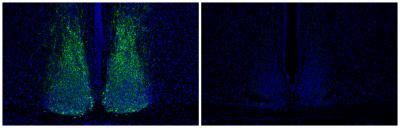
Scientists have identified a gene, Lhx1, that regulates sleep and wake rhythms.

The discovery of the role Lhx1 provides scientists with a potential therapeutic target to help night-shift workers or jet lagged travelers adjust to time differences more quickly. T

Every cell in the body has a "clock" – an abundance of proteins that dip or rise rhythmically over approximately 24 hours. The master clock responsible for establishing these cyclic circadian rhythms and keeping all the body's cells in sync is the suprachiasmatic nucleus (SCN), a small, densely packed region of about 20,000 neurons housed in the brain's hypothalamus.

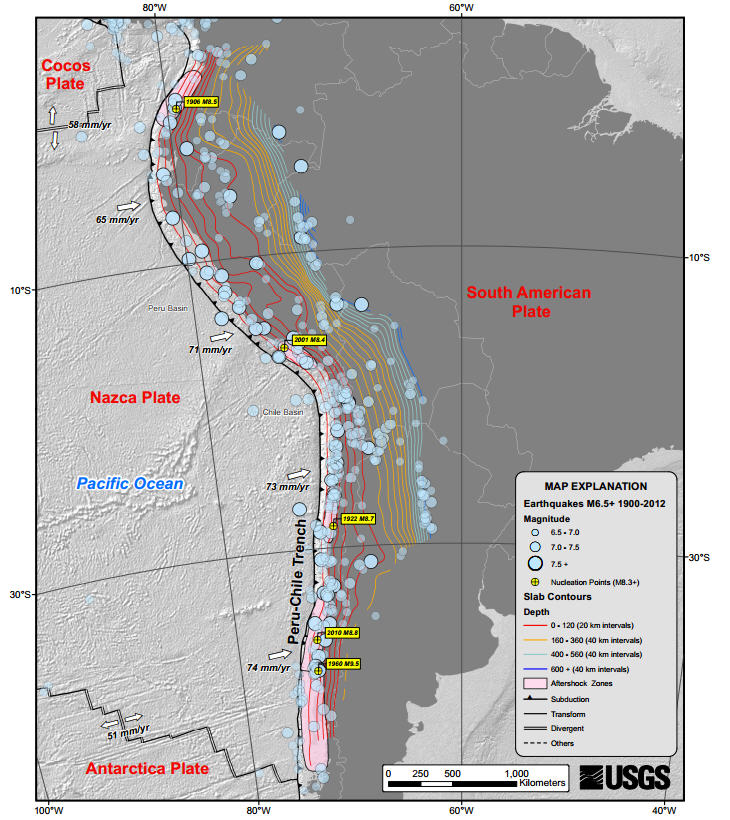
A long lasting foreshock series controlled the rupture process of this year's great earthquake near Iquique in northern Chile, according to an international research team

The earthquake was heralded by a three quarter year long foreshock series of ever increasing magnitudes culminating in a Mw 6.7 event two weeks before the mainshock.

The mainshock (magnitude 8.2) finally broke, on April 1st, a central piece out of the most important seismic gap along the South American subduction zone. The study reveals that the Iquique earthquake occurred in a region where the two colliding tectonic plates where only partly locked.

Attention Deficit Hyperactivity Disorder (ADHD) is so commonly diagnosed – and overdiagnosed, and misdiagnosed – that it is hard to know what is based on evidence and what is based on teachers and concerned parents reacting to children that don't like to sit around and do nothing.

Actual clinical ADHD used to be rare but now it is a common problem of "pill culture" in psychiatry and the most common behavioral disorder label given to children in America, according to the Centers for Disease Control and Prevention.

Not that you want to do this but there is an easy way to speed up a woman's reproductive timing - just get a clock.

Not one of those modern digital things, an actual ticking clock will literally do it, says a paper upcoming in Human Nature.

It turns out that the tick-tock of the metaphor has some basis in reality. Or not. The authors also claim that poor women are more likely to be affected by this ticking sound. And the authors are psychologists so beware of mainstream media making grand biological claims based on this.

Interpreting snow depth records from past decades is as much art as science. Even into the 1990s, Soviets on Arctic drifting sea ice used meter sticks and handwritten logs to record snow depth. Today, things are a lot more accurate. Airborne measurements are validated by researchers on the ground using automated probes similar to a ski pole. 

Accuracy is important. The public has become concerned about what is happening at the poles, and so research led by NASA and the University of Washington combined data collected by ice buoys and NASA aircraft with historic data from ice floes staffed by Soviet scientists since the late 1950s through the early 1990s to track changes over decades. 

In the 1950s and '60s, economics in America really had a heyday. Tinkering is easy when the economy is good. By the 1970s, it was realized that economics truly was, as historian Thomas Carlyle labeled it in the 19th century, a "dismal science" - except leave off the science.