




But why Iceland’s fiery mantle plume had such a dramatic impact has been the subject of debate.
A new paper suggests the thickness of tectonic plates around the North Atlantic might explain the widespread volcanism. Seismic and temperature maps of Earth’s interior show that patches of thinner tectonic plate acted like conduits, funnelling the plume’s molten rock over a wide area. And may be why Iceland, Ultima Thule to the ancient world, remains one of the most volcanically active places on Earth.
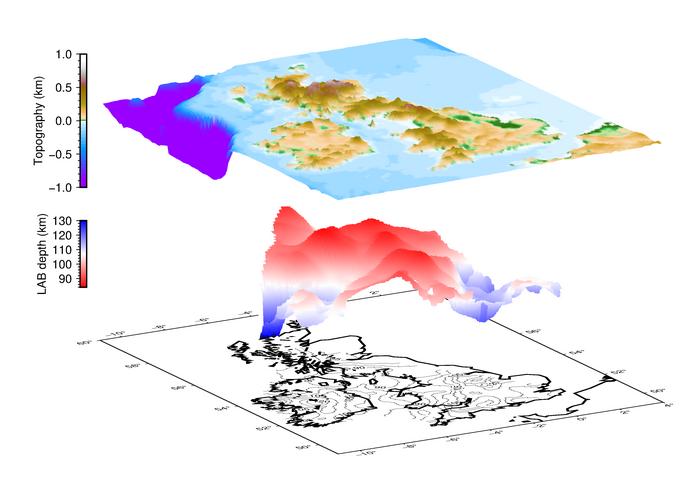
Credit: University of Cambridge
The Iceland Plume shaped the seafloor and ocean circulation in the North Atlantic, which means climate throughout eons. The team focused on a segment of the North Atlantic Igneous Province to learn why the plume’s volcanic imprint was so widespread sixty million years ago, before the Atlantic opened, forming a mantle plume spreading outward in a branched, flowing formation, thousands of miles in size. They wanted to see if Earth’s tectonic plates played a role in the surface expression of volcanism.
Using seismic data extracted from earthquakes, used seismic tomography,, a computer-generated image of Earth’s interior beneath Britain and Ireland, and coupled it with seismic thermography measurements which reveal variations in the temperature and thickness of the tectonic plate. They found that northwest Scotland and Ireland’s volcanoes formed in areas where the lithosphere (Earth’s rigid outer layer that makes up the tectonic plates) is thinner and weaker.
They suggest the hot plume material was preferentially funneled along this corridor, ponding in the thin plate areas due to its buoyancy.Their correlation suggests that hot plume material eroded the lithosphere in this region. This resulting combination of thin lithosphere, hot asthenosphere and decompression melting likely caused the uplift and volcanic activity.



Comments