Epidemiologists say that pollen can cause worse outcomes for students in math, chemistry and physics.
Allergic rhinitis, an allergic reaction to things such as dust, pet hair, and pollen, is common. Epidemiologists link that to cardiovascular health and even blanket terms like wellness. There is no question people with allergies suffer, especially during peak pollen production, but a new paper says allergy sufferers may be less likely to be good at math and science, and pollen could be why.
Their data were 92,280 students who took the national high school matriculation exam in Helsinki and Turku areas of southern Finland between 2006 and 2020. Matriculation exam results were from Statistics Finland, focusing on grades obtained in Finnish, History and Social Studies, Mathematics, Physics, and Chemistry to see if they changed in relation to pollen exposure during this period.
Daily regional pollen counts of alder (Alnus spp) and hazel (Corylus avellana) were monitored throughout this period, because these are the only plants that bloom and release pollen grains in Finland around the time of the spring matriculation exams and expressed as pollen grains per cubic meter of air and then classified as low (1–10); moderate (10–100); or abundant (100+). Data on air quality (including "virtual pollution", small micron particulate matter - PM2.5) and weather were obtained from the Finnish Meteorological Institute.
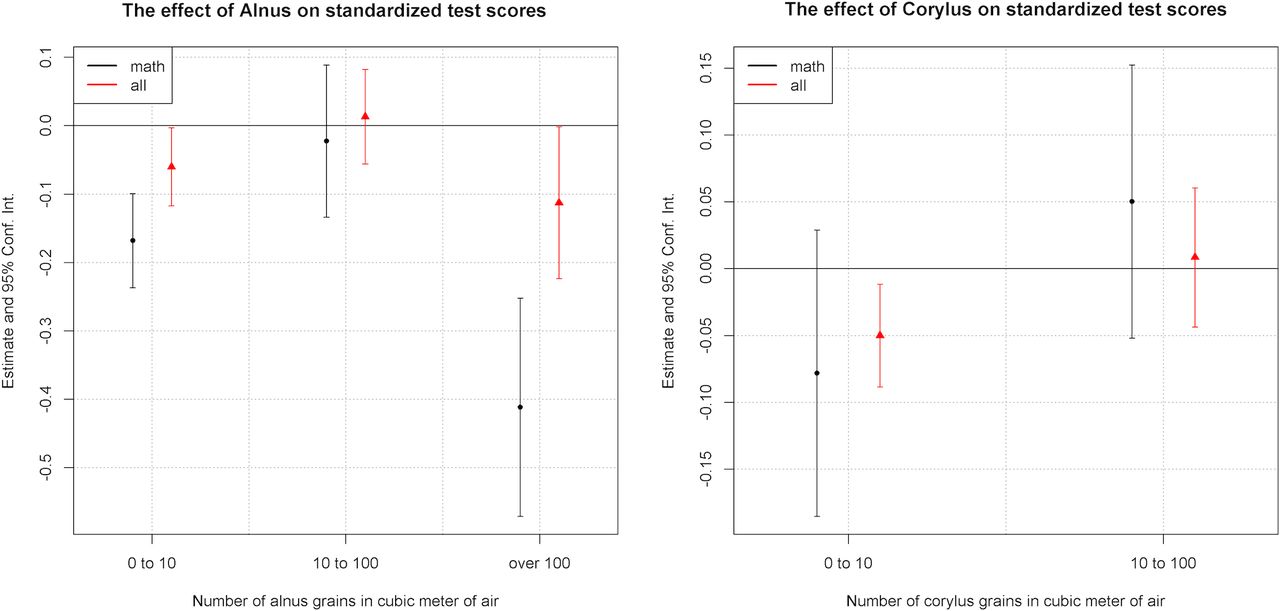
Regression results on the effect of pollen concentration on standardized exam scores using logarithmic scale. Conf. Int., confidence interval.
The maximum average daily alder pollen count was 521 pollen grains/cubic meter of air on an exam day while hazel was 57/cubic meter of air and matching that to 156,059 exam scores they found that matriculation exam scores fell noticeably on days with low and high levels of pollen (U-shaped curve) compared with days when there was no pollen. They associated an increase of 10 alder and hazel pollen grains with a drop in the standardized matriculation exam score by an average of 0.0034 and 0.0144, respectively. This corresponds to a reduction in points of 0.042 and 0.17, respectively (on a scale of 0–66).
Each additional 10 pollen grain increase in alder was associated with a statistically significant fall in exam scores in maths subjects, possibly because these subjects require a greater level of accuracy and concentration, suggest the researchers. Similar trends were observed for both sexes, although an increase of 10 alder pollen grains was associated with a statistically significant drop in the matriculation exam scores only among females, corresponding to a reduction of 0.0652 points. Hazel pollen exposure was associated with a drop in maths scores only among males.
The authors don't know which students were allergic to pollen and if they actually scored worse, which is one reason why this is only EXPLORATORY.
Citation: Hugg TT, Lehto J, Jaakkola JJK, et al., 'Pollen exposure and matriculation exam performance among students in Finland', J Epidemiol Community Health. Published Online First: 03 March 2026. https://jech.bmj.com/content/early/2026/02/08/jech-2025-224112