




Uranus is a “sideways planet” due to its extreme axial tilt, and the ice giant owes its cyan-color to a deep atmosphere composed of hydrogen, helium and methane. And it has moons. Lots of moons. Now it has one more. A James Webb Space Telescope survey found the as-yet unnamed new one, provisionally designated S/2025 U 1, bringing the total to 29, thanks to 10 long exposures obtained by the JWST Near-Infrared Camera.
Why it escaped detection for so long
Amateurs are always on the prowl for new objects and contribute in ways paid astronomers cannot, but this escaped everyone's notice because it is only 6 miles in diameter and below the ability of Voyager 2, the only craft to visit Uranus, in 1986. It went within 50,000 miles of its cloud tops, discovering rings and small satellites, including 10 of its named moons.
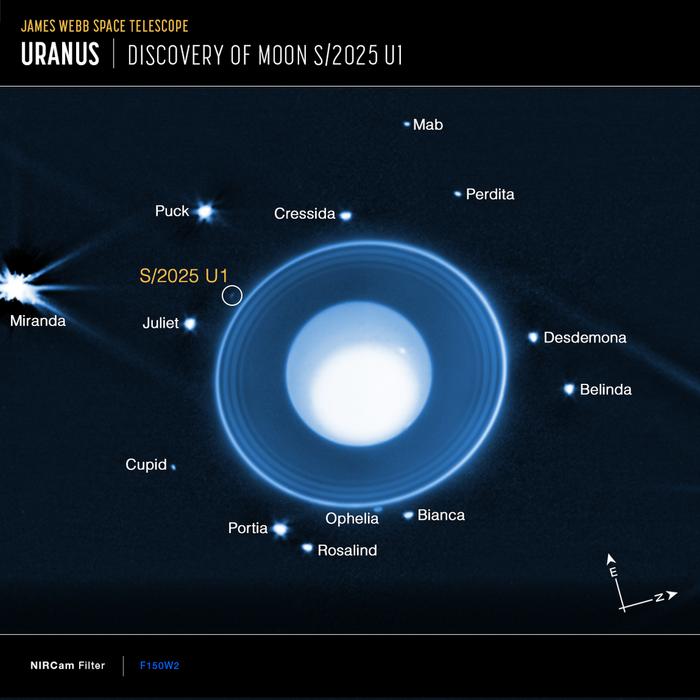
S/2025 U 1. Credit: NASA, ESA, CSA, STScI, M. El Moutamid (SwRI), M. Hedman (University of Idaho)
Most of the moons are small, though five major ones were detected between 1787 and 1948; Titania, Oberon, Umbriel, Ariel and Miranda. Given the previous penchant for Shakespeare, this will also get some name from his literature. Or at least Alexander Pope.
S/2025 U 1 is at the edge of Uranus’ inner rings, about 35,000 miles from its center in the planet's equatorial plane, between the orbits of Ophelia and Bianca. Ophelia is about 13 miles in diameter, while Bianca is an elongated object around 40 by 29 miles in size.



Comments