Air India Flight 171 - Flawed EE Bay Water Ingress Theory
Richard Godfrey, in many videos on the YouTube channel Airline News with Geoffrey Thomas puts forward the hypothesis that the Air India Flight 171 tragedy was caused by water ingress into an Electronic Equipment bay.
This hypothes is well explained and somewhat intuitive, but it is seriously flawed and thus has a very low probability of being correct.
As shown by facts in this article it is unlikely that the Air India 171 crash was caused by water leaking into an EE bay - Electronic Equipment bay.
‘EE bay water ingress may’ve caused AI 171 crash’:
Aviation expert quotes FAA directive; rules out pilot errorAir India plane crash: Aviation expert Richard Godfrey investigated six possible root causes behind the AI 171 crash and listed out the one he thinks is highly likely, followed by the moderate and low ones. He also ruled out two probable causes.
FADEC Glitch: A dual software failure across both FADECs is statistically negligible.
If the hypothesis is proven, then the event was preventable and points instead to a root cause as a failure in maintenance oversight and non-compliance with FAA AD 2025-09-12, which specifically addresses water ingress in the EE bay and the need for improved cabin water sealing.
A Plausible Hypothesis
FAA 2025 Airworthiness Directive Is Not Relevant To The AI 171 Accident
FAA AD 2025-09-12 clearly does not apply to VT-ANB in two ways:
1 The 2025 AD specifically applies to "only 47 U.S-registered airplanes.".
2 The 2025 FAA AD is effectively an addendum to AD 2016-14-04 due to omissions in Boeing instructions dating from 2018. VT-ANB was delivered to Air India in January 2014, long before the flawed 2018 documents were promulgated.
The airplanes identified in this AD are different than those in AD 2016-14-04, and no new actions are required for airplanes that complied with AD 2016-14-04. Therefore, the FAA has
revised this AD to not supersede AD 2016-14-04
...
the inadvertent omission of sealing instructions from Boeing floor panel drawings in 2018 when build requirements were consolidated into one document as part of a value engineering project. ...
this AD now applies to only 47 U.S-registered airplanes.
...
The FAA estimates that this AD affects 47 airplanes of U.S. registry.FAA AD 2025-09-12 ( Emphasis added.)
The 787 water ingress problem was addressed in three ways by Boeing under warranty:
1 prevent potable water leaks;
2 create a barrier to leaks;
3 upgrade equipment protection against water ingress within EE bays.
The suggestion that remedial works may not have been carried out on VT-ANB is purely hypothetical. Even if water did find its way into an EE bay, the racks being duplicated left and right for redundancy, the chances of both left and right electronics being affected by water or moisture in exactly the same way are trivial. Further: a fault serious enough to cause smoke to issue from the aircraft would hardly be likely to self-rectify so as to allow the relighting of the engines. (It was dust, not smoke.)
Water Ingress Incident In 2008
Boeing has a great amount of expertise in the matter of water ingress into electrical and electronic components. Much of that expertise stems from a very serious water ingress incident which, fortunately, occurred on final approach. Boeing no doubt initiated a 'once bitten twice shy' policy.
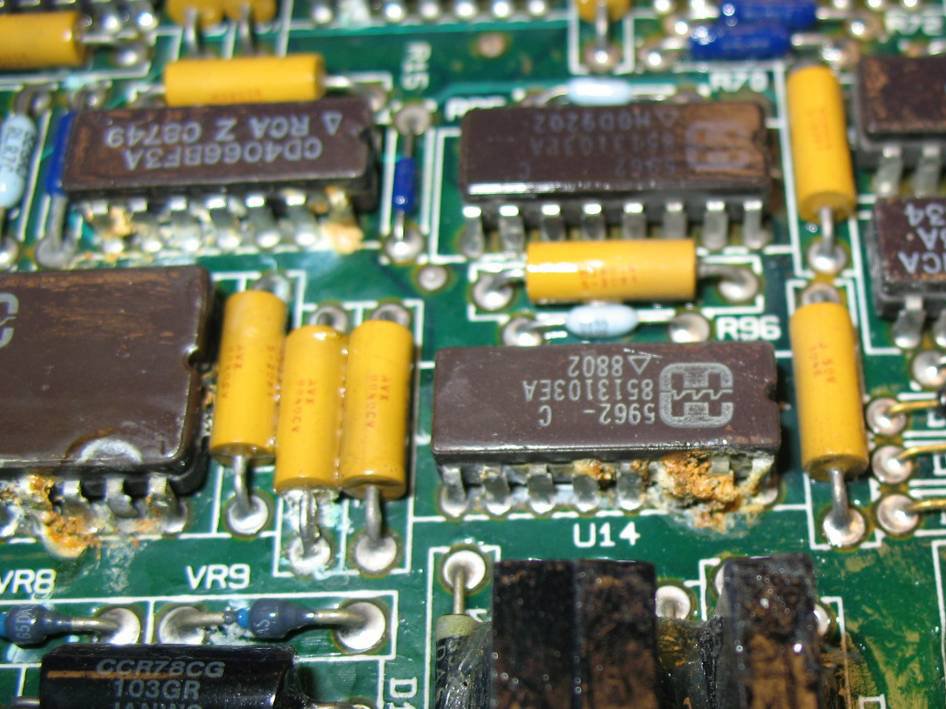
A Water Damaged Boeing 747-438 Circuit Board
On 7 January 2008, a Boeing 747-438 aircraft, registered VH-OJM, was approaching Bangkok Airport, Thailand when the customer service manager notified the flight crew that a substantial water leak had occurred in the forward galley. The water damage triggered a plethora of faults. The plane used battery power in the descent to land, with only about a 15 minute battery capacity safety margin remaining.
Electrical power to the aircraft’s alternating and direct current buses 1, 2, and 3
and associated electrical equipment was lost during the flight after generator
control units 1, 2, and 3 malfunctioned as a result of past and present waste
water ingress.Waste water leaked through a decompression panel in the cabin floor, then
through dripshields and into electrical equipment after the forward drain line
was blocked with ice that formed due to an inoperable drain line heater.ATSB TRANSPORT SAFETY REPORT
Aviation Occurrence Investigation
AO-2008-003 Final
The ATSB recommended important design changes which appear to have been incorporated in the 787 series.
Liquid spills and leaks may occur even with the most stringent operational and maintenance procedures. Although there are benefits in addressing spills and leaks directly, consideration should also be given to reducing the vulnerability of high risk components. Specific consideration should be given to various mitigation strategies, including the protection of areas containing vulnerable equipment, the distribution of redundant systems across different locations, the containment of potential liquid sources, and to the protection, resilience and fault tolerance of equipment.ATSB report page 65
Links to Richard Godfrey's hypothesis
Airline News with Geoffrey Thomas
Air India Crash - Cause of AI 171 Crash Ep 246
AirIndia171-Accident-12thJune2025 RootCause
Analysis - Air India AIC171 Detailed Timeline
.