Arctic Newsflash! Petermann Ice Tongue Loses Huge ChunkI have been watching the Petermann Glacier ice tongue for some time now.
Here is what I wrote in
Arctic Ice July 2010 - Update #3:
Judging from historic maps and images, the normal behavior of the Petermann ice tongue was the formation of a concave front at the fjord mouth. Over recent years it has retreated. Much of the tongue is now detached from the walls of the fjord. Tidal forces will flex the tongue up and down: wind, currents and ice floe impacts will all exert at least a small lateral force on the tongue. It will continue to thin from melting.
Arctic Ice August 2010 - Update #1
Most of the fires in Siberia seem to have been put out or burned out. Meanwhile, the fires near Moscow continue to burn and there are more fires in Alaska. I have made a mosaic composite showing the fires at the time of writing. I have enhanced some of the red fire markers where they were faint in the MODIS originals. Please note that the size of a red blob does
not equate to the size of the fire.
 The Arctic - August 04-05 2010
 - approx. 2km resolution.
Boston had 8 days of above-90 degree Fahrenheit heat temperatures last month, while New York City had 14, Philadelphia had 17 and Washington, DC had 20.
While those numbers are above historical averages (5, 7, 11, and 13 days, respectively) they are beneath consensus projections for the average July by just the middle of this century, assuming nothing is done to reduce pollution of heat-trapping gases. Under that scenario, Boston can expect an average of 12 July days above 90, New York can expect 16, Philadelphia 21, and Washington, DC 22.
A blob-like creature that lived in the ocean approximately 425 million years ago was revealed in research published today.
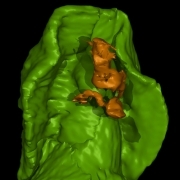
The scientists developed a detailed 3D model of the only known fossilized specimen in the world of a creature called Drakozoon. The specimen was found by one of the team approximately 6 years ago in the Herefordshire Lagerstätte, one of England's richest deposits of soft-bodied fossils. Drakozoon lived in the ocean during the Silurian Period, 444 to 416 million years ago, and today's model hints at how it lived.
What picture should we draw of the quest for new phenomena after the presentation of a wealth of new results at the international conference on high-energy physics in Paris held last week ? I am speaking in particular of results coming from the experiments at the Tevatron and LHC, which are all studying hadron collisions in search for still unseen effects to both confirm (with the discovery of the Higgs boson) or break down (with the observation of Supersymmetry, new particles, extra dimensions, or still other effects) the present theoretical understanding of fundamental physics which the standard model provides us with.
Anemia is a common blood disorder characterized by low hemoglobin levels and has long been associated with those suffering from colorectal cancer, but researchers at Tel Aviv University say that low hemoglobin levels can actually indicate a potential for colon cancer years before it's diagnosed.
Graduate student Inbal Goldshtein, who works with Dr. Gabriel Chodick and Dr. Varda Shalev of Tel Aviv University's School of Public Health, says that paying close attention to routine blood test results can be an effective screening system for colon cancer which, when diagnosed early enough, can be treated effectively. More than 50,000 people in the U.S. will die from colon cancer in 2010. Better screening could significantly reduce those numbers, Goldshtein says.
I am often asked questions about my musical picosatellite, Project Calliope. Easy questions have concrete answers. "What are your sensors?": I-CubeX magnetic, thermal, light. "What magnetic field is expected?": ."How are you going to distribute the tracks?": as free remixable MIDI files via web.
Others are either vague or awkward. "When will the satellite be done?": obviously 'by launch'. "What will it sound like?": whatever the musician wants. "What's your downlink bandwidth?" I'm still working on the radio parts.
Drug trials conducted by the very pharmaceutical company with an obvious vested interest in a positive result are far more likely to yield a... positive result!
Perhaps not earth-shattering news to anybody with a gram of cynicism in their body but is still an orchestrated effort to undermine the credibility of science as anything higher than the distortion of data in the name of money.
“John is a man. All men are mortal. Therefore, John is mortal.” This argument from two premises to the conclusion is a deductive argument. The conclusion logically follows from the premises; equivalently, it is logically impossible for the conclusion not to be true if the premises are true. Mathematics is the primary domain of deductive argument, but our everyday lives and scientific lives are filled mostly with another kind of argument.
Not all arguments are deductive, and ‘inductive’ is the adjective labeling any non-deductive argument. Induction is the kind of argument in which we typically engage.