Type Ia supernovae, the extraordinarily bright "standard candles" astronomers use to measure cosmic growth which led to the theory of dark energy in 1998 and 13 years later to a Nobel Prize "for the discovery of the accelerating expansion of the universe" have remained mysterious – how they detonate and what the star systems that produce them actually look like before they explode - has been unknown.
Green solutions have made lofty claims in the last few decades but they have been optimistic hope more than reality. Simulations from the University at Buffalo may change that; they say it's possible for drivers to cut their tailpipe emissions without significantly slowing travel time.
In computer models of traffic in Upstate New York's Buffalo Niagara region, they found that green routing could reduce overall emissions of carbon monoxide by 27 percent for area drivers, though they did it by increasing the length of trips an average of 11 percent.
Particle physics experiments usually invest a considerable part of the time used to produce a measurement in the task of determining the corresponding uncertainty on the estimate, or -when a new effect is observed (say a quantity is measured away from zero, when zero would be the "null hypothesis", predicted by the current model)- estimating the statistical significance of the observation.
It's two weeks until Christmas and if you are a Science 2.0 reader, that means it is at least time to think about shopping for a Christmas gift. Demographically, not a lot of you were lining up to gratefully overpay for Apple's latest offering or whatever else obedient Oprah viewers are expected to buy on Black Friday.
Here are three nifty ideas that are science related for your consideration, in three age ranges. If you just like gadgets you can check out the Top Gadgets of 2011 instead.
For The Young
Another confirmation of correct evaluation of controversial HEP measurements awaited me just after the Higgs evidence was presented at CERN. I am sort of embarassed by this compulsory self-promotion, but this is my blog so I will excuse myself ;-)
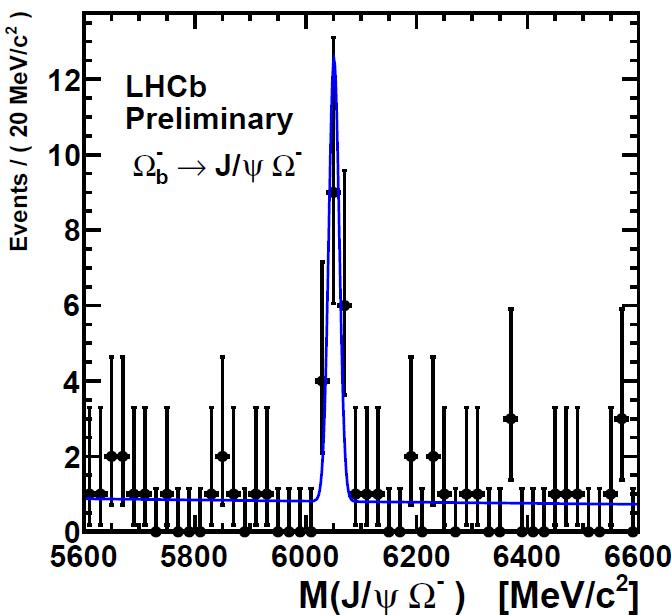
So the story is the following... Some of you might still remember the controversy over the Omega b discovery, at the Tevatron a couple of years ago.
So much sound and fury over the Higgs Boson, signifying what? A complete understanding of the fundamental constituents of the world in which we live? Of the universe of which we are an integral part? No … and yes.
High-energy physicists at CERN, the European Center for Nuclear Research, announced this week they are closer than ever to detecting the apparently hallowed boson — or possibly it is called God Particle merely for mass consumption. Its quantification would at once provide breathtaking insights into the infinitesimal domain affecting Earthly life and to the composition of the entire universe, a broad range, indeed.
Rewards of Basic Science
Cancer cells are, well, cancer cells; cells that grow uncontrollably in the host, and ignore all patterns and signals that govern the structural integrity of tissue and organs.
Much research in the last several decades have defined molecular features attributed to cancer cells, and more importantly what specifically can kill them. Decades of work goes by with the discovery of drugs that change the lives of many individuals and families touched by this disease. Yet despite the euphoria of success, scientists come face to face with a troubling problem of cancer cell resistance to treatment.
The same goes for rabbits thriving in Australia.
Rabbits??
The human brain is very good — quite excellent, really — at finding patterns. We delight in puzzles that involve pattern recognition... consider word-search puzzles, the “Where’s Waldo” stuff, and the game Set.
Slow Food's Michele Rumiz has posted a
ruminative piece about squid fishing on Unije, a Croatian island in the Adriatic Sea:
Every November, the island calls its aficionados to fish squid (called lignjada in Croatian). . . . No sounding leads, nets or electronic devices: they fish using togna - line, and totanara as bait. This is why the more than 20 fishermen involved could manage to fish only a little more than 50 kg of squid in 4 hours. It might seem like a lot, but it's nothing compared to an industrial fishery, which would get the same result in a few minutes with a much smaller crew.
Squids are mercurial, unpredictable
creatures of extremes.
Call them abundant, call them quite rareIt depends on the climate--the sea and the airOne species expands, another contractsThese are the data, these are the factsSometimes it feels like they're growing too fastBut it helps them respond and it's why they can lastThrough environmental change . . .