The Greenland and West Antarctic ice caps are melting at half the speed previously predicted, shows a team from the Jet Propulsion Laboratory, Delft University of Technology (TU Delft, The Netherlands) and SRON Netherlands Institute for Space Research in Nature Geoscience.
The melting of the ice caps has been charted since 2002 using the measurements produced by the two GRACE satellites. From space they detect small changes in the Earth's gravitational field and these changes are related to the exact distribution of mass on Earth, including ice and water. When ice melts and lands in the sea, this therefore has an effect on the gravitational field.
A research team says they have discovered one of the key drivers of human evolution and diversity, accounting for changes that occur between different generations of people.
Professor Alec Jeffreys, who discovered DNA fingerprinting at the University of Leicester in 1984, and has spent the decades since investigating what he describes as "pretty bizarre bits of DNA" - highly variable repeated parts of DNA called 'minisatellites' - found in the human genome. Jeffreys observed that these seemed to be changing and "picking up mutations at an extraordinary rate" when compared to other DNA.
Nuclear waste is one of the biggest downsides to nuclear power, and can remain dangerous for hundreds of thousands of years. Geological disposal is often stated as the most preferable way of dealing with it, but what does it entail? What are the problems that need to be overcome, and how are governments going about overcoming them? Fortunately, most governments are trying to be transparent about the process, with thousands of reports available on the web.
For some coursework earlier this year, I looked at the subject from a geological point of view.
It would seem that mimicking nature would be among the easiest things to do for science. After all, it's right there, in front of us, happening for millions of years.
Take plants, for instance. Every day they absorb sunlight and turn it into energy but our solar technology is bordering on laughable and, if solar lobbyists get there way and it gets more subsidies and even mandates, criminal.
The issue science has is that the sun's rays are highly destructive to man-made materials and that leads to a gradual degradation of many systems developed to harness it.
Most fashion students keep finished designs in a wardrobe but Emily Crane has to use a freezer. Unlike the stereotypical fashion designer, Crane is more likely to be found in a lab coat and wearing goggles than working with pencils or scissors.
Crane’s work forms an exotic part of Kingston University’s display at Vauxhall Fashion Scout on September 17, during London Fashion Week, and she is currently preparing her collection but can’t promise what she’ll be showing - because it doesn't always work, being that her clothes are made of things like gelatin and seaweed.
The sharing, preservation and reuse of data has become an increasingly important element of modern scientific research, but even though granting agencies like the National Science Foundation (NSF) and National Institutes of Health (NIH) naturally embrace data sharing, resistance from parts of the scientific community has continued to block scientific progress and valuable research data over the world is kept under lock and key or hidden away in lab drawers, forcing time and cost of unnecessary duplication.
BMC Research Notes is commissioning a large, ongoing collection of educational articles which outline procedures for sharing data that enable the data to be readily re-used by others and providing researchers with best practice guidance.
Back to breathing the air of Fermilab after a full year away, I got to gauge a bit better the aftermath of the little incident created by
a posting of mine in July. As often happens with internet bubbles, they look quite dramatic as they inflate, but they leave no big scars. Two months have passed, and this looks like a good time to post here some ruminations about the general issue.
Physics Experiments And Confidentiality
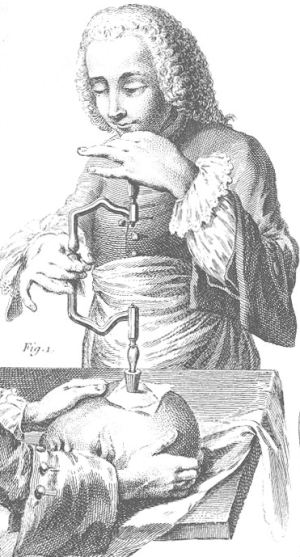
Today, trepanation, or drilling a hole in the head, is commonly used to release the pressure of swelling inside the skull.
Throughout history, it's been used to treat epilepsy, migraines, mood disorders and pretty much any other head condition that seemed to surgeons of the time as if it could be improved by seeing the light of day. But even more interesting than holding someone down and punching a hole through his/her skull is doing it yourself.