Arctic Ice August 2010 - Update #2Since I last posted an update, many things have happened in the Arctic and sub-Arctic.
In my last update -
Arctic Ice August 2010 - Update #1 - I noted that there were no floes in the main pack bigger than 35km2. I invited my readers to find a floe bigger than that anywhere in the main ice pack. Nobody did. Yes, there were a few bigger floes - even big enough to be called ice islands - but they were not in the main pack.
A multiplet is a simple thing to describe: it is a collection of several identical or nearly identical things. Here, however, a difficulty arises because a "multiplet" is a manifestation of symmetry groups, and symmetry groups are tough objects to discuss. So if in a scientific paper you write "the new hadron might belong to a SU(3) multiplet", you have the additional trouble that you need to avoid discussing group theory to an unwilling listener. What is SU(3) ? Do we actually care?
Thus wrote Tommaso Dorigo in
The Language Barrier on 26th May this year.
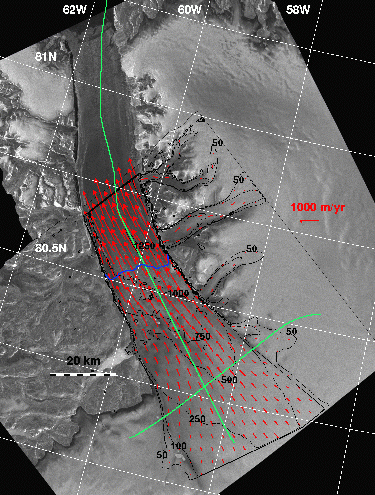
Petermann Glacier Calving 2010 - Update
Before I discuss the recent calving of the Petermann Glacier ice tongue, I want to give credit to the many scientists who were studying, predicting and observing this event. If I miss anyone out, please advise by email or comment and I will edit this article accordingly.
The scientists who deserve credit, in no particular order:
Humfrey Melling at DFO submitted a detailed science article to the Journal of Geophysical Research - Oceans just a few weeks before the event, and so missed the chance of including the calving in his article.
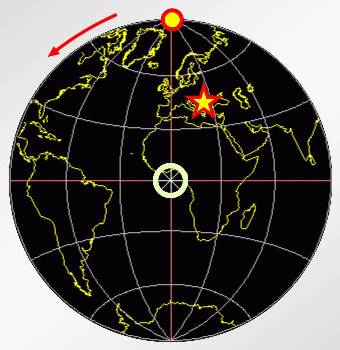
This is a good year for summer meteor watching. The moon, just past new, will not interfere with observations of faint meteors. And the Perseid shower, originated from the dust left behind in the orbit of comet Swift-Tuttle, will produce a nice show.
Perseids are a rather stable stream, and they produce a detectable rate of meteors from late July to late August, with peaks in the nights of August 11th and 12th, depending on the exact trajectory that the Earth takes while plunging in the dust-ridden area of the solar system. The rate is usually encoded in the acronym "ZHR", for zenith-hourly-rate. ZHR values of 100 to 150 are common for the two highest-rate nights.
But what exactly should you expect to see ?