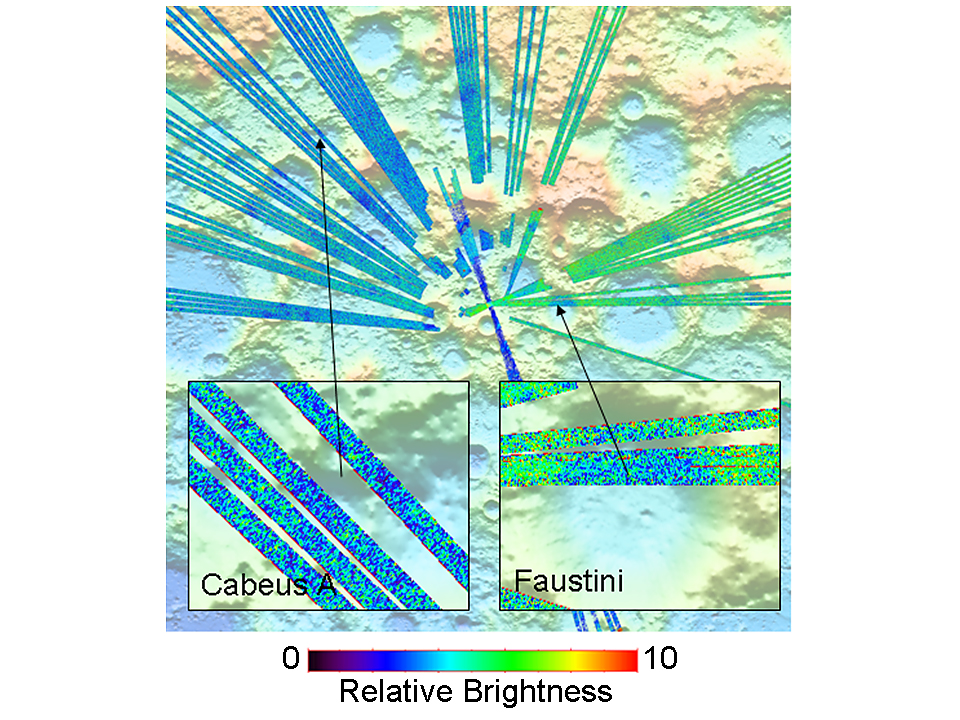
NASA's Lunar Reconnaissance Orbiter (LRO), launched on June 18th, 2009, will return more data about the Moon than any previous mission. The Lyman-Alpha Mapping Project (LAMP), developed by Southwest Research Institute, uses a novel method to peer into the perpetual darkness of the Moon's so-called permanently shadowed regions - the dark side of the moon.
A 9-foot dinosaur excavated illegally from northeastern China and purchased by a private collector who brought it to the attention of paleontologists (hey, they'll return it after they're done) is about the same weight as a grown human yet had still evolved all the hallmark anatomical features of Tyrannosaurus rex - except 30 million years earlier, according to a study in Science.
Raptorex displays the hallmarks of its famous descendant, Tyrannosaurus rex, like an oversized head, tiny arms and feet well-suited for running. The Raptorex brain cast also shows enlarged olfactory bulbs, like T. rex, indicating a highly developed sense of smell.
If you want to create a micro-aircraft that flies with the maneuverability and energy efficiency of an insect (and you know you do) decoding the aerodynamic secrets of insect flight is key because optimization through evolutionary pressures over millions of years far outstrips what we can achieve artificially.
But it's not that simple. Consider the 'bumblebee paradox' that plagued researchers for decades. It turned out not to be a paradox but rather an issue with what we could model aerodynamically. Look at mister bee below:
Scientists have observed ferromagnetism in an atomic gas for the first time, addressing the decades-old question of whether gases could show properties similar to a magnet made of iron or nickel.
A team observed the ferromagnetic behavior in a gas of lithium atoms cooled to 150 billionth of 1 Kelvin above absolute zero (-273 degrees C or -459 degrees F). Team members used the lithium-6 isotope, which consists of three protons, three neutrons and three electrons. Since the number of constituents is odd, lithium-6 is a fermion — a class of exotic particles that have a half-integral spin — and has properties similar to an electron. Therefore, lithium atoms can be used to simulate the behavior of electrons.
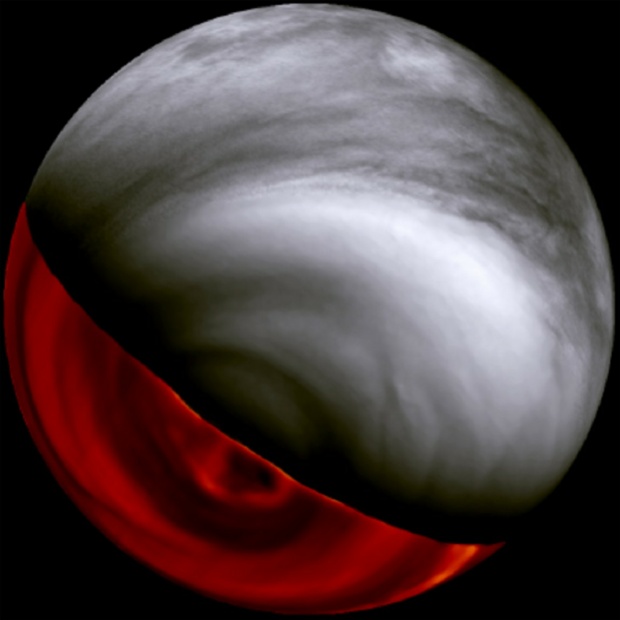
There is new evidence that the solar wind has stripped away significant quantities of water from Venus.
The SPICAV and VIRTIS instruments carried by the Venus Express spacecraft have been used to measure concentrations of water vapor in the Venusian atmosphere at altitudes ranging from the lowest 10 km up to 110 km, high above the cloud tops.
Studies led by scientists from Belgium and Russia have found that the ratio of heavy water, which contains the isotope deuterium instead of hydrogen, to normal water is nearly twice as high above the clouds compared to its value in the lower atmosphere.
In creating a science site for kids (that would be Kids Science Zone - if you haven't written anything there, feel free to do so) , the majority of comments I have gotten have been likely about the same as I would have gotten if I had opened up this site to a large community of people with advice to give - namely a lot of suggestions from people who don't use it about how awesome it would be if it had X, Y or Z added.
Readers of this blog may begin to think that I have a personal antipathy for New York Times editorialist Stanley Fish. I don’t, really. Don’t even know the guy. And yet, somehow he manages to get criticized in writing by yours truly more often (and certainly more harshly) than Richard I-don’t-know-what’s-wrong-with-Bill-Maher-but-I’ll-endorse-his-award Dawkins.
Where does evolution leave God? This question has been debated for over a century, and it likely isn't going anywhere any time soon. Some may feel, myself included, that the glut of fighting among the camps should just be put to rest, like the new song on the radio that is played every five minutes. One is about science, one is about religion. Over and done.
Occasionally I'll come across an article that still sparks my interest (like the many on Scientific Blogging, of course). One such article was an essay featured in the Wall Street Journal, in the vein of point/counter-point, but neither writer knew what the other was going to say.1
I recently attended the International Developmental Biological Congress in sunny Edinburgh, Scotland. Here is my diary.
Day One
Saturday, 8:15 AM: Arrive Edinburgh hotel, early. Wait for room in hotel bar. Soccer, a hateful game, blares at 8:30 in the morning. Bourbon appropriate?
Saturday, 5:15 PM: Take walking tour of city. Discover no one in Scotland speaks English.
Day Two
Sunday, 1:00 PM: Pick up press credentials. Easy because no other sane journalists here.
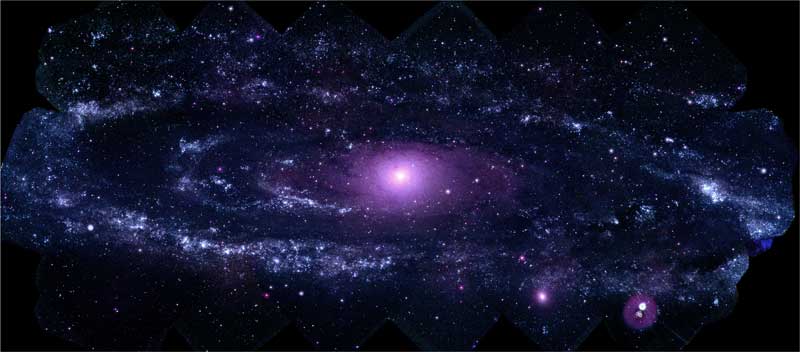
NASA's Swift satellite has acquired a new high-resolution view of a neighboring spiral galaxy; M31 in the constellation Andromeda, the largest and closest spiral galaxy to our own.
M31, also known as the Andromeda Galaxy, is more than 220,000 light-years across and lies 2.5 million light-years away. On a clear, dark night, the galaxy is faintly visible as a misty patch to the naked eye.
Between May 25 and July 26, 2008, Swift's Ultraviolet/Optical Telescope (UVOT) acquired 330 images of M31 at wavelengths of 192.8, 224.6, and 260 nanometers. The images represent a total exposure time of 24 hours.