

In the latest issue of Materials Today, Dr. Gilles Dennler of Konarka Austria GmbH and twenty other experts warn that a race to report organic solar cells (OSCs) with world record efficiencies is leading to a significant number of published papers claiming unrealistic and scientifically questionable results and performances.

“World record efficiencies are popping up almost every month, leading the OSC community into an endless and dangerous tendency to outbid the last report,” stated Dennler et al. in the article. “The current outbidding phenomenon does a severe disservice to the whole community, damaging its reputation.

It is generally perceived that feminism and romance are in direct conflict yet according to a study by Laurie Rudman and Julie Phelan of Rutgers University, feminism and romance are not incompatible and feminism may actually improve the quality of heterosexual relationships.

They carried out both a laboratory survey of 242 American undergraduates and an online survey including 289 older adults, more likely to have had longer relationships and greater life experience.

Legislation targeting companies has the best of intentions - preventing another Enron by Sarbanes-Oxley is an example - yet the punishment clauses have made it difficult to attract anyone except risk takers and has pushed CEO salary costs through the roof.

The opposite of the salary-heavy CEO is the one who takes options instead. On the exterior, it may seem to make sense because companies are paying solely for performance. More often than not, companies are paying no matter what.

A new study by Donald Hambrick of Penn State and W. Gerard Sanders of Brigham Young finds that CEOs with stock option-heavy compensation packages tend to lead their companies to more extreme performance yet they are more big losses than big gains.

'Social science' is not like the social sciences - economics, psychology, etc. - rather it's a mix of science and 'social news.' We're in the social news business but a niche part of it. We stick to science yet we're social news because a great part of the content is decided by you: you write it, you read it and your interest in specific articles is what decides the content on the main page. The more people that like an article and comment on it, the higher up it appears on our site.

Web 2.0, Science 2.0, whatever we call it, it's catching on. From the beginning of our private beta in February until now we have gone from no readers to hundreds of thousands per month.

Although nearly 500 people have died in the UK over the last 12 years as a result of accidental CO poisoning, small quantities of CO are produced naturally within the human body and are essential to life.

Chemists at the University of Sheffield have discovered an innovative way of using targeted small doses of CO which could benefit patients who have undergone heart surgery or organ transplants and people suffering from high blood pressure.

Although the gas is lethal in large doses, small amounts can reduce inflammation, widen blood vessels, increase blood flow, prevent unwanted blood clotting – and even suppress the activity of cells and macrophages ( macrophage cells are part of the human body’s natural defence system ) which attack transplanted organs.

Humans are hard-wired to form enduring bonds with others. One of the primary bonds across the mammalian species is the mother-infant bond. Evolutionarily speaking, it is in a mother’s best interest to foster the well-being of her child; however, some mothers just seem a bit more maternal than others do. Now, new research points to a hormone that predicts the level of bonding between mother and child.

In animals, oxytocin, dubbed “the hormone of love and bonding,” is critically important for the development of parenting, is elicited during sexual intercourse, and is involved in maintaining close relationships. Animals with no oxytocin exhibit slower pup retrieval and less licking and self-grooming.

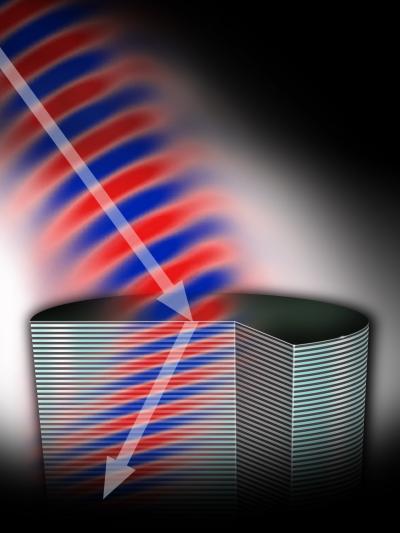
A Princeton-led research team has created an easy-to-produce material from the stuff of computer chips that has the rare ability to bend light in the opposite direction from all naturally occurring materials. This startling property may contribute to significant advances in many areas, including high-speed communications, medical diagnostics and detection of terrorist threats.

A Princeton-led research team has created an easy-to-produce material from the stuff of computer chips that has the rare ability to bend light in the opposite direction from all naturally occurring materials.

Patients have on average a 71 percent lower chance of dying at the nation’s top-rated hospitals compared with the lowest-rated hospitals across 18 procedures and conditions analyzed in the tenth annual HealthGrades Hospital Quality in America Study, issued today by HealthGrades, the healthcare ratings company.

Attention-deficit/hyperactivity disorder (ADHD), a state of serious impairments in both learning ability and social functioning, is one of many labels for one of the most prevalent conditions in child psychiatry, and, undoubtedly, the most controversial, which partly persists into adulthood. ADHD is conservatively estimated to occur in 3,0–7,5% of school-age children (Goldman et al., 1998), but more permissive criteria yield estimates of up to 17% (Barbaresi et al., 2002). Up to 20% of boys in some school systems receive psychostimulants for the treatment of ADHD (LeFever et al., 1999).

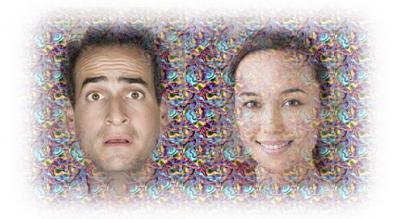
You may not be fully dressed without a smile, but a look of horror will make a faster first impression. Vanderbilt University researchers have discovered that the brain becomes aware of fearful faces more quickly than those showing other emotions.

"There are reasons to believe that the brain has evolved mechanisms to detect things in the environment that signal threat. One of those signals is a look of fear," David Zald, associate professor of psychology and a co-author of the new study, said.


