






Although anorexia nervosa is categorized as an eating disorder, it is not known whether there are alterations of the portions of the brain that regulate appetite.

Now, a new study finds that women with anorexia have distinct differences in the insulta – the specific part of the brain that is important for recognizing taste – according to a new study by University of Pittsburgh and University of California, San Diego researchers.

The study also implies that there may be differences in the processing of information related to self-awareness in recovering anorexics compared to those without the illness – findings that may lead to a better understanding of the cause of this serious and sometimes fatal mental disorder.

Understanding whether inbreeding accounts for early mortality is a long-standing concern in demographic research. Analyzing Bedouin villages in Bekaa, Lebanon, in which the marriage rate among first cousins is more than twice the national average, a new study finds that the greatest single determinant of infant mortality is not closely related parents – though this does present a significant risk – but short birth intervals.

The Bekka Bedouin are Sunni Muslims.

For more than a decade, University of Georgia researcher Steve Stice has focused on using embryonic stem cells to improve the lives of people with degenerative diseases and debilitating injuries. His most recent discovery, which produces billions of neural cells from a few stem cells, could now aid in national security.

“It's like a canary-in-a-coal-mine scenario,” said Stice, animal science professor and Georgia Research Alliance eminent scholar.

In collaboration with the U.S. Naval Research Laboratory, Stice hopes to use his recently developed neural cell kits to detect chemical threats.
“They have a device that looks like a small tool box that contains neural cells and can detect changes in their electrical activity,” Stice said.

Stars in galaxies are similar to people: during the first phase of their existence they grow rapidly but they slow later, and we can see it, says Dutch astronomer Mariska Kriek with the Gemini Telescope on Hawaii and the Very Large Telescope (VLT) in Chile.

Her research shows that a part of the heavy galaxies stopped forming stars when the universe was still a toddler, about 3 billion years old. Astronomers suspect that black holes exert an influence on this halt in births.

So how does that happen and why are fewer stars being born?


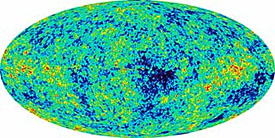
This "baby picture" of the universe shows small changes in temperature from more than 13 billion years ago. That's not long after the big bang would have taken place.

A new infrared imaging system that automatically counts the number of people in cars could offer a cost effective solution to help lower congestion and carbon emissions - or it could be a handy government monitoring system.

Carpool lanes are not popular. In Britain 20% of the road capacity is used by multi-occupancy vehicles. In a state like California that percentage is even less, around 7%, yet every highway has 'carpool' lanes.

We had about a dozen participants at the Open Notebook Science Case Studies SciFoo Lives On session yesterday. I talked about using a free and hosted blog (Blogger), wiki (Wikispaces), referral tracker (Sitemeter), mailing list (Google Groups), molecule database (

Today we can print documents from anywhere using protocols and techniques unknown 20 years ago. I can send them from my phone to my printer in seconds.

But 'printing' solid objects, like a piece of sports equipment or a kitchen utensil, or even a prototype car design for wind tunnel tests could also be in the works soon. It just needs that always vague, always essential "killer app."

Such technology already exists and is maturing rapidly so that high-tech designers and others can share solid designs almost as quickly as sending a fax. The systems available are based on bath of liquid plastic which is solidified by laser light. The movements of the laser are controlled by a computer that reads a digitized 3D map of the solid object or design.

A new NASA-supported study reports that 2007 melting in high-altitude areas was greater than ever - 150 percent more than average.

Marco Tedesco, a research scientist at the Joint Center for Earth Systems Technology, used satellite data to compare average snow melting from 1988-2006 with what has taken place this summer. He found that in high altitude areas over 1.2 miles above sea level, the melting index -- an indicator of where melting is occurring and for how long - was significantly higher than average. Melting over those areas occurred 25-30 days longer this year than the observed average in the previous 19 years.

What killed the wooly mammoths? Overhunting, climate change and disease lead the list of probable causes but a once-ridiculed theory is now being supported by an international team of scientists; namely that a comet or meteorite exploded over the planet roughly 12,900 years ago, causing the abrupt climate changes that led to the extinction of the wooly mammoth and other giant prehistoric beasts.

At the end of the Pleistocene era, wooly mammoths roamed North America along with a cast of fantastic creatures – giant sloths, saber-toothed cats, camels, lions, tapirs and the incredible teratorn, a condor with a 16-foot wingspan.

About 12,900 years ago, these megafauna disappeared from the fossil record, as did evidence of human remains.

Researchers from Duke University and the University of Cambridge think they can "shock the foundation of general relativity," according to Arlie Petters, a Duke professor of mathematics, by determining whether some black holes are not actually black.

Finding such an unmasked form of what physicists term a singularity "would show that nature has surprises even weirder than black holes," Petters added.

Albert Einstein originally theorized that stars bigger than the sun can collapse and compress into singularities, entities so confining and massively dense that the laws of physics break down inside them.


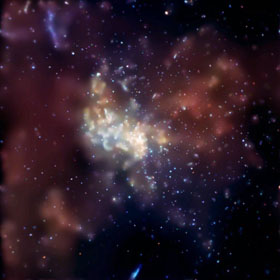
A supermassive black hole is thought to lurk in Sagittarius A East at our own galaxy's center.

