



For as many people as seem to like the metric system, few realize that both the motive for its creation ( competing with England, much like the calendar the French created, though that did not last ) and its inherent accuracy were flawed. The French took a provisional measurement ( conveniently in Paris ) between the North Pole and the Equator for the meter, for example, and got it wrong.

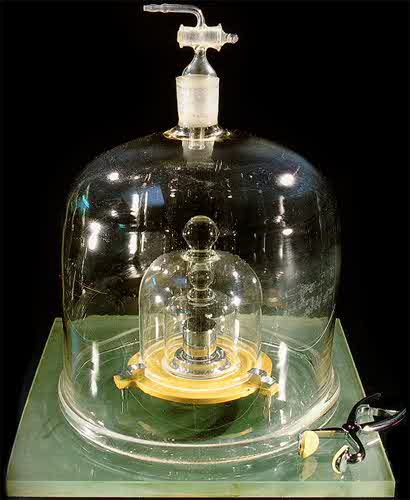
Likewise, the 'official' kilogram has been losing weight for a while and some people think it's time to fix the metric measure of mass so that it will still be accurate 10 or 10,000 years from now, using the number of carbon-12 atoms rather than an object.

“Our standard would eliminate the need for a physical artifact to define what a kilogram is,” said Ronald F.

Basic principles of biology rather than women’s newfound economic independence can explain why fewer of them are getting married and having children, and why the trend may only be temporary, says a Queen’s researcher.

“Only in recent times have women acquired significant control over their own fertility, and many are preferring not to be saddled with the burden of raising children,” says Lonnie Aarssen, a Biology professor who specializes in reproductive ecology. The question is whether this is just a result of economic factors and socio-cultural conditioning, as most analysts claim, or whether the choices that women are making about parenthood are influenced by genetic inheritance from maternal ancestors that were dominated by paternal ancestors.”

In Sunday’s NY Times Magazine, Gary Taubes argued that epidemiology does not provide a good basis for health decisions — it is often wrong, he claimed. By “wrong” he meant experiments were more pessimistic. Things that seemed to help based on surveys turned out not to help, or help much less, when experiments were done. A 2001 BMJ editorial disagrees:

Astronomers have found evidence that stars have been forming in a long tail of gas that extends well outside its parent galaxy. This discovery suggests that such "orphan" stars may be much more prevalent than previously thought.

The comet-like tail was observed in X-ray light with NASA's Chandra X-ray Observatory and in optical light with the Southern Astrophysical Research (SOAR) telescope in Chile. The feature extends for more than 200,000 light years and was created as gas was stripped from a galaxy called ESO 137-001 that is plunging toward the center of Abell 3627, a giant cluster of galaxies.

"This is one of the longest tails like this we have ever seen," said Ming Sun of Michigan State University, who led the study.

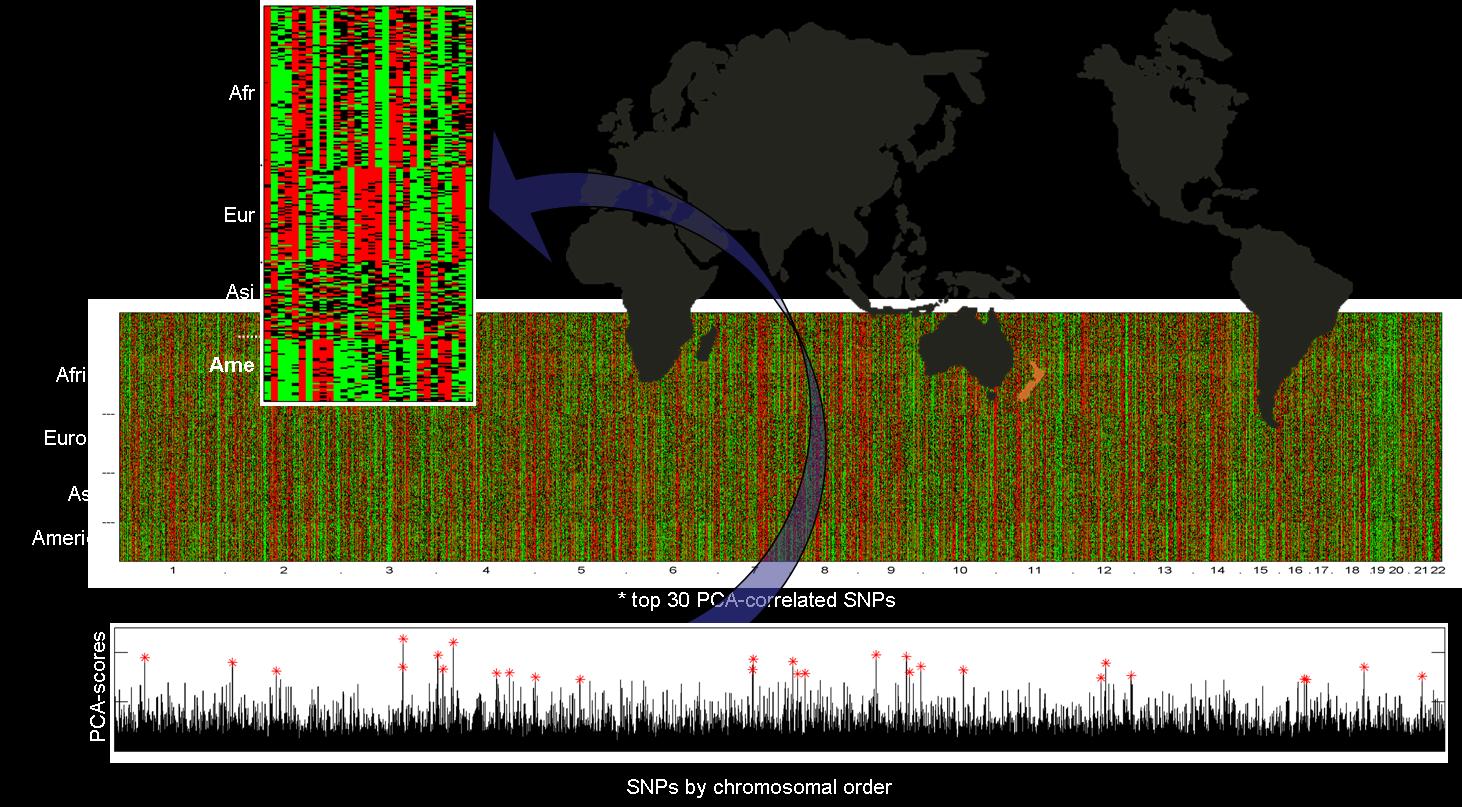
A group of computer scientists, mathematicians, and biologists from around the world have developed a computer algorithm that can help trace the genetic ancestry of thousands of individuals in minutes, without any prior knowledge of their background.

Unlike previous computer programs of its kind that require prior knowledge of an individual’s ancestry and background, this new algorithm looks for specific DNA markers known as single nucleotide polymorphisms, or SNPs (pronounced snips), and needs nothing more than a DNA sample in the form of a simple cheek swab. The researchers used genetic data from previous studies to perform and confirm their research, including the new HapMap database, which is working to uncover and map variations in the human genome.

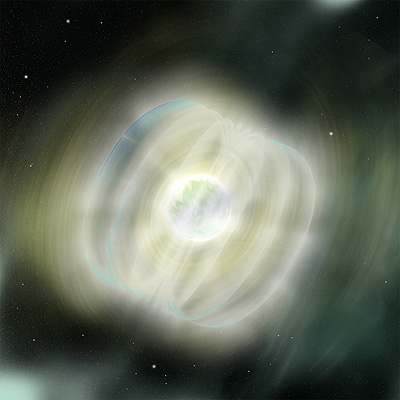
Magnetars are small neutron stars that occasionally suffer extraordinarily powerful outbursts which shine X-rays across the galaxy.

In 2003, astronomers saw a neutron star brighten to around 100 times its usual faint luminosity. This outburst allowed them to discover XTE J1810-197. Detecting pulsations from the source helped classify it as the first transient anomalous X-ray pulsar (AXP). The massive outburst moved it to the rank of magnetar.

Magnetars are perplexing objects. Each one is the highly magnetic core of a star that was once at least eight times more massive than the Sun. When it exploded as a supernova, the core was compressed into a highly compact object, a neutron star, roughly fifteen kilometres in diameter, but containing about as much mass as the Sun.

Wind turbines are one of the most environmentally sound technologies for producing electricity. However, the removal and recycling phase of wind turbines has been identified as a blind spot in assessing their overall environmental impact.

Most studies have ignored this phase and focused entirely on their operation and in some cases the production and installation of wind turbines.

Danish researchers now suggest that in order to assess the overall environmental impact of wind power, however, the finite lifespan of wind turbines and the need to replace and recycle them must be taken into account.

The growth and conversion of biofuel crops could raise rather than lower greenhouse gas emissions, says a new study led by Nobel prize-winning chemist Paul Crutzen, best known for his work on the ozone layer.

He and his colleagues have calculated that growing some of the most commonly used biofuel crops releases around twice the amount of the potent greenhouse gas nitrous oxide (N2O, also known as ‘laughing gas’) than previously thought – wiping out any benefits from not using fossil fuels and, worse, probably contributing to global warming.

The University of Navarra has installed a thermal gradient greenhouse in order to study the impact of climate change on plants. This is a pioneering methodology for studying the simultaneous effect of increased CO2 and ambient temperature. The research project, which will be undertaken by researchers from the area of Plant Biology of the University, could become a reference for later scientific studies in this area.

These studies, financed by the Spanish Ministry of Education and Science, the University Foundation of Navarra and the Foundation Caja Navarra, have already obtained their first results. “We have discovered that plants respond to enrichment of atmospheric CO2 with increased growth.

Pedophilia, the sexual attraction of adults to children, is a significant public health concern and it does not respond well to treatment. Additionally, the brain mechanisms underlying pedophilia are not well understood.

A new study in Biological Psychiatry is the first of its kind to use functional brain imaging to describe neural circuits contributing to pedophilia.

Using functional magnetic resonance imaging, or fMRI, Martin Walter and colleagues report that pedophilic patients showed reduced activation of the hypothalamus, a brain region involved in regulating physiologic arousal and hormone release, as compared to healthy individuals when they were viewing sexually arousing pictures of adults.

