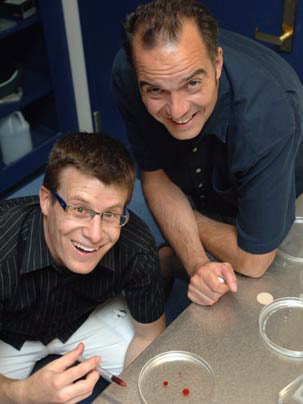



Simple experiments don't always have simple explanations. This 'throbbing' oil experiment, for example, can be done in your kitchen but getting to the heart of the throbbing has not been possible until now.

Try it yourself. Pour clean water onto a small plate. Wait for all the ripples to stop. Then mix a small amount of mineral oil with an even smaller amount of detergent. Squeeze a tiny drop of that mixture onto the water and watch in amazement as the oil appears to pump like a beating heart.

It's a simple experiment, but explaining what makes the drop of oil throb--and then stop when deprived of fresh air--has long mystified the scientific community.

A specific genetic variation may be tied to an increased risk for severe premenstrual depression, scientists at the University of North Carolina at Chapel Hill and the National Institute of Mental Health have found.

Known medically as premenstrual dysphoric disorder, or PMDD, this psychiatric condition affects roughly 8 percent of women in their childbearing years. It's characterized by bouts of major depression and/or anxiety and severe irritability during the second half of the menstrual cycle. Symptoms subside with the onset of each menstrual period.

A research study carried out by the Universitat Autònoma de Barcelona describes the brain region connected to our declarative memory functions.

According to this experiment, part of the prefrontal cortex plays a key role in the social transmission of food preference. This research has helped learn more about how this type of memory functions. In the future, this information could be useful to find new treatment for diseases that affect the memory, such as Alzheimer's disease.

Declarative memory is described as a flexible, conscience and associative type of memory (i.e., it is based on relations between different stimuli).

New fundamental particles aren’t found only at Fermilab and at other particle accelerators. They also can be found hiding in plain pieces of ceramic, scientists at the University of Illinois report.

The newly formulated particle is a boson and has a charge of 2e, but does not consist of two electrons, the scientists say. The particle arises from the strong, repulsive interactions between electrons, and provides another piece of the high-temperature superconductivity puzzle.

Twenty-one years ago, superconductivity at high temperatures was discovered in copper-oxide ceramics (cuprates).

Researchers at the University of Warwick are co-ordinating a global effort to sequence the genome of one of the World’s most important mushrooms - Agaricus bisporus. The secrets of its genetic make up could assist the creation of biofuels, support the effort to manage global carbon, and help remove heavy metals from contaminated soils.

The Agaricus mushroom family are highly efficient ‘secondary decomposers’ of plant material such as leaves and litter –breaking down the material that is too tough for other fungi and bacteria to handle. How exactly it does this, particularly how it degrades tough plant material known as lignin, is not fully understood.

By sequencing the full genome of the mushroom, researchers hope to uncover exactly which genes are key to this process.

You're thinking flying speed is just size and strength. Not so, say researchers from the University of Lund in Sweden. It's also a behavior issue and it's related to evolution.

Aerodynamic scaling rules that explain how flight varies according to weight and wing loading have been used to compare general speeds of a wide range of flyers, from the smallest insects to the largest aircraft but Thomas Alerstam, Mikael Rosen and colleagues analyzed the flight speeds of 138 bird species and overturn the general assumption that maximum flight speed of a species is solely determined by such rules.

Flight speed doesn’t just depend on mass and wing loading but also reflects the evolutionary lineage of the species in question.

The classic model of how brain cells communicate was put forth in 1943 by Warren McCulloch and Walter Pitts, at the time the first digital computers were being envisaged, and the McCulloch-Pitts model suggested that brain cells communicate in a binary fashion, represented by a “1” for firing and a “0” for not firing, much as a modern computer functions.

While it is common to say that a mammalian brain functions like a computer, this is a somewhat faulty idea, in part because the observation from the Traub lab suggests that gap junctions cause “short circuiting” as part of the brain’s normal functions. A real computer could not function if it short circuited.

Researchers isolated bisdemethoxycurcumin, the active ingredient of curcuminoids – a natural substance found in turmeric root – that may help boost the immune system in clearing amyloid beta, a peptide that forms the plaques found in Alzheimer’s disease.

Using blood samples from Alzheimer’s disease patients, researchers found that bisdemethoxycurcumin boosted immune cells called macrophages to clear amyloid beta. In addition, researchers identified the immune genes associated with this activity.

The study provides more insight into the role of the immune system in Alzheimer’s disease and points to a new treatment approach. Researchers say that it may be possible to test a patient’s immune response with a blood sample in order to individualize treatment.

Your ability to listen to a phone message in one ear while a friend is talking into your other ear—and comprehend what both are saying—is an important communication skill that’s heavily influenced by your genes, say researchers of the National Institute on Deafness and Other Communication Disorders (NIDCD), one of the National Institutes of Health.

The finding may help researchers better understand a broad and complex group of disorders—called auditory processing disorders (APDs)—in which individuals with otherwise normal hearing ability have trouble making sense of the sounds around them.

“Our auditory system doesn’t end with our ears,” says James F. Battey, Jr., M.D., Ph.D., director of the NIDCD. “It also includes the part of our brain that helps us interpret the sounds we hear.

Early man was on a constant quest for food. The demands of nourishment and conserving as much energy as possible may even have changed the course of evolution.

While no one has an authoritative answer, anthropologists have long theorized that early humans began walking on two legs as a way to reduce locomotor energy costs.

In the first study to fully examine this theory among humans and adult chimpanzees, researchers have found that human walking is around 75 percent less costly, in terms of energy and caloric expenditure, than quadrupedal and bipedal walking in chimpanzees.


Ground reaction force (GRF) vectors for humans and chimpanzees. © Cary Wolinsky. Credit: Michael D.

