






I wrote about this briefly in our nifty new 'quick blog' feature but I thought it merited more consideration so I wrote down some thoughts and you can tell me if I'm off base.

Vertebrate genomes are full of junk. Despite the occasional confusing magazine article, the spurious claims by creationists, or obfuscatory statements by some scientists, we know that our genomes are stuffed full of DNA sequence that serves no functional role for the organism. The vast bulk of this junk sequence consists of molecular parasites, called transposable elements, whose only 'function' is to replicate themselves. While our genomes obviously contain critical information required to build and maintain ourselves, they are also vast ecosystems of virus-like parasites that have colonized our DNA.

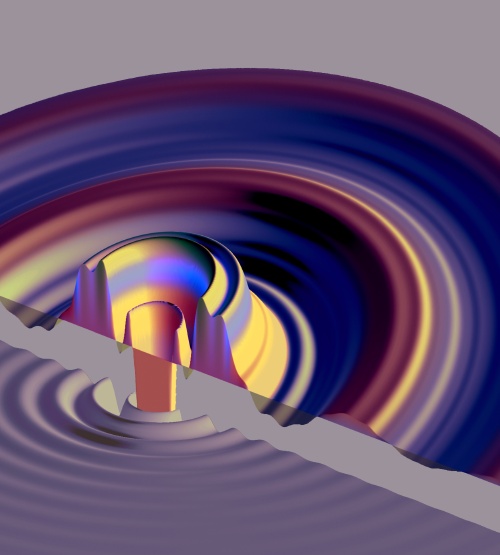
New research led by University of New Hampshire physicists has proved the existence of a new type of electron wave on metal surfaces: the acoustic surface plasmon, which will have implications for developments in nano-optics, high-temperature superconductors, and the fundamental understanding of chemical reactions on surfaces. The research, led by Bogdan Diaconescu and Karsten Pohl of UNH, is published in the July 5 issue of the journal “Nature.”

“The existence of this wave means that the electrons on the surfaces of copper, iron, beryllium and other metals behave like water on a lake’s surface,” says Pohl, associate professor of physics at UNH. “When a stone is thrown into a lake, waves spread radially in all directions.

For some years now, scientists throughout the world have been in a position to use the complete base sequence of the human genome for their analyses.

A question often encountered is whether or not specific sequence motifs have a special function. This is likely in cases where the motif is found in a particular place more often than mere chance distribution would suggest. So far, such calculations have only been possible using time-consuming computer simulations.

Increased exposure to common chemicals may impact ovarian development, says Dr. Paul Fowler, of the University of Aberdeen, Scotland. His research showed that exposing a developing female sheep fetus to low doses of chemicals in the modern-day environment can disturb the development of the ovary

“Our ‘real life’ model exposed developing sheep fetuses by pasturing their mothers on fields fertilised with either inorganic fertiliser, the control group, or, in the case of the treatment group, with digested human sewage sludge, before and during pregnancy”, said Dr. Fowler.

A generator that is 10 times more powerful than any other similar devices has been developed by engineers at the University of Southampton.

Dr Steve Beeby and his team at the University's School of Electronics & Computer Science (ECS) have developed a kinetic energy generator which generates electrical energy from the vibrations and movements present within its environment.

A team of international researchers has collected the oldest ever recovered DNA samples and used them to show that Greenland was much warmer at some point during the last Ice Age than most people have believed. Their findings also confirm that the whole ice sheet will not melt and bring about the tremendous sea-level rises which have been the subject of so much discussion.

The ancient DNA was discovered at the bottom of a two kilometer thick ice sheet and came from the trees, plants and insects of a boreal forest estimated to be between 450,000 and 900,000 years-old.

Refuting the popular stereotype that females talk more than men, researchers at The University of Texas at Austin have found women and men both use an average of 16,000 words each day.

The psychology researchers have published their findings in “Are Women Really More Talkative Than Men"” in the July issue of Science.

For more than a decade, researchers have claimed that women use far more words each day than men. One set of numbers that is commonly tossed around is that women use 20,000 words per day compared to only 7,000 for men.

Blood vessels that have been tissue-engineered from bone marrow adult stem cells may in the future serve as a patient's own source of new blood vessels following a coronary bypass or other procedures that require vessel replacement, according to new research from the University at Buffalo Department of Chemical and Biological Engineering.

“Our results show that bone marrow is an excellent source of adult stem cells containing smooth muscle and endothelial cells, and that these stem cells can be used in regenerative medicine for cardiovascular applications,” said Stelios T. Andreadis, Ph.D., associate professor in the UB Department of Chemical and Biological Engineering in the School of Engineering and Applied Sciences.

Klyuchevskoy (pronounced Kloo-shef-skoy), a stratovolcano located in the north central region of the Kamchatka Peninsula, is blasting ash up to 32,000 feet in the air, and has diverted air traffic headed toward the Far East.

This is the largest eruption to occur in the North Pacific in a decade, and is providing students at the University of Alaska Fairbanks a unique opportunity to collaborate with scientists, as well as state and federal agencies.

Klyuchevskoy’s been erupting since January, but the largest explosions in the eruption began June 28, 2007.

These explosions created a 1,360-mile-long band of ash, stretching from the Sea of Okhotsk to the Aleutian Islands, clogging well-used air routes with volcanic ash that prove deadly for aircraft.

