




The first pigs containing genes responsible for Alzheimer’s disease will be born in Denmark in August. This event is a landmark achivement in the effort towards finding a cure for the disease.

Scientists from the universities of Copenhagen and Århus, Denmark are once again at the cutting edge of biotechnology. This time with cloned pigs that have been genetically modified so that they may function as animal models for the notorious Alzheimer’s disease. In the US alone, 5 million people suffer from this human brain disorder and globally the number is set at approx. 24 million (source: Alzheimer's Disease International).

Bats are one of the zoological groups attracting most interest around the world in terms of studying the epidemiology of rabies.

However, the dynamics of the viral infection in these organisms remains poorly understood. A team from the UB and the Institut Pasteur in Paris has just reported the first epidemiological, ecological and virological study with previously unpublished data on the transmission and development of rabies in these mammals.

The study is the result of twelve years of monitoring the dynamics of rabies virus infection (European bat lyssavirus subtype 1 - EBL1) in two wild bat (Myotis myotis) colonies in Spain. In total, the scientific data refer to the monitoring of over 1000 individuals from two colonies situated 35 km from one another.

Today ended more than a year of hard work for Europe's space-based scientists and their collaborators located all over the world. It was final submittal day to the European Space Agency's (ESA's) Cosmic Vision 2015-2025 Program. The proposals responding to this call, encompassing approximately 1000-2000 proposal-writing-dazed scientists, will eventually lead to the selection of one medium-sized mission (Class M) to enter the implementation phase in 2012, with a launch foreseen in the mid-2017 time-frame.

In May, Nobel Laureate James D. Watson, the scientist who co-discovered the structure of DNA, became the first person to receive his own complete personal genome -- all three billion base pairs of his DNA code sequenced. The cost was $1 million, and the process took two months.

A million dollars for a map of all your genes is way out of reach for most people. The National Institutes of Health would like to bring it down to $1,000 by the year 2014, but plenty of technological hurdles remain before you’ll be able to secure your genetic blueprint for this more affordable price.

A factor in immune cells regulates human semen and seems to determine whether a man will be fertile, according to a new study.

Yousef Al-Abed, PhD, and his colleagues at The Feinstein Institute for Medical Research have isolated an immune substance called macrophage migration inhibitory factor (MIF) in semen samples from infertile and reproductively healthy men. MIF is key to helping sperm mature, which is necessary for its union with an egg. The finding could lead to a diagnostic test to determine fertility status.

Using echo-sounding equipment to create images and maps of areas below the ocean floor, researchers have begun to unravel a new story about the Antarctic Ice Sheet.

Images of areas below the Eastern Ross Sea, next to West Antarctica, provide evidence that the subcontinent was involved in the general growth of the Antarctic Ice Sheet as it formed many millions of years ago, according to scientists at the University of California, Santa Barbara. The National Science Foundation provided funding for the project.

Changes in Antarctica, an area that contains approximately 90 percent of the world’s ice, are particularly important for understanding some implications of global warming.

The Genographic Project is studying the genetic signatures of ancient human migrations and creating an open-source research database. It allows members of the public to participate in a real-time anthropological genetics study by submitting personal samples for analysis and donating the genetic results to the database.

In the first scientific publication from the project they report on genotyping human mitochondrial DNA during the first 18 months of the project.

To making sorting and cataloguing so much data easier, they created the Nearest Neighbor haplogroup prediction tool. The accurate classification of genetic lineages into distinct branches on the human family tree, known as haplogroups, has long been a struggle for anthropologists.

About 250 years before Daniel Massey built his farm house in Huntingdon County, Pennsylvania, his great-grandfather came to the New World as an indentured servant. 150 years later, Penn State's Archaeological Field School is excavating Daniel's house to see how far he came from those humble beginnings.

"I think historic archaeology can engage a little more directly than the prehistoric archaeology we sometimes do," says Dr. Claire Milner, director of the field school and director of exhibits and curator of Penn State's Matson Museum of anthropology. "It is more obvious and immediate who the people were and what the artifacts are."


Student measures artifact location for mapping.

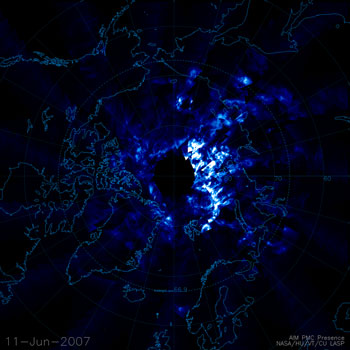
A NASA satellite has captured the first occurrence this summer of mysterious iridescent polar clouds that form 50 miles above Earth's surface.

The first observations of these clouds by the Aeronomy of Ice in the Mesosphere (AIM) satellite occurred above 70 degrees north on May 25. Observers on the ground began seeing the clouds on June 6 over northern Europe. AIM is the first satellite mission dedicated to the study of these unusual clouds.

These mystifying clouds are called Polar Mesospheric Clouds, or PMCs, when they are viewed from space and referred to as "night-shining" clouds, or noctilucent clouds, when viewed by observers on Earth. The clouds form during the Northern Hemisphere's summer season that begins in mid-May and extends through the end of August.

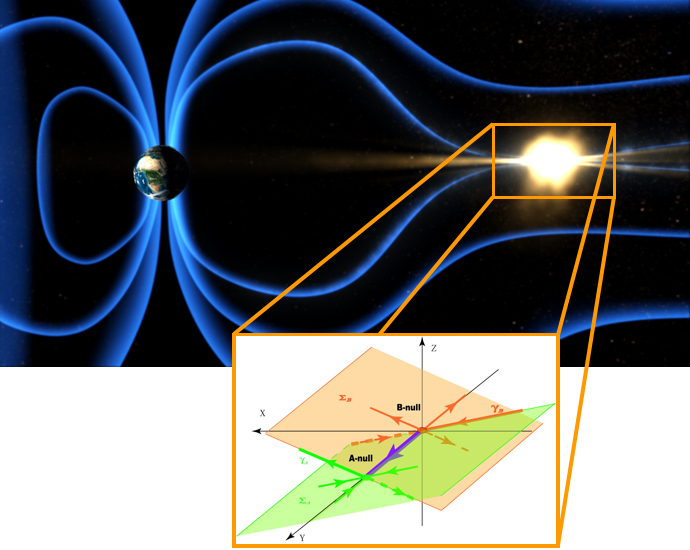
Scientists have obtained the first-ever 3D pictures of magnetic reconnection events, the dances on the solar winds of near-Earth space.

In magnetic reconnection, magnetic field lines from different magnetic domains collide and reconnect, mixing previously separated plasma. Plasma is a gas composed of ions and electrons but is electrically neutral, spread over large distances in space and guided by the action of magnetic and electric fields.

Magnetic reconnection converts the energy of the magnetic field into particle energy, generating jets and heating the plasma.


