A new report describes how researchers analyzed a major 2011 Texas wildfire using a scientifically based post-fire data collection approach, a system they believe will lead to improved defensive measures and strategies for significantly reducing structural damage and property loss.

ITHACA, N.Y. - Just as the single-crystal silicon wafer forever changed the nature of communication 60 years ago, a group of Cornell researchers is hoping its work with quantum dot solids - crystals made out of crystals - can help usher in a new era in electronics.

The team, led by Tobias Hanrath, associate professor in the Robert Frederick Smith School of Chemical and Biomolecular Engineering, and graduate student Kevin Whitham, has fashioned two-dimensional superstructures out of single-crystal building blocks. Through a pair of chemical processes, the lead-selenium nanocrystals are synthesized into larger crystals, then fused together to form atomically coherent square superlattices.

Serious burn victims are immunocompromised and may be missing skin on parts of their body, and this makes them highly vulnerable to bacteria. Thanks to progress in intensive care, they are decreasingly likely to die from burn trauma. Death is more commonly the result of infections that can occur several months after being hospitalized. The bandages used to treat burns actually represent a real breeding ground for microbes.

(Vienna, Feb. 23, 2016) One in four cases of colorectal cancer (CRC) detected in a guiac faecal occult blood testing (gFOBT) programme are diagnosed within two years of a negative screening result, a study in the UEG Journal (1) has found, suggesting that gFOBT should be replaced by more sensitive screening methods to improve detection rates.

CRC is the most common type of digestive cancer in Europe (2) and annual incidence is predicted to rise by 12% by 2020 (3).

Archaeological and genetic analysis may indicate that three skeletons buried in medieval graves in France may have been Muslim, according to a study published February 24, 2016 in the open-access journal PLOS ONE by Yves Gleize from the French National Institute for Preventive Archaeological Research (Inrap) and University of Bordeaux, France, Fanny Mendisco from University of Bordeaux, France, and colleagues.

GAINESVILLE, Fla. -- The human brain has a remarkable defense system that filters bacteria and chemicals. For brain tumor patients, the barrier works almost too well by blocking most chemotherapy drugs.

Now, a team led by a University of Florida Health researcher has found that a laser system already used to kill brain tumors has another benefit: It opens a temporary "window" in the blood-brain barrier that enables crucial chemotherapy drugs to pass into the brain for up to six weeks. The findings are published today (Feb. 24) in the journal PLOS ONE.

BUFFALO, N.Y. -- One of the great joys in mathematics is the ability to use it to describe phenomena seen in the physical world, says University at Buffalo mathematician Gino Biondini.

With UB postdoctoral researcher Dionyssios Mantzavinos, Biondini has published a new paper that advances the art -- or shall we say, the math -- of describing a wave. The findings, published Jan. 27 in Physical Review Letters, are thought to apply to wave forms ranging from light waves in optical fibers to water waves in the sea.

The study explores what happens when a regular wave pattern has small irregularities, a question that scientists have been trying to answer for the last 50 years.

Agriculture is one of the few areas where government regulations have not caused costs to boom with little value to the public. In the past few decades, American science and technology have produced more food on less land with less environmental strain than ever thought possible. There is so much food people can self-identify with the organic growing process, something that would have meant starvation when organic was the only solution.

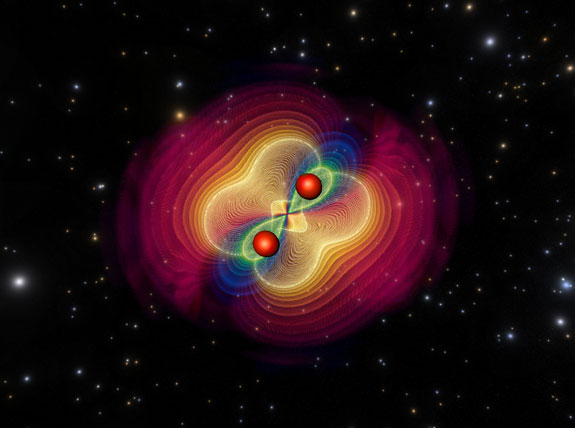
There is nothing so compelling as a story about falling down, recovering your footing, and then charging over the goal line completely redeemed … unless it is two such stories. The Denver Broncos’ Super Bowl 50 victory and the laser interferometer gravitational-wave observatory’s (LIGO’s) detection of gravity waves offer parallel examples. What, football and physics? Yep. I watched the big game on TV, like tens of millions of others. But as a technical consultant to LIGO, I had a Goodyear blimp’s view of their gridiron when the collaboration fumbled its funding, recovered its mojo, and then sprinted to victory by observing gravitational radiation generated more than a billion years ago.

Self-organizing social behaviour in the so-called plant-animal, a 'solar-powered' species of marine flat worm that gains all its energy from the algae within its own body, has been demonstrated by researchers from the University of Bristol, UK.

Professor Nigel Franks in the School of Biological Sciences and colleagues, especially Dr Alan Worley, formerly of the School of Physics, made direct comparisons between videos of the real worms and computer simulations of virtual worms with different patterns of behaviour. This showed that individual plant-animal worms (Symsagittifera roscoffensis) interact with one another to coordinate their movements.

