
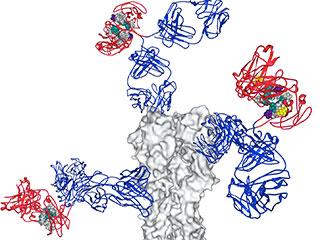





Researchers have discovered that a human antibody specific to dengue virus serotype 2, called 2D22, protects mice from a lethal form of the virus -- and they suggest that the site where 2D22 binds to the virus could represent a potential vaccine target.

The mosquito-borne virus, which infects nearly 400 million people around the world each year, has four distinct serotypes, or variations, and there is currently no protective vaccine available.

Flu vaccines can be a shot in the dark - they must they be given yearly and there's no guarantee the strains against which they protect will be the ones circulating once the season arrives. 

New research suggests it may be possible to harness a previously unknown mechanism within the immune system to create more effective and efficient vaccines against this ever-mutating virus.

Being busy with acts of kindness can help people who suffer from social anxiety to mingle more easily, according to a new stud. 

Sufferers from social anxiety are more than just a little shy. Dealings with others might make them feel so threatened or anxious that they often actively avoid socializing. Although this protects them from angst and possible embarrassment, they lose out on the support and intimacy gained from having relationships with others. They have fewer friends, feel insecure when interacting with others, and often do not experience emotional intimacy even in close relationships.

When you create an energetic collision between two protons, as the Large Hadron Collider does at large rates and very high energy, the question is what is the chance that a rare process is generated. In the quantum world, everything that is possible is also mandatory - but it happens with a probability that is sometimes very hard to calculate. 
Think the 'chocolate as miracle food' hoax was something new?

Two migraine surgery techniques targeting a specific "trigger site" are both highly effective in reducing the frequency and severity of migraine headaches, according to a randomized trial.

Patients with temporal-type migraine derive similar and significant improvement from techniques that relieve pressure on (decompression) or remove a portion of (neurectomy) the nerve responsible for triggering their headaches, reports Bahman Guyuron, MD, Emeritus professor of plastic surgery at Case School of Medicine, Cleveland, and colleagues. 

Trees that can tolerate soil pollution are also better at defending themselves against pests and pathogens.

While studying the presence of genetic information (RNA) from fungi and bacteria in the trees, the researchers found evidence of a very large amount of RNA from a very common plant pest called the two-spotted spidermite.

99% of spidermite RNA was in higher abundance in trees without contamination, suggesting that the polluted plant's defense mechanisms, used to protect itself against chemical contamination, improves its resistance to a biological invader. 

Another Fourth of July is here, the time for backyard barbecues, picnics, cookouts, parades, swimming and fireworks.

One of those Independence Day pastimes, however, stands apart: fireworks. They’re a somewhat controversial topic in the US and are covered by a patchwork of different laws.

When we smell a rose, we might take a deep breath to get the the sweet but subtle floral scent - and in a public bathroom we would wisely do just the opposte. Yet people with autism spectrum disorder (ASD) don't make this natural adjustment like other people do, autistic children go right on sniffing in the same way, no matter how pleasant or awful the scent.

Researchers writing in a new paper suggest that non-verbal tests related to smell might serve as useful early indicators of ASD. Earlier evidence had indicated that people with autism have impairments in "internal action models," the brain templates we rely on to seamlessly coordinate our senses and actions. It wasn't clear if this impairment would show up in a test of the sniff response, however.

In a step that they say overturns traditional assumptions and practice, researchers at the Tata Institute of Fundamental Research, Mumbai and Institute for Plasma Research, Gandhi Nagar have fashioned bacteria to emit intense, hard x-ray radiation.

When one thinks of hard x-rays and bacteria it is usually that the bacteria are at the receiving end of the x-ray source - being imaged, irradiated for some modification or simply assessed for radiation damage. One hardly thinks of using bacteria as a source of x-rays, far from turning them into the brightest among such sources.

