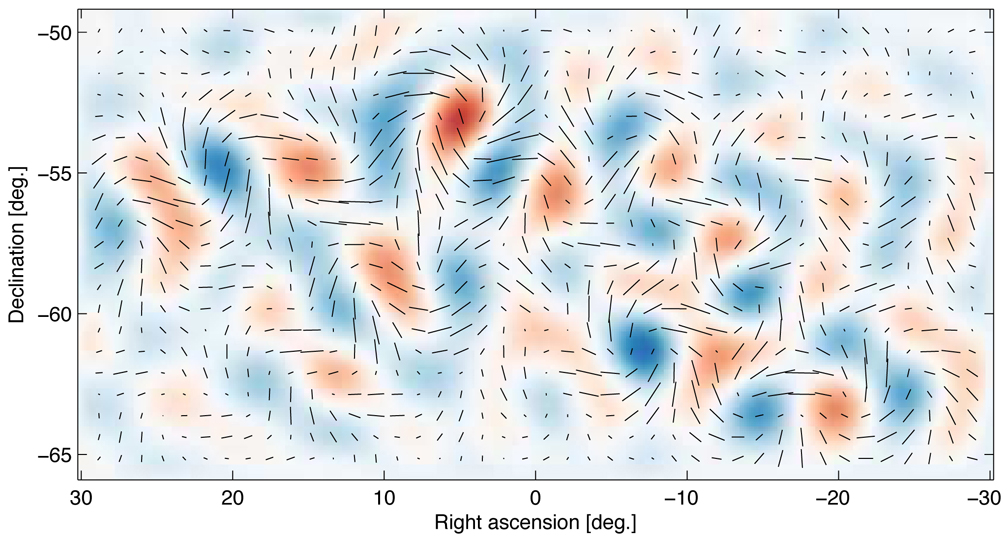




Almost 14 billion years ago, the universe we inhabit burst into existence in an extraordinary event that initiated the Big Bang. In the first fleeting fraction of a second, the universe expanded exponentially, stretching far beyond the view of our best telescopes. All this, of course, was just theory.

Researchers from the BICEP2 collaboration today announced the first direct evidence for this cosmic inflation. Their data also represent the first images of gravitational waves, or ripples in space-time. These waves have been described as the "first tremors of the Big Bang." Finally, the data confirm a deep connection between quantum mechanics and general relativity.

Does BPA make you fat?

The tau lepton is a particle of very complex phenomenology. Although point-like as its lighter counterparts - the electron and the muon - the tau has a quite respectable mass, 1.77 GeV, which makes all the difference from the other charged leptons.

The tau was discovered in 1975 by Martin Perl at the SPEAR electron-positron collider. The acceptance of that observation was quite slow: the events found by Perl and his team were complicated because of the peculiar properties of the newfound particle. Perl had found an excess of events featuring an electron and a muon and an energy imbalance, which were hard to explain unless hypothesizing the creation of a pair of short-lived, heavy leptons.
This semester I’m teaching a graduate level course on “Hume Then and Now,” which aims at exploring some of the original writings by David Hume, particularly the Enquiry Concerning Human Understanding, and contemporary philosophical treatments of Humean themes, such as induction, epistemic justification, and causality.

New evidence gathered by NASA's MESSENGER spacecraft at Mercury solves an apparent enigma about Mercury's evolution. 

The data indicate the tiny planet closest to the sun, only slightly larger than earth's moon, has shrunk up to 7 kilometers in radius over the past 4 billion years, much more than earlier estimates. Older images of surface features indicated that, despite cooling over its lifetime, the rocky planet had barely shrunk at all. But modeling of the planet's formation and aging could not explain that finding.

The agave's claim to fame is as the plant from which the distilled adult beverage Tequila, named after the nearby town that made it famous, is produced.

But that may change. A sweetener created from the agave plant could lower blood glucose levels for the 26 million Americans and others worldwide who have type 2 diabetes and even help the obese lose weight, according to a paper presented at the   National Meeting of the American Chemical Society (ACS).

Colon cancer incidence rates have dropped sharply - 30 percent in the U.S. in the last 10 years, among adults 50 and older.

The drop has been attributed to the widespread uptake of colonoscopy, with the largest decrease in people over age 65. Colonoscopy use has almost tripled among adults ages 50 to 75, from 19 percent in 2000 to 55 percent in 2010.

The findings come from Colorectal Cancer Statistics, 2014, and are published in CA: A Cancer Journal for Clinicians. The article and its companion report, Colorectal Cancer Facts&Figures, were released today by American Cancer Society researchers as part of a new initiative by the National Colorectal Cancer Roundtable to increase screening rates to 80 percent by 2018.

It's hard to imagine how plants, one of nature's greatest successes, could be improved, but nanobionic plants which enhance the photosynthetic function of chloroplasts isolated from plants for possible use in solar cells may get a boost.

By augmenting them with nanomaterials, plants could enhance their energy production and get completely new functions, such as monitoring environmental pollutants.

Leftover cigarette smoke clings to walls and furniture and could pose a far more serious threat, according to a presentation at the National Meeting&Exposition of the American Chemical Society (ACS) which says that one compound from this "third-hand smoke" can damage DNA and and even potentially cause cancer. 

Bo Hang, Ph.D., of Lawrence Berkeley National Laboratory noted that the idea of third-hand smoke only come into existence in 2009, But that evidence already suggests it could threaten human health. In test tubes, anyway.

"The best argument for instituting a ban on smoking indoors is actually third-hand smoke," said Hang.

Bisphenol A (BPA) is currently banned from baby bottles so the search is on for alternatives. 

Lignin, the compound that gives wood its
strength, from waste in paper manufacturing could be ready for the market within five years, according to a paper at the National Meeting of the American Chemical Society.

There is no evidence of harm due to BPA despite 50 years of common use but some critics allege  it mimics the hormone estrogen and that it might be unsafe for young children and pregnant women in ways as yet undiscovered. Parents scared by the precautionary principle and the Dr. Oz show are not replacing it with a completely unknown alternative no matter how 'green' it claims to be, but alternatives are worthwhile research.


