




The newspaper, that daily chronicle of human events, is undergoing the most momentous transformation in its centuries-old history. Online versions are proliferating, attracting young readers, and generally carving out a sizable swath of the news business. In the United States alone, 34 million people have made a daily habit of reading an online newspaper.

An online news site can change minute by minute and generate a different front page for each reader. The most interesting and useful customization involves capturing information about the readers' interests from their past behavior. There's already a model for that--the recommendation systems used by Web sites like Amazon, TiVo, and Netflix.

Researchers at the Department of Artificial Intelligence (DIA) of the Universidad Politécnica de Madrid’s School of Computing (FIUPM) have, in conjunction with Madrid’s Universidad Rey Juan Carlos, developed an algorithm that is capable of processing 30 images per second to recognize a person’s facial expressions in real time and categorize them as one of six prototype expressions: anger, disgust, fear, happiness, sadness and surprise.

Applying the facial expression recognition algorithm, the developed prototype is capable of processing a sequence of frontal images of moving faces and recognizing the person’s facial expression. The software can be applied to video sequences in realistic situations and can identify the facial expression of a person seated in front of a computer screen.

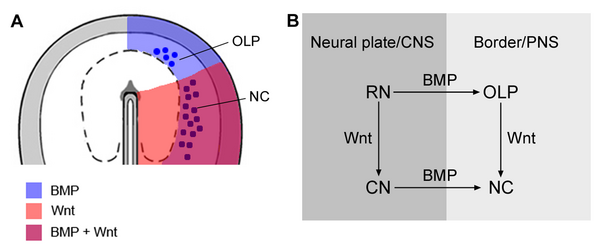
The human nervous system consists of the brain and spinal marrow, which constitute the central nervous system (CNS), and sensory nerve cells that comprise the peripheral nervous system (PNS).

Information from our surroundings-sight, smell, hearing, etc.-are transmitted from specific sensory nerve cells in the PNS to the central nervous system, where it is processed and governs our response. These processes require the two nervous systems to be functionally connected.

NASA's Aeronautics Research Mission Directorate has amended its NASA Research Announcement to solicit additional research proposals. The Research Opportunities in Aeronautics 2007 has been amended to include new topics in support of the Subsonic Rotary Wing Project.

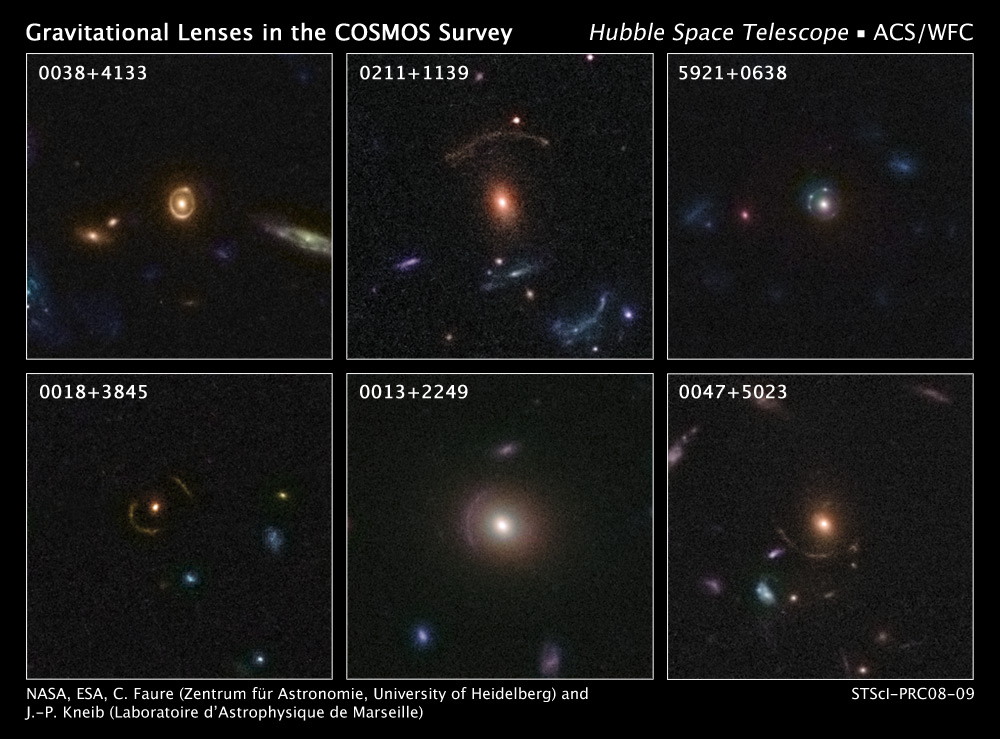
Astronomers using NASA's Hubble Space Telescope have compiled a large catalog of gravitational lenses in the distant universe. The catalog contains 67 new gravitationally lensed galaxy images found around massive elliptical and lenticular-shaped galaxies. This sample demonstrates the rich diversity of strong gravitational lenses. If this sample is representative, there would be nearly half a million similar gravitational lenses over the whole sky.

The lenses come from a recently completed, large set of observations as part of a huge project to survey a single 1.6-square-degree field of sky (nine times the area of the full Moon) with several space-based and Earth-based observatories.

In people affected by acquired immuno-deficiency syndrome it may often be observed a rise of cutaneous emergencies, whose impact spans from 25% in asyntomatic subjects to 100% in the case of very evident AIDS.

The frequency and the atypic nature of these emergencies gives a highlighted role to the dermatologist, characterizing the early diagnosis of cutaneous pathologies as the qualifying moment in the analysis of AIDS affected patient.

As the starting moment in the HIV-positive subject examination, search for injuries referable to Kaposi's sarcoma, especially at the mucous level (pharinx wounds are evident in 10 to 50% of total cases).

CALGARY, Canada, February 22 /PRNewswire/ -- THIS ANNOUNCEMENT IS NOT FOR RELEASE, PUBLICATION OR DISTRIBUTION, DIRECTLY OR INDIRECTLY, IN OR INTO THE UNITED STATES, SOUTH AFRICA, AUSTRALIA, JAPAN OR ANY JURISDICTION IN WHICH THE SAME WOULD BE UNLAWFUL. THIS ANNOUNCEMENT IS NOT AN OFFER OF SECURITIES IN THE UNITED STATES, SOUTH AFRICA, AUSTRALIA, JAPAN OR ANY JURISDICTION IN WHICH THE SAME WOULD BE UNLAWFUL.

LAKE WORTH, Florida, February 22 /PRNewswire/ --

Graphic Security Systems Corporation (GSSC) and 3M have signed a reseller agreement that grants 3M worldwide nonexclusive sales rights to offer GSSC's proprietary Scrambled Indicia technology within the passport and ID markets. The two companies had achieved technical compatibility between 3M travel document readers and the Scrambled Indicia technology some two years ago. That brought enhanced image security to ePassports and travel documents, and gave document authenticators additional verification capabilities.

While current-generation solar cell technologies are too expensive and inefficient for wide-scale commercial applications, the demands of United States energy needs are spurring new advancements in improving solar cell efficiency.

A team of Northwestern University researchers has developed a new anode coating strategy that significantly enhances the efficiency of solar energy power conversion. Their paper about the work focuses on “engineering” organic material-electrode interfaces in bulk-heterojunction organic solar cells.

Introduction: Bioterrorism is the utilization of microorganisms or toxins in order to produce a disease and/or death in human beings, animals or plants. Different from conventional weaponry, relatively economic means are used that allow the elimination of living beings without destroying the surrounding atmosphere.

The most probably method for spread of bioweapons is aerial transmission, continuing into water supplies and food. The CDC (US Centers for Disease Control and Prevention, Atlanta) has subdivided into three categories the aggressiveness of "Bioweapons".

Category A comprises:

