


When we search the cosmos for evidence we are not the first advanced life form, we look for things that we could share in common. This anthropomorphism is common in culture, in everything from science studies to science-fiction. And it may not be wrong.

Assuming we have any extra-terrestrial neighbors, far less popular is the idea that we will be the advanced civilization new ones are terrified about being invaded by, they will likely have undergone natural selection just like we did. In the video game Spore, almost everyone evolved creatures that were purple and had huge eyes, despite trying to do things randomly, and that may happen on other planets also.

Rich people are more likely to shop at Whole Foods, buy supplements, vote for a particular political party and...racially discriminate against minorities? That last part is according to a new sociology paper which will force some inconvenient questions about race and money in America.

Though it is commonly believed that wealth leads to better health and less discrimination, wealthier African- and Latino-Americans report more racial discrimination than poor ones, according to survey results. Meanwhile, as whites became more wealthy they report improved health.

Though genetically engineering food using science remains controversial in some circles, with concerns about genetically modified corn syrup in candy and claims that CRISPR can somehow be harmful whereas mutagenesis-derived foods can be labeled organic, progress marches on.

We're on our way to 9 million people and existing agriculture could easily handle it...if great agricultural land were evenly distributed. But is isn't evenly distributed, which is why the US and Europe can have robust markets for food created using an organic-certification process. Yield does not matter, just profit margins do, when land grows food easily.

Traumatic brain injuries in baseball and softball are down, but they were not really all that high to begin with, and that may be why there is poor compliance overall with helmet use and return-to-play guidelines following concerns about a concussion.

Today at CERN a workshop started on the physics of the High-Luminosity and High-Energy phases of Large Hadron Collider operations. This is a three-days event meant at preparing the ground for the decision on which, among several possible scenarios that have been pictured for the future of particle physics in Europe, will be the one on which the European Community will invest in the next few decades. The so-called "European Strategy for particle physics" will be decided in a couple of years, but getting the hard data on which to base that crucial decision is today's job. 

Some context

Surveys of students in two Canadian provinces have led scholars to warn that e-cigarettes, also called vaping, are causing cigarette uptake in high school students.

This will be a surprise to American and British public health officials, who know cigarette smoking has plummeted and even among those who get hooked, vaping is considered a viable harm reduction and smoking cessation alternative.

Though men account for the overwhelming majority of suicides and have increasingly sought help for depression, the clinical community has yet to figure out how to better help them. 

A new pilot study from Australia shows the extent of the problem. Men surveyed reported that instead of receiving tailored treatment regimens more suited toward them, the clinical community seems to take a one-size-fits-all-genders unstructured talk therapy approach. Few gave their clients goals to work towards or outlined skills they could gain to deal with their depression, which was the opposite of the action-oriented, functional treatment the men were most often seeking. 

A cannabinoid neuropathic treatment that provided pain relief in rats for a period of eleven days after the oral administration of a single dose has received a patent and signed an intellectual property license with GB Sciences, Inc. 

Next up, they will work on formulations based on polymer nanoparticles with active ingredients developed by GB Sciences for the treatment of chronic pain in hopes it will be suitable for humans.

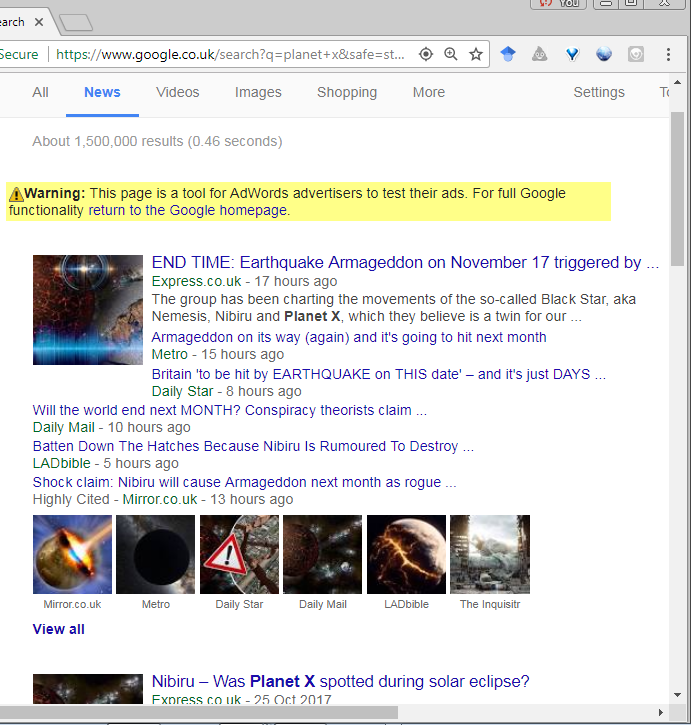
I've been writing Doomsday Debunking articles for a couple of years now. The amount of fake news about the end of the world on the web is incredible. What makes it worse is that stories that say the world is about to end get widely shared, linked to, read over and over, and rise right to the top of Google and Apple news. If you are intrigued by a news story about the search for "planet X" by astronomers, say, and go to Google News, the top result is usually one or other article from the Daily Express who regularly publish fake news saying that an extra planet is about to hit Earth or fly past Earth in the next week or month.This is followed by pages and pages of search results consisting almost entirely of "news" in a similar vein.

It may not seem to make sense but most of the universe - mass - can really only account for about 6 percent of what is going on. The rest of it can be under just about any umbrella at this point. Some call it the God of the Gaps, scientists call the unknown mass Dark Matter.

What is it? No one knows, when it comes to the very large and the very small, physics does not have all the answers, but something has made the universe at least 100 billion light years in size even though it's only 13 billion years old. As you know, a light year is the distance light will travel in that time. Since nothing can go faster than the speed of light, it's long been time to think about what Nothing is.

That's dark matter. And whatever is propelling it can be called Dark Energy.


