We've all heard it before. Some of you may even have used it: "I thought she was X" age. Alcohol impairs judgment, it is said, or releases inhibitions, depending on whether you like the effects.
There may be nothing to that argument, according to a new study. Consuming alcohol did not affect how men judged the age of women, which has important legal implications if alcohol is cited as a cause of impairing judgement in cases of unlawful sex with a minor, because men always think women look older.
The fossil record usually shows what adult animals looked like. But the appearance and lifestyle of juvenile animals often differ dramatically from those of the adults. A classic example is provided by frogs and salamanders. New discoveries from Uppsala, Cambridge and Duke Universities, published in Science, show that some of the earliest backboned land animals also underwent such changes of lifestyle as they grew up.
Scientists at the University of Liverpool have developed a new method to help researchers identify genes that can help protect the body during the aging process.
The team developed a method of analysing genes in multiple ageing tissue types in both animals and humans. The analysis, which included more than five million gene measurements, highlighted the mechanisms used by the body to protect against cellular changes with age that can result in conditions such as muscle degeneration and cognitive aging.
More restaurants and vending machines offer healthy choices these days, so why do Americans' waistlines continue to expand? A new study in the Journal of Consumer Research shows that some efforts to control eating may backfire.
Consumers may feel they have fulfilled a healthy eating goal even if they choose an unhealthy food, and the presence of a healthy option among food choices may draw their attention to the least-healthy choice available, according to authors Keith Wilcox (City University of New York), Beth Vallen (Loyola College), Lauren Block (City University of New York), and Gavan J. Fitzsimons (Duke University).
Breast cancer cells in the laboratory that don't respond to tamoxifen may be producing high amounts of cholesterol in order to provide a kind of shield against the drug, say researchers at Georgetown University Medical Center (GUMC).
They say their study, presented at the Annual Meeting of the American Association for Cancer Research (AACR), suggests that currently available statin drugs that reduce cholesterol might be useful in patients with tamoxifen-resistant breast cancer. Alternatively, investigators say, new agents could potentially be designed that specifically inhibit the molecules they found to be responsible for this excess production of cholesterol.
Astronomers using the United Kingdom Infrared Telescope (UKIRT) in Hawaii, the IRAM Millimetre-wave Telescope in Spain, and the Spitzer Space Telescope in orbit above the Earth, have completed the most wide-ranging census ever produced of dynamical star formation in and around the well-known Great Nebula of Orion.
They have found this stellar nursery to be a lively and somewhat overcrowded place, with young stars emitting gas jets in all directions, creating quite a chaotic picture and demonstrating there is much more going on in Orion than previously thought. Researchers including UKIRT Director Professor Gary Davis will present this and other UKIRT science results on Monday 20th April at the European Week of Astronomy and Space Science at the University of Hertfordshire.
An international team have discovered one of the coolest sub-stellar bodies ever found outside our own solar system, orbiting the red dwarf star Wolf 940, some 40 light years from Earth.
The object is thought to have formed like a star, but has ended up looking more like Jupiter. It is roughly the same size, despite being between 20 and 30 times as heavy, and when the infrared spectral "fingerprints" of the two objects are compared, their resemblance is striking.
The new object orbits its star at about 440 times the distance at which the Earth orbits the sun. At such a wide distance, it takes about 18,000 years to complete a single orbit.
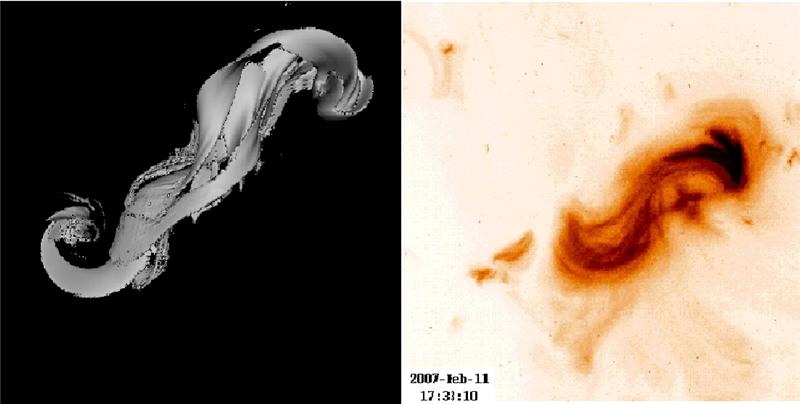
'Sigmoids' are S-shaped structures found in the outer atmosphere of the Sun (the corona), seen with X-ray telescopes and thought to be a crucial part of explosive events like solar flares. Now a group of astronomers have developed the first model to reproduce and explain the nature of the different stages of a sigmoid’s life.
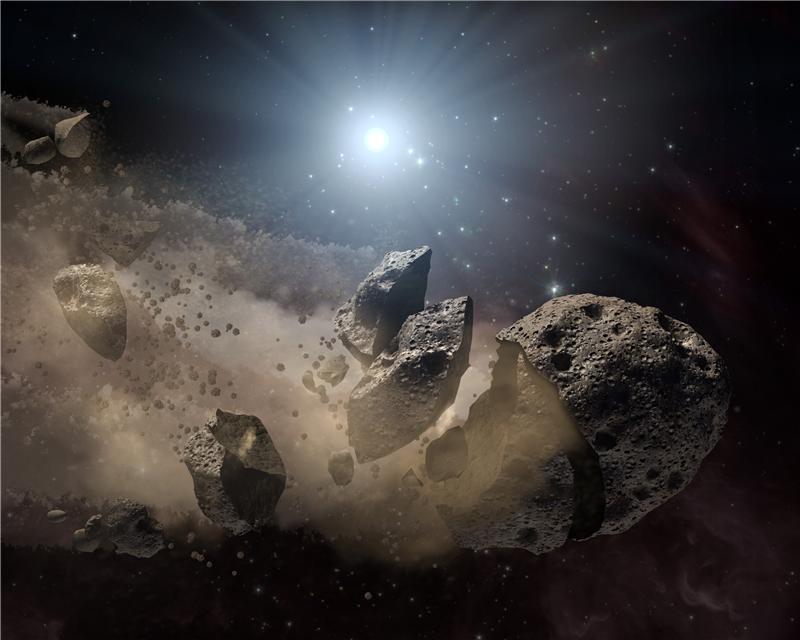
Using NASA’s Spitzer Space Telescope, an international team of astronomers have found that at least 1 in 100 white dwarf stars show evidence of orbiting asteroids and rocky planets, suggesting these objects once hosted Solar Systems similar to our own. Team member Dr Jay Farihi of the University of Leicester will present this discovery on Monday 20th April at the European Week of Astronomy and Space Science conference at the University of Hertfordshire.
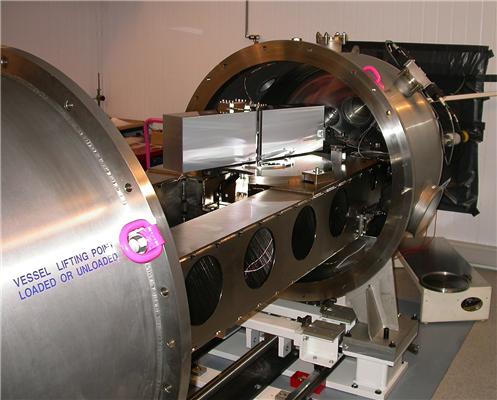
Astronomers have announced plans to build an ultra-stable, high-precision spectrograph for the Science and Technology Facilities Council's 4.2-m William Herschel Telescope (WHT - part of the Isaac Newton Group or ING on La Palma) in an effort to discover habitable Earth-like planets around other stars. Dr Ian Skillen of the ING will present the new High Accuracy Radial-velocity Planet Search – New Earths Facility (HARPS-NEF) spectrograph in a poster on Monday 20th April at the European Week of Astronomy and Space Science conference at the University of Hertfordshire.