





PITTSBURGH, September 3 /PRNewswire/ --

Mice given quercetin, a naturally occurring substance found in fruits and vegetables, were less likely to contract the flu, according to a study published by The American Physiological Society. The study also found that stressful exercise increased the susceptibility of mice to the flu, but quercetin canceled out that negative effect.

Quercetin, a close chemical relative of resveratrol, is present in a variety of fruits and vegetables, including red onions, grapes, blueberries, tea, broccoli and red wine. It has been shown to have anti-viral properties in cell culture experiments and some animal studies, but none of these studies has looked specifically at the flu.

Although this study was done with mice, a recent human study found that people who took quercetin suffered fewer illnesses following three days of exhaustive exercise compared to those who did not. Unlike the mouse study, the humans were not inoculated with a virus.

Today there is rapidly growing interest in 'intelligent' computer-based methods that use various classes of measurement signals, from different patient samples, for instance, to create a model for classifying new observations. This type of method is the basis for many technical applications, such as recognition of human speech, images, and fingerprints, and is now also beginning to attract new fields such as health care.

These 'intelligent' computer-based methods for classifying patient samples have been evaluated by Swedish researchers at Uppsala University with the help of two methods that have completely dominated research for 25 years; cross validation and resampling/bootstrapping.

Their conclusion; they're worthless for practical problems.

According to the Center for Disease Control (CDC), osteoarthritis, the most common type of arthritis, is on the rise. A new study published in the August journal of Phytotherapy Research, says that Pycnogenol, bark extract from the French maritime pine tree, reduced overall knee osteoarthritis (OA) symptoms by 20.9 percent and lowered pain by 40.3 percent. To date, this is the third clinical trial on osteoarthritis treatment with Pycnogenol.

This study investigated what happens to joint symptoms after treatment with Pycnogenol is terminated and the results show that no relapse occurred after two weeks. Pycnogenol acts as an anti-inflammatory and the effects found in this study suggest that Pycnogenol may help the joints to recover.

A new study published online today in the British Journal of Nutrition found that timing of dietary protein intake affects feelings of fullness throughout the day. The study concluded that when people ate high-quality protein foods, from sources such as eggs and lean Canadian bacon, for breakfast they had a greater sense of sustained fullness throughout the day compared to when more protein was eaten at lunch or dinner.i

"There is a growing body of research which supports eating high-quality protein foods when dieting to maintain a sense of fullness," said Wayne W. Campbell, PhD, study author and professor of Foods and Nutrition at Purdue University. "This study is particularly unique in that it looked at the timing of protein intake and reveals that when you consume more protein may be a critical piece of the equation."

From the 1933 classic "The Invisible Man" to the more recent Harry Potter series, devices that achieve invisibility have been popular parts of film fantasy. In recent years, scientists using special types of 'meta' materials have shown that fantasy invisibility could one day become reality.

Scientists from Oregon State University and the Natural History Museum in London have announced the discovery of the oldest known fossil of a gecko, with body parts that are forever preserved in life-like form after 100 million years of being entombed in amber.

Due to the remarkable preservative power of being embalmed in amber, the tiny foot of this ancient lizard still shows the tiny “lamellae,” or sticky toe hairs, that to this day give modern geckos their unusual ability to cling to surfaces or run across a ceiling. Research programs around the world have tried to mimic this bizarre adhesive capability, with limited success.

This gecko’s running days are over, however, as only the foot, toes and part of a tail are left in the stone. The rest might have become lunch for a small dinosaur or other predator during an ancient fight in the tropical forests of Myanmar during the Lower Cretaceous Period, from 97 million to 110 million years ago.

HO CHI MINH CITY, Vietnam, September 3 /PRNewswire/ --

- NIIT Students and IT Professionals in Vietnam and Other Asia Pacific Markets to Gain Skills in the Latest and Most Advanced Technologies

Sun Microsystems, a leading provider of advanced network computing systems, software and IT-related solutions, and NIIT, a leading Global Talent Development Corporation have announced a partnership to offer training on Sun technologies to students in Vietnam. This partnership will also be expanded to other Asia Pacific markets including Indonesia, Thailand and Malaysia through NIIT's network of IT training centers in the Asia Pacific region.

Experienced Zen meditators can clear their minds of distractions more quickly than novices, according to a new brain imaging study.

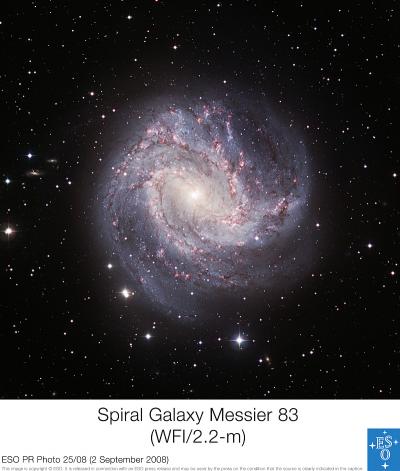
ESO's Wide Field Imager has captured the intricate swirls of the spiral galaxy Messier 83, a smaller look-alike of our own Milky Way. Shining with the light of billions of stars and the ruby red glow of hydrogen gas, it is a beautiful example of a barred spiral galaxy, whose shape has led to it being nicknamed the Southern Pinwheel.

This dramatic image of the galaxy Messier 83 was captured by the Wide Field Imager at ESO's La Silla Observatory, located high in the dry desert mountains of the Chilean Atacama Desert. Messier 83 lies roughly 15 million light-years away towards the huge southern constellation of Hydra (the sea serpent). It stretches over 40 000 light-years, making it roughly 2.5 times smaller than our own Milky Way. However, in some respects, Messier 83 is quite similar to our own galaxy. Both the Milky Way and Messier 83 possess a bar across their galactic nucleus, the dense spherical conglomeration of stars seen at the centre of the galaxies.


