



The hereditary disease ponto cerebellar hypoplasia (PCH) occurs when certain areas of the brain do not develop properly; this results in severe mental and physical developmental disorders. Life expectancy of those affected ranges from a few months to a few years.

Scientists from Cologne and Amsterdam have discovered the mutations in human genetics which cause PCH of the types 2 and 4.

“In the case of PCH, the protein complex – the so-called tRNA-Splicing-Endonuclease, is mutated. This complex in involved in the manufacture of proteins in the human body and was identified in connection with a disease for the first time,” reports Birgit Budde from the Cologne Center for Genomics and Institute for Genetics of the University of Cologne.

MUNICH, Germany, August 31 /PRNewswire/ --

- Sub-group analysis of landmark trial showed prasugrel substantially reduced risk of heart attack and stent thrombosis compared with clopidogrel among ACS patients with diabetes

MUNICH, Germany, August 31 /PRNewswire/ --

Press conference The BEAUTIFUL study: a step further in title Coronary Artery Disease ESC Hotline Title: The BEAUTIFUL study: efficacy of session title ivabradine in reduction of cardiovascular events among patients with stable coronary artery disease and left ventricular dysfunction ESC Hotline 31st August 2008, 11:18 - 11:31 AM session time Press conference 9.00-10.00 Timing Executive 31st August 2008: 9.00 - 10.30 AM committee members available for interview

TEL AVIV, Israel, August 31 /PRNewswire/ --

Delek Group Ltd. (TASE: DLEKG.TA) (hereinafter: "Delek Group" or "The Group") announced today its results for the three and sixth month period ending June 30, 2008. The full financial statements are available in English on Delek Group's website at: www.delek-group.com .

On January 1, 2008, the Group adopted the IFRS Accounting Standards, and the comparable data for the first six months of 2007 have been restated in accordance with IFRS principals. Additional information with regard to the changes between the previous and new accounting standards can be found in the full first quarter financial statements.

Researchers report the discovery of the first new living species of giant clam in two decades, according to a report in Current Biology. While fossil evidence reveals that the new species, called Tridacna costata, once accounted for more than 80 percent of giant clams in the Red Sea, it now represents less than one percent of giant clams living there.

The researchers said they cannot say for sure which factors contributed to the loss of this giant clam species in favor of others, but the overall decline in giant clam stocks and the striking loss of large specimens is a "smoking gun" for overharvesting by humans many thousands of years ago, said Claudio Richter of the Alfred-Wegener-Institute for Polar and Marine Research in Germany. The new species appears to live only in the shallowest waters, making it particularly vulnerable to overfishing.

Scientific happenings, big and small, on this day in history

But first, today’s quiz:

The answer may seem obvious, but don’t be fooled – it’s not what you think. On this day in 1886, the first earthquake on record with significant human consequence (over 100 deaths) took place. In what U.S. state did it occur? Just to confirm, it’s NOT California. You can discover the answer at the end of this article.

Now on to other events:

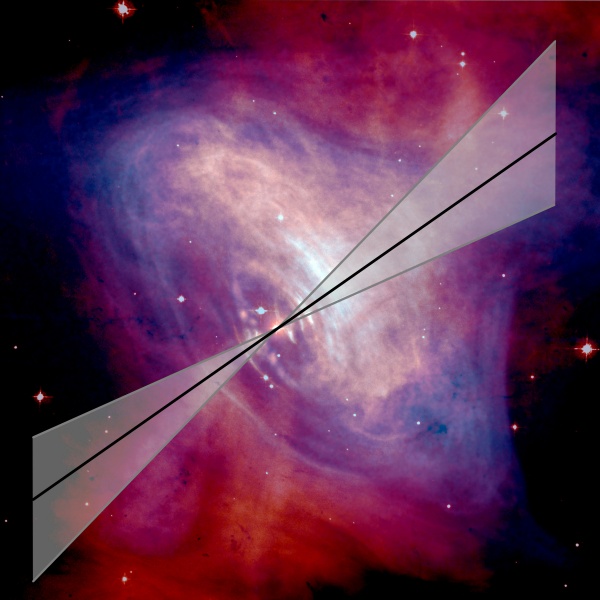
Another piece of the jigsaw in understanding how neutron stars work has been put in place following the discovery by scientists of the origin of the high energy emission from rotation-powered pulsars.

Pulsar systems containing neutron stars accelerate particles to immense energies, typically one hundred times more than the most powerful accelerators on Earth. Scientists are still uncertain exactly how these systems work and where the particles are accelerated.

Now a team of researchers from the UK and Italy, led by Professor Tony Dean of the University of Southampton, has detected polarized gamma-ray emission from the vicinity of the Crab Nebula - one of the most dramatic sights in deep space. By using spectroscopic imaging and measuring the polarization - or the alignment - of the waves of high energy radiation in the gamma-ray band, they have shown that these energetic photons originate close to the pulsar.

If you live in Melbourne, Australia or even Sydney and are concerned that climate change will make your great cities ripe for a cane toad invasion, fear no more.

Yes, that is one of the many doomsday scenarios out there about climate change, but according to research recently published in Ecography by Dr Michael Kearney from the University of Melbourne and collaborators from Australia and the USA, the cane toad’s march will grind to a halt once it is physically too cold for the toads to hop.

Don't be too disappointed. There is still a chance that the LHC will doom the world, likely in December 2012, but it will not be cane toads coming out of black holes to subjugate us, it will be Mayans.

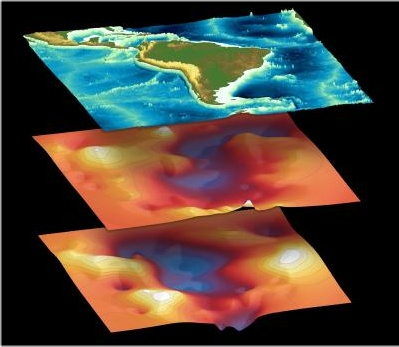
Worldwide, there are between 50 and 70 volcanoes that erupt each year but due to the long gaps between eruptions it is difficult to pin down what triggers volcano behavior.

A team from Durham University and the University of Leeds, studied crystal formations from a volcano in Santorini, Greece, to calculate the timescale between the trigger of volcanic activity and the volcano’s eruption.

These crystals from the lava were able to tell them about the triggers for the volcano, they say, and could help civil defense agencies better prepare in the future.

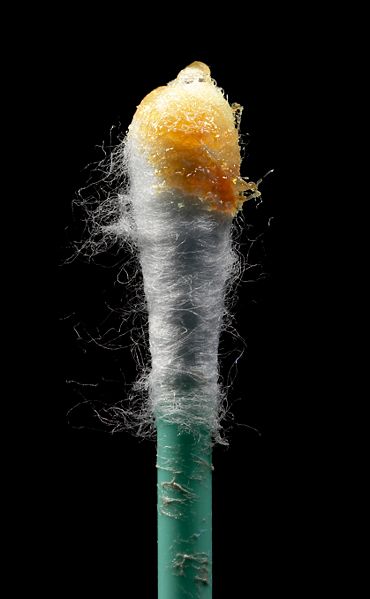
If you use Q-Tips to clean your ears, you may want to read this. And if you use a water pick to clean your ears, you may want to read this too (yes, some people actually use a dental water pick to clean their ears). The guidelines, which will appear as a supplement to the September 2008 issue of Otolaryngology–Head and Neck Surgery, are the first comprehensive clinical guidelines to help health care practitioners identify patients with cerumen impaction. Who knew earwax could be so interesting? But it's still gross.


