Alzheimer’s disease (AD), the most frequent cause of dementia, is a form of amyloidosis. It has been known for a century that dementia, brain atrophy and amyloidosis can be caused by chronic bacterial infections, namely by Treponema pallidum in the atrophic form of general paresis in syphilis. Bacteria and viruses are powerful stimulators of inflammation. It was suggested by Alois Alzheimer and his colleagues a century ago that microorganisms may be contributors in the generation of senile plaques in AD.

A number of chronic diseases are in fact caused by one or more infectious agents - stomach ulcers are caused by Helicobacter pylori while chronic lung disease in newborns and chronic asthma in adults are both caused by Mycoplasmas and Chlamydia pneumonia and some other pathogens have been associated with atherosclerosis.

The realization that pathogens can produce slowly progressive chronic diseases has opened new lines of research into Alzheimer’s disease.

The government in the UK is proposing to change their NHS in response to complaints about waste, delays in treatment and quality concerns.

The new idea is to create 'polyclinics' - general practitioners and specialists in one location. Will it lead to better care or just more cost? The public is against it. Recent data from 1562 patients across 24 Primary Care trusts suggests that only 1 in 10 patients favor the polyclinic model over their current practice.

Michael Dixon, Chair of the NHS Alliance and Stewart Kay, Chair of the Londonwide Local Medical Committees (LMC’s), debated the issue on BMJ.com today - here and here.

An international team of scientists surveying the waters of the continental shelf off the West Coast of North America has discovered for the first time high levels of acidified ocean water within 20 miles of the shoreline, raising concern for marine ecosystems from Canada to Mexico.

Researchers aboard the Wecoma, an Oregon State University research vessel, also discovered that this corrosive, acidified water that is being “upwelled” seasonally from the deeper ocean is probably 50 years old, suggesting that future ocean acidification levels will increase since atmospheric levels of carbon dioxide have increased rapidly over the past half century.

“When the upwelled water was last at the surface, it was exposed to an atmosphere with much lower CO2 (carbon dioxide) levels than today’s,” pointed out Burke Hales, an associate professor in the College of Oceanic and Atmospheric Sciences at Oregon State University and an author on the Science study. “The water that will upwell off the coast in future years already is making its undersea trek toward us, with ever-increasing levels of carbon dioxide and acidity.

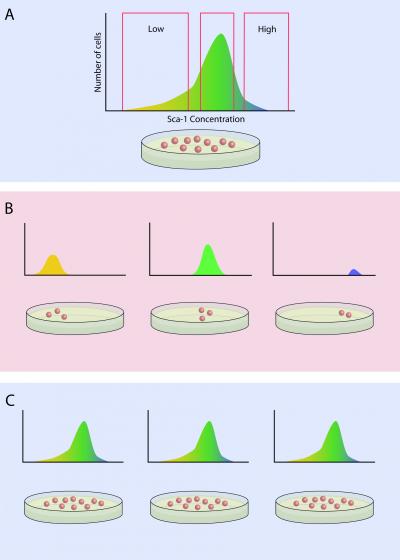
How does a stem cell decide what specialized identity to adopt – or simply to remain a stem cell? A new study suggests that the conventional view, which assumes that cells are “instructed” to progress along prescribed signaling pathways, is too simplistic. Instead, it supports the idea that cells differentiate through the collective behavior of multiple genes in a network that ultimately leads to just a few endpoints – just as a marble on a hilltop can travel a nearly infinite number of downward paths, only to arrive in the same valley.

The findings, published in the May 22 issue of Nature, give a glimpse into how that collective behavior works, and show that cell populations maintain a built-in variability that nature can harness for change under the right conditions. The findings also help explain why the process of differentiating stem cells into specific lineages in the laboratory has been highly inefficient.

Led by Sui Huang, MD, PhD, a Visiting Associate Professor in the Children’s Hospital Boston Vascular Biology Program (now also on the faculty of the University of Calgary), and Hannah Chang, an MD/PhD student in Children’s Vascular Biology Program, the researchers examined how blood stem cells “decide” to become white blood cell progenitors or red blood cell progenitors.
GOMARINGEN, Germany, May 22 /PRNewswire/ --

- RealWORX(TM) Web is the only system to perform both ingress and RF performance monitoring, providing technical staff with the tools to proactively and effectively minimize cable modem and RF Signal quality problems.

SAN DIEGO, May 21 /PRNewswire/ --

- Three Presentations and Four Additional Posters Reinforce Efficacy and Safety Profile of RESOLOR

BOSTON, May 21 /PRNewswire/ --

RISI, the leading information provider for the global forest products industry, today announced the launch of a free weekly email update with top timber industry news headlines. This free email is part of RISI's North American Timber News Service -- the only comprehensive news service dedicated to the North American timber industry. The service will provide subscribers updated news on timberlands and timber markets, as well as corporate, government, trade, transportation and demand issues.

(Logo: http://www.newscom.com/cgi-bin/prnh/20080521/NEW122LOGO )

BEACHWOOD, Ohio, May 21 /PRNewswire/ --

Aleris International, Inc. announced today that Scott A. McKinley was elected Senior Vice President and Controller of the Company.

Mr. McKinley had served as Senior Vice President and Treasurer since September 2006. Prior to joining Aleris, he served as Vice President and Chief Financial Officer for Lubrizol Corporation's Specialty Chemicals Segment. Before that, he was the Vice President and Controller of Noveon, Inc. Mr. McKinley also previously held the position of Director, Financial Planning and Analysis for BF Goodrich Performance Materials and spent the first 15 years of his career at the General Electric Company.

WASHINGTON, May 21 /PRNewswire/ --

Today, the Brazilian Sugarcane Industry Association (UNICA) issued the following statement in response to President Bush's veto of the Farm Bill:

The President's veto of the Farm Bill is an opportunity for Congress to reexamine the 54 cent per gallon secondary import tariff on ethanol. With gasoline and corn prices at record highs and the summer driving season right around the corner, this tariff prevents Americans from recognizing the price savings that increased ethanol imports would bring consumers.

ANTWERP, Belgium, May 21 /PRNewswire/ -- Atlas Copco announced today that it will run a worldwide 'roadshow' for its most energy-efficient oil-injected compressors ever produced, the new GA 90-160 kW range. Its Specific Energy Requirement (SER) is best-in-class, using up to 11% less electricity than the previous GA models. The Atlas Copco GA 160 VSD compressor has broken no less than eight performance records in the industry: in terms of overall energy requirements, energy consumption of individual elements and lifetime of replacement parts. The roadshow will start in Antwerp, Belgium on June 4th and will be followed by events in North America, South America and Asia.

(Photo: http://www.newscom.com/cgi-bin/prnh/20080521/306077 )






