





The other shoe drops. A year ago Atul Gawande wrote in The New Yorker about the Apgar score, a low-tech measurement of newborn viability that led to vast improvements in obstetrics. That’s the “how to improve?” side of things. Now Gawande has written about something equally simple and powerful on the “here’s how to improve” side of medicine: the use of checklists to improve ICU treatment.

Nothing is stranger than telling someone you play guitar and having them respond that you would therefore really enjoy playing "Guitar Hero" on a television.

Wouldn't the time they spent learning an interface and practicing a game have been better spent practicing on an actual guitar?

It would seem. There are some things that are fun to do virtually because obviously we can't do them in real life. In real life a British shoemaker got to put an end to Napoleon's dreams of conquest but I can't go back in time 200 years and learn to make shoes and go to war. Likewise I can't defeat alien Nazis in World War II but ... bowling? I can do that.

Should we drink at least eight glasses of water a day?
Does shaving hair cause it to grow back faster or coarser?
Does reading in dim light ruin your eyesight?
What percentage of our brains do we use?
Do fingernails grow after death?

These and other common medical beliefs were tackled in this week’s Christmas issue of the BMJ.

Researchers in the United States selected seven medical beliefs, espoused by both physicians and members of the general public, for critical review. They then searched for evidence to support or refute each of these claims. The quality of evidence was taken into account and instances in which no evidence supported the claim were noted.

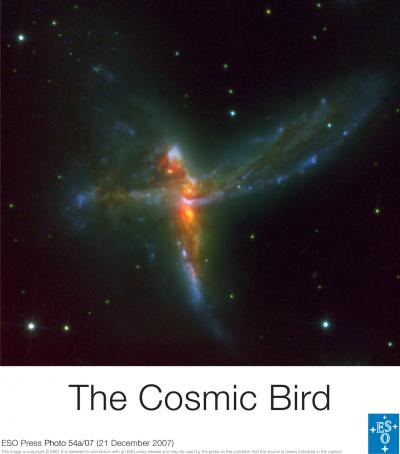
Using ESO's Very Large Telescope, an international team of astronomers [1] has discovered a stunning rare case of a triple merger of galaxies. This system, which astronomers have dubbed 'The Bird' - albeit it also bears resemblance with a cosmic Tinker Bell - is composed of two massive spiral galaxies and a third irregular galaxy.

The galaxy ESO 593-IG 008, or IRAS 19115-2124, was previously merely known as an interacting pair of galaxies at a distance of 650 million light-years.

LONDON, December 21 /PRNewswire/ --

The MS Society has approved funding of approximately GBP3.7 million for new research projects ranging from clinical trials, research into the cause, cure and care of multiple sclerosis (MS) and projects investigating symptom relief for people with MS.

In line with the MS Society Research Strategy, funding was prioritised for two key areas identified by researchers and people affected by MS. These are 'mechanisms of nerve damage, repair and protection' and 'symptom relief research'. The MS Society also awarded grants for research focusing on 'improving MS services'.

LONDON, December 20 /PRNewswire/ --

- Amazon Sites Grows 13% to Reach Highest Ever U.K. Audience

comScore, Inc. (Nasdaq: SCOR), a leader in measuring the digital world, today released its report on the most visited and fastest growing Internet properties in the U.K. for November, based on data from the comScore World Metrix audience measurement service.

Top 10 Properties for November

Not all individuals who have epilepsy respond to traditional treatments and these individuals are said to have medically refractory epilepsy.

Strict use of a ketogenic diet high in fats and extremely low in carbohydrates is sometimes used for treatment of refractory epilepsy, and is effective about half of the time. However, the mechanisms whereby ketogenic diets suppress epileptic symptoms have long been a mystery.

New data generated by Kelvin Yamada and colleagues at the Washington University School of Medicine, St. Louis, has revealed that intranasal delivery of leptin, a hormone important in feeding and energy metabolism, delayed the onset of convulsions in a rodent model of seizures.

New research at York has revealed so-called ‘Jekyll and Hyde’ bacteria, suggesting a novel way to control insect pests without using insecticides.

Researchers at the University of York studied the relationship between plant-dwelling insects and the bacteria that live in them – and discovered an unexpected interaction.

Plants are not ‘easy meat’ for insects. In fact, many insects thrive on plant food only because of the presence of a third party: symbiotic bacteria that live in the insects and provide extra nutrients.

Methane, a potent greenhouse gas, is emitted in great quantities as bubbles from seeps on the ocean floor near Santa Barbara. About half of these bubbles dissolve into the ocean, but the fate of this dissolved methane remains uncertain. Researchers at the University of California, Santa Barbara have discovered that only one percent of this dissolved methane escapes into the air -- good news for the Earth's atmosphere.

Coal Oil Point (COP), one of the world's largest and best studied seep regions, is located along the northern margin of the Santa Barbara Channel. Thousands of seep fields exist in the ocean bottom around the world, according to David Valentine, associate professor of Earth Science at UC Santa Barbara.

The climatic event El Niño, literally “the Baby Jesus”, was given its name because it generally occurs at Christmas time along the Peruvian coasts.

This expression of climatic variability, also called El Niño Southern Oscillation (ENSO), results from a series of interactions between the atmosphere and the tropical ocean. It induces drought in areas that normally receive abundant rain and, conversely, heavy rainfall and floods in usually arid desert zones.

Scientists term this phenomenon a “quasi-cyclic” variation because its periodicity, which varies from 2 to 7 years, shows no regular time pattern. Research conducted over the past 25 years, by oceanographers, climatologists and meteorologists has much improved knowledge on the mechanisms generating an El Niño event.

