



BASEL, Switzerland, December 10 /PRNewswire/ --

- Phase II Results Suggest Avastin Can be Used in Curative Setting Date

Experts attending the 30th San Antonio Breast Cancer Symposium (SABCS) December 13-16, will be amongst the first to hear new data that highlight further advances in the treatment of breast cancer with Avastin, Herceptin, pertuzumab and Xeloda.

GERRARDS CROSS, England, December 10 /PRNewswire/ --

- MORE Study Shows Potential for Vascular Benefits in Addition to BP Lowering with olmesartan

LONDON, December 10 /PRNewswire/ --

- Free service works with a phone call

reQall (http://www.reqall.com) today announced the launch of a free trial service which will help people across Britain remember better. In the run-up to Christmas, the pressure to remember all those little things is greater than ever. From trying to be better organized, to getting things done early, to taking memory pills ... there are many 'foolproof' solutions. Finally there is, and it's free, and it's available to anybody who owns even the most basic mobile phone. reQall is a new service which allows people to record voice notes, reminders or even short conversations, and then be automatically reminded of them, search for them and recall them weeks, months or even years later.

TARRYTOWN, New York, December 10 /PRNewswire/ --

- First Drug Regimen Shown to Prevent AML Relapse

EpiCept Corporation (Nasdaq and OMX Nordic Exchange: EPCT) today released new clinical data that demonstrate a durable improvement in leukemia-free survival (LFS) over five years among Acute Myeloid Leukemia (AML) patients who receive post-consolidation immunotherapy with Ceplene(TM) (histamine dihydrochloride) in conjunction with low dose interleukin-2 (IL-2). These data were presented on December 9th at the 49th Annual Meeting of the American Society of Hematology (ASH) in Atlanta.

(Logo: http://www.newscom.com/cgi-bin/prnh/20020513/NYM112LOGO )

Imagine you are sitting around a campfire. If you move closer to the fire you get hotter. If you move awayy ou get cooler. Pretty basic, right?

Our closest star, the sun, doesn't follow those rules. As you move away from the solar surface, into the sun's outer atmosphere (the corona) it actually gets a lot hotter before it cools off. The solar surface is about 10,000 degrees Fahrenheit, while temperatures in the corona soar to millions of degrees.

Although scientists have some ideas of what might heat the solar corona, there is no universally accepted explanation.

Countering a common theory that human evolution has slowed to a crawl or even stopped in modern humans, a new study examining data from an international genomics project describes the past 40,000 years as a time of supercharged evolutionary change, driven by exponential population growth and cultural shifts.

In a study published in the Dec. 10 issue of the Proceedings of the National Academy of Sciences (PNAS), a team led by UW-Madison anthropologist John Hawks estimates that positive selection just in the past 5,000 years alone — around the period of the Stone Age — has occurred at a rate roughly 100 times higher than any other period of human evolution.

You study the menu at a restaurant and decide to order the steak rather than the salmon. But when the waiter tells you about the lobster special, you decide lobster trumps steak. Without reconsidering the salmon, you place your order—all because of a trait called “transitivity.”

“Transitivity is the hallmark of rational economic choice,” says Camillo Padoa-Schioppa, a postdoctoral researcher in HMS Professor of Neurobiology John Assad’s lab. According to transitivity, if you prefer A to B and B to C, then you ought to prefer A to C. Or, if you prefer lobster to steak, and steak to salmon, then you will prefer lobster to salmon.

Some anti-drinking advertising campaigns may be “catastrophically misconceived” because they play on the entertaining ‘drinking stories’ that young people use to mark their social identity, say researchers who have just completed a three year study of the subject.

Adverts that show drunken incidents, such as being thrown out of a nightclub, being carried home or passing out in a doorway, are often seen by young people as being a typical story of a ‘fun’ night out, rather than as a cautionary tale.

Whilst these adverts, such as Diageo’s thechoiceisyours campaign, imply that being very drunk with friends carries a penalty of social disapproval, for many young people the opposite is often the case.

While the biological basis for homosexuality remains a mystery, a team led by University of Illinois at Chicago researcher David Featherstone has discovered that sexual orientation in fruit flies is controlled by a previously unknown regulator of synapse strength.

Armed with this knowledge, the researchers found they were able to use either genetic manipulation or drugs to turn the flies' homosexual behavior on and off within hours.

Featherstone, associate professor of biological sciences at UIC, and his coworkers discovered a gene in fruit flies they called "genderblind," or GB. A mutation in GB turns flies bisexual.

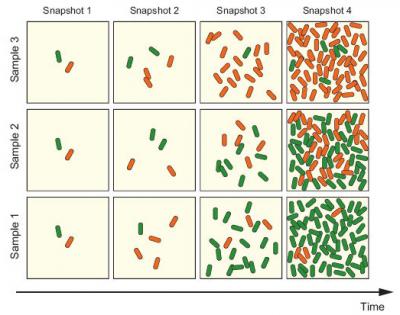
One gene for pea pod color generates green pods while a variant of that gene gives rise to the yellow-pod phenotype, a feature that helped Gregor Mendel, the 19th century Austrian priest and scientist, first describe genetic inheritance. However, many modern-day geneticists are focused on the strange ability of some genes to be expressed spontaneously in either of two possible ways.

In order to better understand this phenomenon of epigenetic multistability, a major complication for Mendelian genetics, scientists at UC San Diego grew virtual bacterial cells in a computer experiment. They created a two-phenotype model system programmed to grow in ways that matched natural growth.

