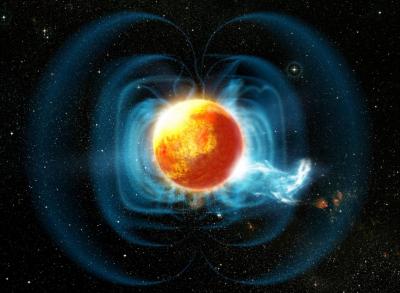





A dwarf star with a surprisingly magnetic personality and a huge hot spot covering half its surface area is showing astronomers that life as a cool dwarf is not necessarily as simple and quiet as they once assumed.

Simultaneous observations made by four of the most powerful Earth- and space-based telescopes revealed an unusually active magnetic field on the ultracool low-mass star TVLM513-46546. A team of astronomers, led by Dr. Edo Berger, a Carnegie-Princeton postdoctoral fellow at Princeton University, is using these observations to explain the flamboyant activity of this M-type dwarf that lies about 35 light-years away in the constellation Boötes.

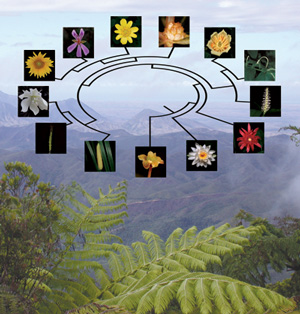
The evolutionary Tree of Life for flowering plants has been revealed using the largest collection of genomic data of these plants to date, report scientists from The University of Texas at Austin and University of Florida.

The scientists, publishing two papers in Proceedings of the National Academy of Sciences this week online, found that the two largest groups of flowering plants, monocots (grasses and their relatives) and eudicots (including sunflowers and tomatoes), are more closely related to each other than to any of the other major lineages.

The Herkules supercomputer is not only powerful, but also kind to the environment. It consumes considerably less electricity than similar supercomputers. In terms of energy efficiency, it occupies a leading position worldwide.

Herkules, the new number-cruncher at the Fraunhofer Institute for Industrial Mathematics ITWM in Kaiserslautern, is not only one of the fastest supercomputers in Germany, but also one of the most efficient.

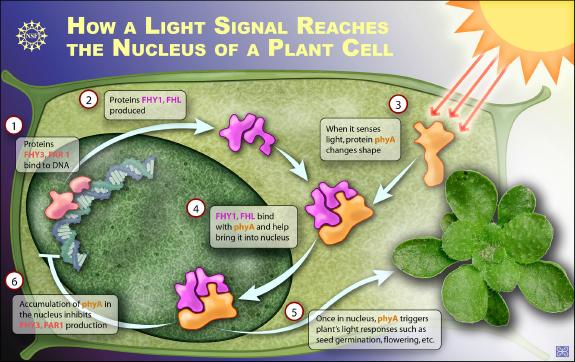
Most of us take it for granted that plants respond to light by growing, flowering and straining towards the light, and we never wonder just how plants manage to do so. But the ordinary, everyday responses of plants to light are deceptively complex, and much about them has long stumped scientists.

Now, a new study "has significantly advanced our understanding of how plant responses to light are regulated, and perhaps even how such responses evolved," says Michael Mishkind, a program director at the National Science Foundation (NSF).

The belief among some archaeologists that Europeans introduced alcohol to the Indians of the American Southwest may be faulty.

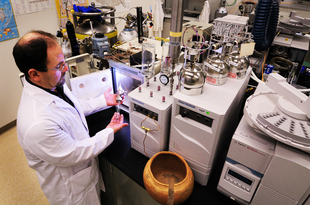
Ancient and modern pot sherds collected by New Mexico state archeologist Glenna Dean, in conjunction with analyses by Sandia National Laboratories researcher Ted Borek, open the possibility that food or beverages made from fermenting corn were consumed by native inhabitants centuries before the Spanish arrived.

Taking oral contraceptives can lower a young women’s bone density according to research by LMU Professor of Natural Science Hawley Almstedt and Oregon State University Professor of Natural Science Christine M. Snow.

This is the first study to analyze 18-25 year old women oral contraceptives and bone density. It is critical for women to develop strong bone mass during their adolescence. Although women’s peak bone development occurs at the age of 16, women’s bones are still developing during their late teens and early twenties.

People with high blood pressure may find relief from Transcendental Meditation, a controversial alternative to medicine promoted by the Maharishi University of Management in Iowa, where some of the co-authors sell their techniques.

Their meta-analysis was 107 published studies on stress reduction programs and high blood pressure and published in the December issue of Current Hypertension Reports.

A new study from the Journal of Consumer Research suggests that the presence of other people may enhance our movie-watching experiences. Over the course of the film, movie-watchers influence one another and gradually synchronize their emotional responses. This mutual mimicry also affects each participant’s evaluation of the overall experience – the more in sync we are with the people around us, the more we like the movie.

“When asked how much they had liked the film, participants reported higher ratings the more their assessments lined up with the other person,” explain Suresh Ramanathan and Ann L. McGill (both of the University of Chicago). “By mimicking expressions, people catch each other’s moods leading to a shared emotional experience.

Prominent claims from observational studies of the cardiovascular benefits of vitamin E often continue to be supported in medical literature despite strong contradictory evidence from randomized trials, according to a study in the December 5 issue of JAMA.

Similar findings were found for claims regarding the protective effects of beta-carotene on cancer and estrogen on Alzheimer disease.

“Some research findings that have received wide attention in the scientific community, as proven by the high citation counts of the respective articles, are eventually contradicted by subsequent evidence. A number of such high-profile contradictions pertain to differences between nonrandomized and randomized studies,” the authors write.

The journal Experimental Mathematics, started in 1992, publishes “formal results inspired by experimentation, conjectures suggested by experiments, descriptions of algorithms and software for mathematical exploration, [and] surveys of areas of mathematics from the experimental point of view.” The founder wanted to make clearer and give more credit to an important way that mathematicians come up with new ideas. As the journal’s statement of philosophy puts it, “Experiment has always been, and increasingly is, an important method of mathematical discovery.

