




Do cats adjust their behavior to what works to get what they want or do they nag humans until people begin to respond in more agreeable ways?

Some cat owners, and probably most dog owners, might argue that cats engage in the latter and when it seems like the former it is just a lucky meeting of personalities. A new study in Animal Cognition finds they 'read the room' better than expected.

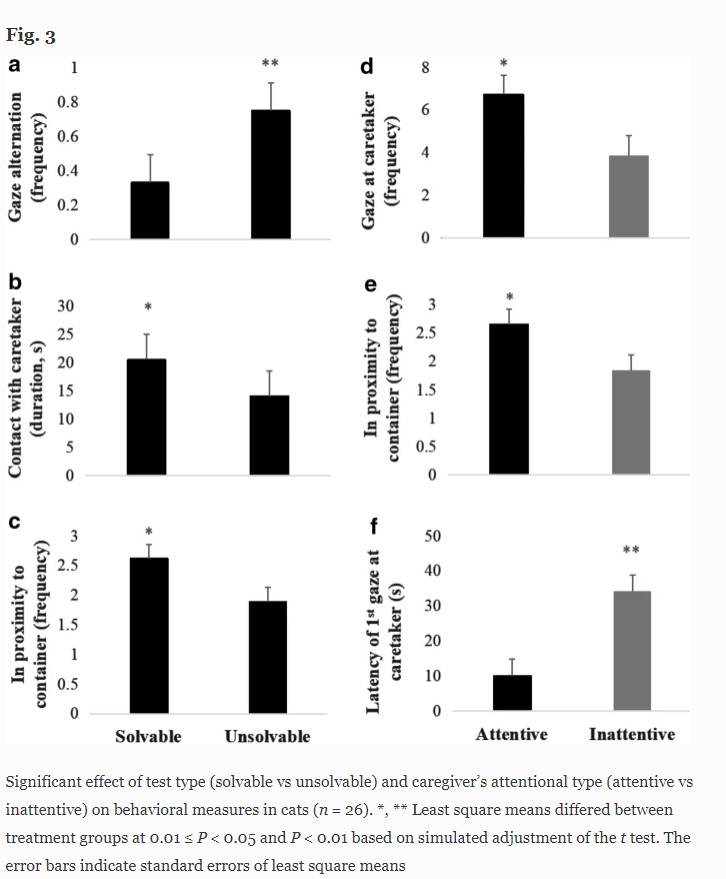
Cats were presented with a solvable task (an easily accessible treat in a container with a loose lid) and an unsolvable task (a treat in a closed container) in the presence of either an attentive or inattentive caregiver.
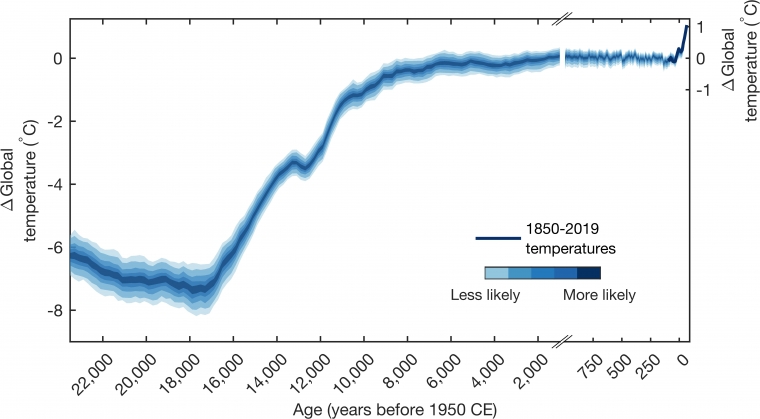
For the last 10,000 years the earth has been in a warming cycle. The latest ice age ended around that time, a recurring phenomenon in nature where 90,000 of every 100,000 years were ice ages.

How warm has it gotten compared to other warming bursts since the last ice age ended? A lot. Maps of global temperature changes for every 200-year interval going back 24,000 years finds that the magnitude and rate warming over the last 150 years far surpasses the magnitude and rate of changes over the rest of the period - including when we were leaving an ice age.

As the crown jewel of Henry VIII’s, its flagship, the Mary Rose, patrolled the Atlantic with her heavy cannons for 34 years. It then spend 437 more buried beneath the turbulent English Channel before being recovered and placed on display at the Mary Rose Museum in Portsmouth, England. 

The Mary Rose sank during a naval battle with France in 1543 and was excavated in 1982, along with 19,000 objects from the Tudor period. There remains one thing the 510-year-old English warship can't defeat; nature.
In 1958, shortly after passage of a misguided law related to chemicals and food - a problem that haunts trust in science like vaccines even today - America got its first government-created chemophobia craze. In cranberries.

The poorly worded Delaney Clause specified that any trace of an artificial chemical that had been linked to cancer - even if it was just epidemiological correlation or in a mouse and regardless of dose - had to be pulled from shelves. It was bizarre because the actual chemical did not matter, a natural version of the same chemical at 100X the dose was considered okay, it only mattered that it was artificial.(1)

Many physics students would tell you immediately off the bat what Newton's Third Law of Motion states.

Even at prescription strength doses, purified omega-3 fatty acid did not reduce incidents of hospitalizations and/or deaths among people with COVID-19, according to results from Scientific Sessions 2021. 
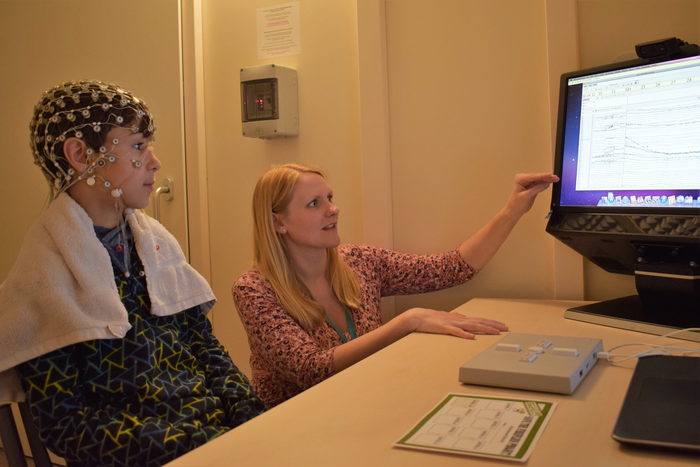
Dyslexia is well-known to impact reading ability but it has been unclear which brain processes are affected by the condition. Whether dyslexia is, at its core, a visual processing disorder is hotly debated among researchers. With reading and writing a key challenge among children with dyslexia, increasing understanding of its effects on the brain might improve existing interventions. 
Anti-vaccine sentiment is not new but from the 1950s until the late 1990s it was isolated small pockets of deniers. With claims that MMR vaccines, and then preservatives in vaccines, caused autism, the west coast of America became overrun with vaccine denial. In 2021, anti-vaccine sentiment switched to middle America with COVID-19. 

The names change but health disinformation remains the same, as are ways to combat it. A recent study looked at combating typhoid misinformation in Sierra Leone and found that explicitly addressing falsehoods seems more effective in busting misbeliefs than simply stating scientific facts.
What do Taylor Swift, the Jonas brothers, and Miley Cyrus share in common? They're all great musicians and nice people. They were also home schooled. 

A new study examining how homeschooling affected adolescents’ character, health and well-being found that adolescents who are homeschooled are more likely to report greater character strengths and fewer risky health behaviors later in life, but are less likely to attain a college degree. 
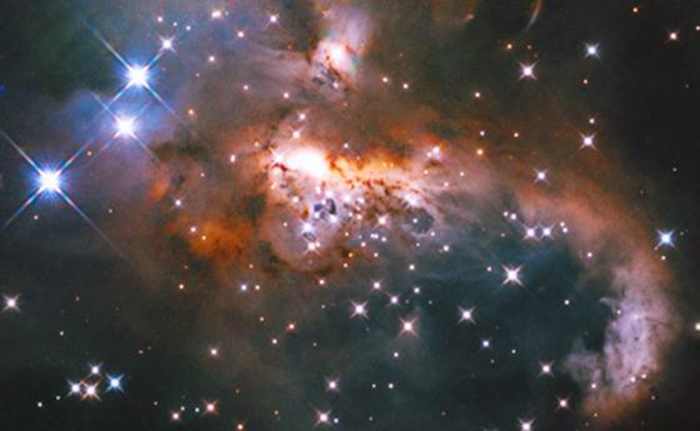
Over 6,000 light-years away from earth, in the constellation Puppis in the southern sky, is an emission nebula.

Emission nebulae are diffuse clouds of gas that have become so charged by the energy of nearby massive stars that they glow with their own light. The radiation from these massive stars strips electrons from the nebula’s hydrogen atoms - ionization. As the energized electrons revert from their higher-energy state to a lower-energy state, they emit energy in the form of light, causing the nebula’s gas to glow.

