




Did you even know there was a discipline called paleomagnetics?   Probably not.(1)   It isn't easy to find a category on this site to put it in, that's for sure.

But a discipline it is and it even has its own controversies, as all science must; namely, the nature of Earth's magnetic field 1.1 billion years ago.

The Earth's magnetic field in two sentences:   it wraps around the globe and helps shield us from cosmic rays - lest we all burst into flame or turn into orange rock and say things like, "It's clobberin' time!"  

fantastic four cosmic rays magnetic core
Ever play games in school?  Ever have the teacher suggest you play games?  Heck, ever had your entire middle and high school curricula be designed around games?   In a news piece titled "New York Launches Public School Curriculum on Playing Games", reporter Jeremy Hsu writes:
After wrapping up the minutiae of funding, we're finally entering the lab for Project Calliope.  Next week, I get to build a model ionosphere and replicate a spinning satellite to test what sort of music to expect.

In practice, this means rigging up a magnet to replicate ionospheric magnetic fields, putting a strobe for mimicking the Sun as seen by a rapidly spinning satellite, then seeing what sort of data my detectors spit out.

The science of Chaos is usually defined as the systematic study of non-linear processes within dynamic turbulent systems (see www.hesiodproject.net). Vivid examples of such systems are: the global economy and the global crisis, wars and armed conflicts, human beings and social organizations, the stock market, science and technology, the Olympic Games, football games an

Everyday use of a mathematical concept

The concept of probability is not alien to even the least mathematically versed among us: even those who do not remember the basic math they had in primary schools use it currently in their daily reasoning. I find the liberal use of the word "probability" (and derivates) in common language interesting, for two reasons. One, because the word has in fact a very definite mathematical connotation. And two, because the word is often used to discuss the knowledge of a system's evolution in time without a clear notion of which, among either of two strikingly different sources, is the cause of our partial or total ignorance.
The diagnosis of mental health disorders in the US has nearly doubled in the past 20 years and clinical psychologists and therapists are on the front lines of handling it but many are falling short because they use methods that are out of date or lack any scientific rigor or both.

How is that possible?   Because many of the training programs, and especially some Doctorate of Psychology (PsyD) programs and for-profit training centers, are not grounded in science, according to a new report in Psychological Science in the Public Interest.
Mind over matter. Think happy thoughts. Don't worry be happy. Accentuate the positive.

Is happiness really that simple?

Sure, it's easy to say, "Think positively." But to actually do it? Not so much.1 We spend bazillions of dollars trying to buy happiness and yet somehow we're not satisfied.2 I don't have any money left to spend, so my options are (a) a life of misery and despair, or (b) find a cheaper alternative.

The Coldplay Proof, and searching the InterGoogle
In the first article, we explored the determinism of the brain and considered that within the constraints of brain physiology it is clear that random or indeterminate processes cannot be responsible for behavior.  Every action can be traced back to a cause, so it would seem that complete determinism is a fundamental aspect of our normal brain's operation.
Tomorrow's Science will be a special issue reporting tons of new information on the fossil hominid Ardipithecus ramidus ("Ardi"), which is really exciting (though not as much as Darwinius, which was "like a meteor hitting the Earth" or whatever).


Is 'dark energy', the mysterious unidentified thing that would be a nice explanation for a lot of universal questions, physics or religion?  Maybe baryon oscillations can tell us.  

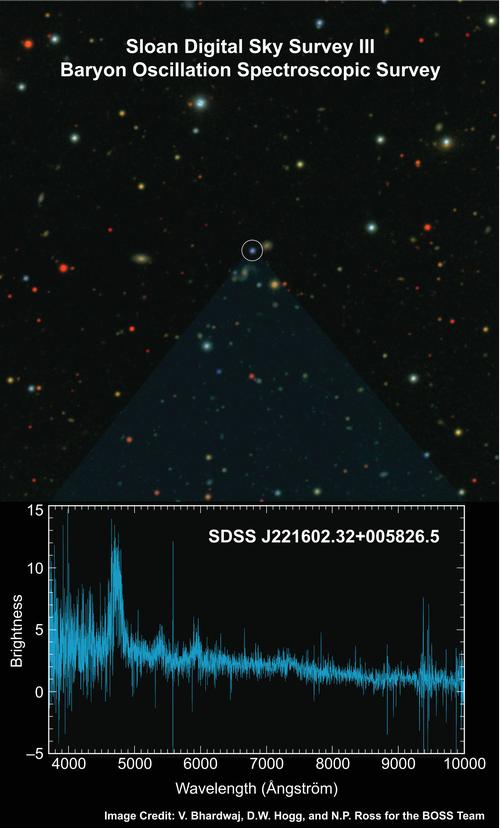
Baryon oscillations began when pressure waves travelled through the early universe.   An ambitious attempt to trace the history of the universe, called the Baryon Oscillation Spectroscopic Survey (BOSS),  has seen first light.  BOSS, a part of the Sloan Digital Sky Survey III (SDSS-III), took its first astronomical data on the night of September 14th.

