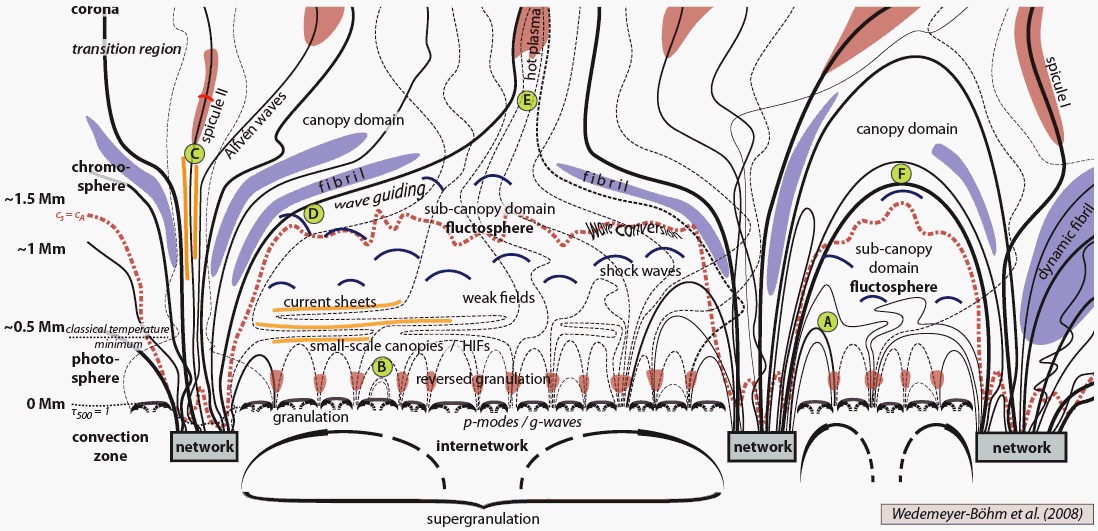







The mystery of the solar corona may be resolved.  ScientificBlogging has covered this, as did space.com, Space Fellowship, and other sites.  Two of them couldn't resist the same money quote, too:
"Why is the sun's corona so darned hot?" said study member

James Klimchuk of NASA's Goddard Space Flight Center in Greenbelt, MD.
Why is this useful?
A few days ago a local skeptic group here in Brooklyn organized a roundtable discussion on the concept of the paranormal. We thought this was going to be a chat about what people mean by that term, how one goes about investigating alleged cases of paranormal happenings, and so on.

We were in for a surprise. Turns out that a couple of real believers in the ghosts and the afterlife showed up, a somewhat rare opportunity to sit down with “the other side” and have a probing conversation to find out about what brings people to believe weird things.
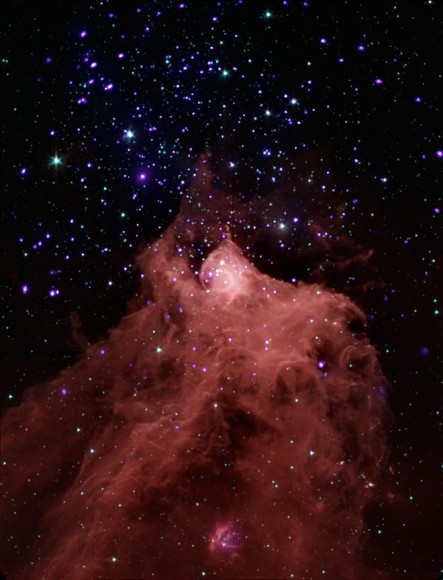
Ptolemy's 20 century-old constellation, Cepheus, seems to have been reserved for long hours of star gazing by astronomers with all levels of experience - especially after it was declared the best yet model for studying the star formation process. Its close, its exciting, its inspiring, and its forming (the last one's most important: a star is forming).

The Cepheus B region, lying in the Cepheus constellation in the Cave Nebula (aka Caldwell 9) near the M52 galaxy, has apparently begun a star-formation process owing to - much to the schock of many astronomers - a radiation nudge (if I may call it so) by a massive star just outside the region's molecular cloud.
Framing alternative energy in terms of lives saved can be risky business.   People die ... thousands from guns, tens of thousands from cars and a lot more than that from malpractice.

In the 700,000 employees in the US energy sector, 130 can be saved by switching to renewable energy, according to a commentary by Medical College of Wisconsin researchers in the August 19, 2009, Journal of the American Medical Association
It is estimated that at least 10 percent of the population may be tone deaf – unable to sing in tune.  A new finding identifies a particular brain circuit that appears to be absent in these individuals.

Nerve fibers in the neural "highway" called the arcuate fasciculus that link perception and motor regions of the brain are disconnected in tone-deaf people, according to new research in The Journal of Neuroscience.

Turns out that Dr. Scholl's Freeze Away doesn't work on worry-warts.  So for many people, personality traits like chronic worrying can lead to earlier death, at least in part because these people are more likely to engage in unhealthy behaviors, such as smoking, according to research from Purdue University.

"Research shows that higher levels of neuroticism can lead to earlier mortality, and we wanted to know why," said Daniel K. Mroczek, (pronounced Mro-ZAK) a professor of child development and family studies. "We found that having worrying tendencies or being the kind of person who stresses easily is likely to lead to bad behaviors like smoking and, therefore, raise the mortality rate.

How's this for something new: instead of a steel dental pick poking and prodding around your teeth at you next dentist appointment, imagine a laser doing all that work pain-free.

Thanks to a group of researchers in Australia and Taiwan, this may be possible. They have developed a new way to analyze the health of human teeth using lasers. As described in Optics Express, by measuring how the surface of a tooth responds to laser-generated ultrasound, they can evaluate the mineral content of tooth enamel -- the semi-translucent outer layer of a tooth that protects the underlying dentin.

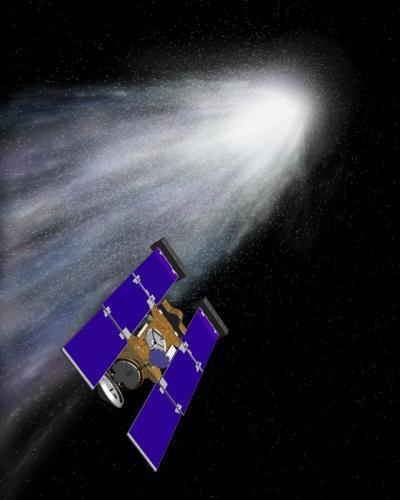
NASA scientists have discovered glycine, a fundamental building block of life, in samples of comet Wild 2 returned by NASA's Stardust spacecraft.

"Glycine is an amino acid used by living organisms to make proteins, and this is the first time an amino acid has been found in a comet," said Dr. Jamie Elsila of NASA's Goddard Space Flight Center in Greenbelt, Md. "Our discovery supports the theory that some of life's ingredients formed in space and were delivered to Earth long ago by meteorite and comet impacts."

A University of Texas Health Science Center at Houston study suggests that ancient Chinese herbal formulas used primarily for cardiovascular indications including heart disease may produce large amounts of artery-widening nitric oxide.

Nitric oxide is crucial to the cardiovascular system because it signals the inner walls of blood vessels to relax, which facilitates the flow of blood through the heart and circulatory system. The messenger molecule also eliminates dangerous clots, lowers high blood pressure and reduces artery-clogging plaque formation.
There's great news for movie lovers.   That popcorn slathered in butter at the movie theater may be only mostly bad for you.

Snack foods like popcorn and many popular breakfast cereals contain "surprisingly large" amounts of healthful antioxidant substances called polyphenols, said chemist Joe Vinson, Ph.D., who headed a new study and presented the results at the ACS meeting today.

Polyphenols are one reason why fruits, vegetables and foods like chocolate, wine, coffee, and tea have become renowned for their potential role in reducing the risk of heart disease, cancer, and other diseases.

