As you might imagine, I get a lot of press releases. As I have said here before, I like getting them because it's difficult for me to know all the good things happening out there, especially if an organization lacks the budget to hire an expensive PR firm. A little proactive work helps get your message out.
Hitler's gift to astronomy? What?
Believe it or not, Hitler wanted to give Mussolini and Rome a planetarium*. Rome was
among the first in the world to build a planetarium. Italy (and Mussolini) had already taken a planetarium as part of the 'compensation' for the damage Germany did to Italy in WW1 and opened the first Roman planetarium already in 1928.
It is the most peculiar story, so much so that I feel compelled to tell, however little, what I know about this hidden treasure of planetarium history...
Until recently, I had only known of Thomas Carlyle as a writer, mightily significant in the 19th century, but somehow superannuated by the time I heard of him. However, recently I learnt that he is responsible for that famous English mis-definition:
A straight line is the shortest distance between two points.
which he gave us while translating the Eléments de géométrie of
Legendre. The great French mathematician actually wrote
"La ligne droit est le plus court chemin d'un point à un autre."
There's this little company you may have heard of called GE. Yeah, it's the one Edison started and I don't know where you come down in the whole Westinghouse/Edison fight but one of those guys screwed Tesla and one did not, so I am inclined to like Westinghouse more than Edison even though GE stock obviously did much better.
Hey, I can stick with my principles and still make some money.
But GE has earned my respect, not because of Jack Welch (though he earned my respect, mostly by making the stock a gold mine and despite being a part of that annoying Six Sigma crap that has been foisted off on MBAs since the 1990s) but because they made smart grids seem kind of cool.
What are smart grids?
It's easy for Arizona residents to hope for widespread solar power usage - they don't have to think about the thousands of miles of new power lines on land that will be grabbed under eminent domain.
And you'd think hockey stick analogies regarding climate issues would be bad, since the most famous one turned out to be made up.
But University of Arizona postdoctoral electrochemist Erin Ratcliff can't resist. She says solar power is ready to take off. "We're right at the magic moment when the hockey stick starts to take off, when you go from flat to hockey stick. We're right there. It's exciting to read the literature and hope that, yes, we will take off. It will be exciting to look back and say 'I was there for that.'"
HD 87643, a member of the exotic class of B[e] stars, is in a very rich field of stars towards the Carina (the Keel) arm of the Milky Way. It recently became part of a set of observations that provide astronomers with the best ever picture of a B[e] star.
B[e] stars are stars of spectral type B, with emission lines in their spectra, hence the "e". They are surrounded by a large amount of dust.
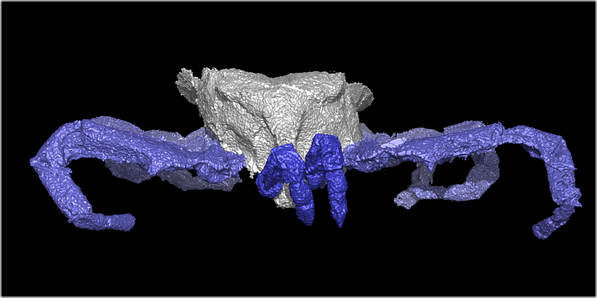
Scientists at Imperial College London have created detailed 3D computer models of two fossilized specimens of ancient creatures called
Cryptomartus hindi and
Eophrynus prestvicii that lived around 300 million years ago and are closely related to modern-day spiders. The study reveals some of the physical traits that helped them to hunt for prey and evade predators.
The researchers created their images by using a CT scanning device, which enabled them to take 3,000 x-rays of each fossil. These x-rays were then compiled into precise 3D models, using custom-designed software.
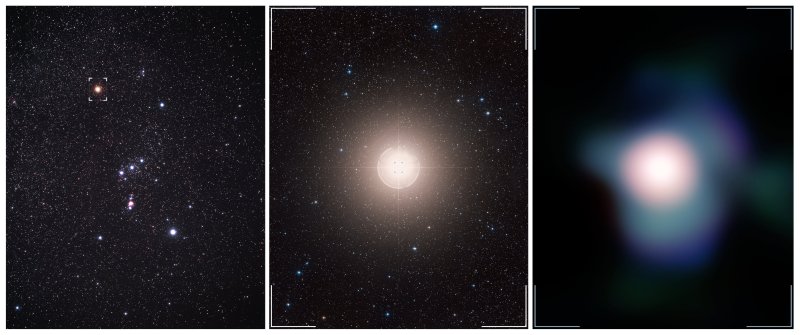
Betelgeuse, the second brightest star in the constellation of Orion (the Hunter), is a red supergiant, one of the biggest stars known, and almost 1,000 times larger than our Sun.
To put that in perspective, if Betelgeuse were at the center of our Solar System it would extend out almost to the orbit of Jupiter, engulfing Mercury, Venus, Earth, Mars and the main asteroid belt.
The world's environment ministers, government officials, diplomats and campaigners are preparing for the biggest poker game of their lives - the COP15 conference in Copenhagen in December 2009.
It's one of the most complicated political deals the world has ever seen but third world countries are holding the cards.
In Environmental Research Letters, the paper 'Tripping Points: Barriers and Bargaining Chips on the Road to Copenhagen' lays bare the main tripping points – those political barriers and bargaining chips – which need to be overcome for countries to reach a consensus on how to address global climate change.
CO2 reduction targets can be met with affordability. An EPRI report released this week concludes affordability requires a "full portfolio" of electricity sector technologies. Diverse generation "could simultaneously address the challenge of growing load demand while meeting carbon constraints and limiting increases in the cost of electricity."



_0.jpg "The Shortest Distance?")