





Where there is cigarette smoking there is probably misuse of alcohol too, according to a study by Yale School of Medicine researchers in the Archives of Internal Medicine.

"This means cigarette smoking status can be used as a clinical indicator for alcohol misuse, which presents an opportunity for intervention," said the principal investigator, Sherry McKee, assistant professor of psychiatry.

Penn State researchers will soon provide he first demonstration of a fundamentally new method for measuring a particular quantum property of individual atoms. "This method allows us to directly and precisely measure the phase shifts that result when ultracold atoms collide, in a way that is independent of the accuracy-limiting density of the atoms," says Kurt Gibble, an associate professor of physics and principal investigator of the Penn State University research team that developed the method.


Schematic of the Experiment. We collide a clock atom with atoms in another state (labeled |4, 4>).

Turning a greenhouse gas into a clean energy fuel is the Holy Grail of energy research. UC San Diego chemists have a prototype they think is an important milestone.

Their device captures energy from the sun, converts it to electrical energy and "splits" carbon dioxide into carbon monoxide (CO) and oxygen.

Obviously carbon monoxide in and of itself is not great either but millions of pounds of it are used each year to manufacture chemicals including detergents and plastics. It can also be converted into liquid fuel.

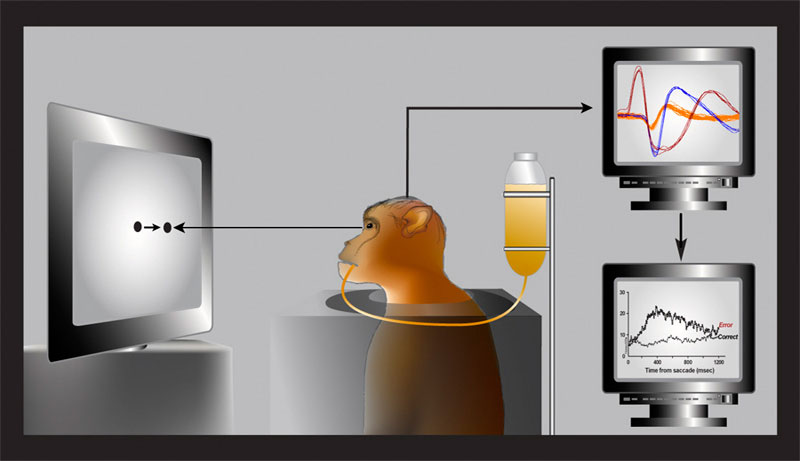
In the children’s game "red light green light," winners are able to stop, and take off running again, more quickly than their comrades. New research reveals that a similar race goes on in our brains, with impulse control being the big winner.

"The research provides new insights into how the brain controls movements, which helps explain the impulsivity of people with attention deficit and hyperactivity disorder," study co-author Jeffrey Schall, E. Bronson Professor of Neuroscience at Vanderbilt University, said.

Scientists using one of the nation's newest and most capable research aircraft are launching a far-reaching field project this month to study plumes of airborne dust and pollutants that originate in Asia and journey to North America. The plumes are among the largest such events on Earth, so great in scope that scientists believe they might affect clouds and weather across thousands of miles while interacting with the sun's radiation and playing a role in global climate.

Often people say they are good at one subject but worse at the other. For instance one claims to be good at math, but not so good at english. It is a dividing line in the way people think about how they learn, i.e. an identity construct like anything else.

Both english and math are simply systems of abstractions "algorythmytized" by the brain. They are two sides of the same coin. Ultimately the purpose behind learning either subject, is to give you a special nichefied edge in being social with these concepts. The real value of learning anything comes mechanistically from being able to talk about it with other people.

Researchers have discovered that the genetic malfunction that causes a form of mental retardation called Noonan Syndrome (NS) produces an imbalance in the genesis of two types of cells in the developing embryonic brain. This imbalance, they theorize, could explain how the genetic abnormality gives rise to the neural pathology of the disorder. More broadly, they said, the new insight into the mechanism underlying NS could apply to other inherited forms of retardation.

Marvin Chun of Yale University and colleagues have pinpointed brain regions critical to one of the brain’s more remarkable feats — piecing together a continuous view of the world by integrating snippets of visual input from constantly moving eyes.

Since the eyeball has only a narrow field of clear view, it must continually make tiny shifts to sample the visual world. And during these shifts, which last thousandths of a second, people are essentially blind.

Despite the fact that they both infect the liver, the hepatitis A and hepatitis C viruses actually have very little in common. The two are far apart genetically, are transmitted differently, and produce very different diseases. Hepatitis A spreads through the consumption of fecal particles from an infected person (in pollution-contaminated food or water, for example), but hepatitis C is generally transmitted only by direct contact with infected blood. Hepatitis A produces fever, nausea and abdominal pain that can last for weeks, but rarely lead to death; hepatitis C, by contrast, often spends decades quietly damaging the liver, until a victim’s only hope for survival is an organ transplant.

This device, called HeartLander, can be inserted using minimally invasive keyhole surgery. Once in place, it will attach itself to the heart and begin inching its way across the outside of the organ, injecting drugs or attaching medical devices. In tests on live pigs, the HeartLander has fitted pacemaker leads and injected dye into the heart.

