



I just finished watching the Women's World Cup semifinal football match, USA versus France, and am currently preparing to watch Japan versus Sweden and an important difference is immediately noticeable about womens' matches compared to men's.

A lot less flopping.

If you are not up on complex technical sports jargon, flopping is when, after a minor collision, you fall down and grasp a body part with a look of excruciating pain on your face, milk the drama to see if it draws a penalty and then look indignantly at the opposing team while you bravely resume as if nothing was wrong.   If you don't watch soccer, think NBA.
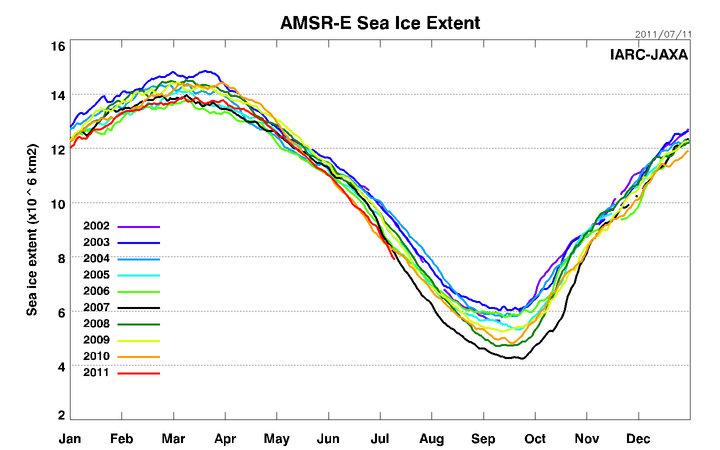
Arctic Ice July 2011

For much of the written history of the Arctic, exceptional extents of open water were reported in terms of what the explorer, fisherman, whaler or sealer had previously experienced.  That would make such events likely every 20 to 30 years.  However, for each report of open ice in a specific area there is likely to be found in the archives a report from 180 degrees opposite across the pole of a greater than usual ice extent.
Goodbye Tuna?

Goodbye Tuna?

Jul 13 2011 | comment(s)

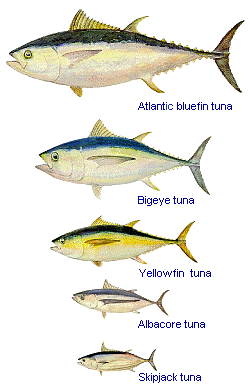
Recently, all species of scombrids and billfish have been assessed by the IUCN to determine their ranking on the Red List of Threatened Species. And for tuna specifically, the results weren't good at all. Five of eight species aren't doing well.

Critically endangered: Southern Bluefin (Thunnus maccoyii).
Endangered: Atlantic Bluefin (T. thynnus).
Vulnerable: Bigeye (T. obesus)
Near threatened: Yellowfin (T. albacares), Albacore (T. alalunga).


I was waiting for the announcement in the Fermilab seminar of next Friday, but apparently despite I am still a member I am not well enough informed of what happens inside CDF, the experiment at the Tevatron proton-antiproton collider of Fermilab. So the paper is now public, and you can read the news in the Cornell arxiv: CDF sees an excess of muon pairs which is compatible with originating from the decay of B_s mesons.
There were concerns among people who don't understand physics that the LHC might create a black hole and swallow the Earth.    Obviously in an infinite Universe anything can happen but the precautionary principle taken to such extremes is really only used by groups like anti-environment crusaders, pro-environment crusaders and also anti-vaccine people, etc.  In reality, the energy couldn't kill a fly (see Shut Down The LHC? I'd Rather Not Hurt A Fly).

Niko Alm has after a three year wait finally gotten permission to wear his religious head covering in his driver license photo - progress for religious freedom everywhere.


In Austria, a license or ID photo cannot show the person with her head covered, except if the person is religious, in which case law and order are not so important. Niko Alm, an entrepreneur and blogger, belongs to the holy church of the Flying Spaghetti Monster, which is the one and only true god, praise it and kill all infidels. Niko cannot possibly ascent to the one true Italian-mushroom sauce heaven if his driver license would show him naked. A pasta sieve must be worn.

Must be a zeitgeist thing.  Our own Ground Station Calliope kickstarter fundraiser succeeded, to help fund our Science 2.0 Project Calliope.  Now the NY Times is reporting that other scientists have also been using kickstarter to fund science.  They cite missions in the $4-15K range, and give it the catchy term 'substitutional funding'.
Julian Barbour is an independent theoretical physicist who has gained some attention of late. Minkowski is dead. From my soapbox here, I will channel Minkowski in this gentlemen’s disagreement. Links to Julian’s work will be provided, they are worthy of your time. Nothing I say against Barbour’s ideas are personal, they are all technical in nature, as is my way. I have a bullet with “The Nature of Time” written on it. At this moment, I am not sure if it will kill the paper. I will have to find out and report the result at the end of this blog.
I don’t care how long (or short) of a time you’ve spent lounging in the Stanford bubble. If you haven’t popped out yet to see a sea otter, I have an assignment for you: Drop everything and get to the coast. Charismatic fur balls await.

Today, sea otters are the poster children of cuddle appeal, but their endearing behaviors were lost on the fur hunters of the 1800s. Otter fur lined jackets (and the fur trade lined pockets), but soon otters no longer lined the Pacific Coast.

The sea otter, however, is a “keystone species” — its impact on our coastal ecosystems is disproportionately large compared to its natural abundance in the marine community — so its removal had profound effects that we only noticed recently, as the otter staged a dramatic return over the last 70 years.

Researchers are reporting the construction of what they term "artificial molecules" and say they can use the technology to engineer a new generation of nanomaterials that control and direct the energy absorbed from light.

Including an antenna that can build itself.

Traditional antennas increase the amount of an electromagnetic wave – such as a radio frequency – that is absorbed, and then funnel that energy to a circuit. These nanoantennas instead increased the amount of light that is absorbed and funneled it to a single site within their molecule-like complexes. This concept is already used in nature in light harvesting antennas, constituents of leaves that make photosynthesis efficient.

