





Songbirds have been used in the past to examine the precursor functions to human language in our neural circuitry, but they may be capable of much more than being animal models. 

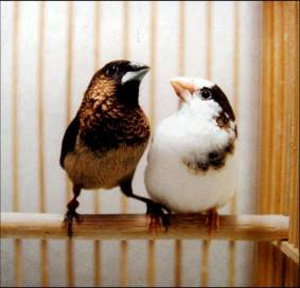
A new study shows the Bengalese finch (Lonchura striata var. domestica) can learn the rules of an artificial grammar system - hierarchical language structure has been previously thought to be specific only to humans.
The common refrain when climate science detractors point out the flaws in numerical models is that, if no one is sure of the accuracy, the risks are being exaggerated.

It could be the opposite.   Numerical models could be giving us a false sense of security, a belief that we have plenty of time to fix pollution issues.   

Writing in Nature Geoscience, Paul Valdes from the University of Bristol School of Geographical Sciences, discusses four examples of abrupt climate change 'tipping points' over the last 55.8 million years that have been reconstructed from palaeoclimate data and states that the level of inaccuracy could be too comforting. 
A fairly new method in genetic research, known as optogenetics (selected as Method of the Year in 2010 by Nature Methods, see video for a great explanation), uses light to control gene expression. Now, researchers form EHT Zürich have engineered human cells (implanted in mice) so that the expression of a gene that plays a role in diabetes can be controlled by light. Instead of creating a whole new genetic network, they combined existing signal pathways, one from the immune system, and one from the eye.


It's rare that you will find me arguing for gender quotas.   Obviously I am not for discrimination but, at least in science, mandating representation - which is discrimination against the qualified in the interests of sex organs - does not lead to better science, it leads to equality at the expense of excellence.

Economics, however, is not science and some mandated equality might help.  Science says so.

This recent Nature article makes people jump up and down in classical, non-quantum jumps as we speak: “Experimental non-classicality of an indivisible quantum system”.

There are plenty of misleading news articles already, including here on Science2.0, about that this experiment is disproving classicality without even needing “spooky action at a distance” or entanglement. The message one often takes away is therefore that this new experiment may be the best proof yet, the most convenient disprove of hidden variables.

Now we come to the second part of the series

Botany: A Blooming History


entitled

One of the nice things about studying a big charismatic animal, like the Humboldt squid, is that you don't have to convince anyone that your science is cool. People are already interested in your science as soon as you tell them what you study. Journalists want to interview you; filmmakers want to video your animal.

Unfortunately, that last item can turn into one of the not-so-nice things. Filmmakers tend to be on a pretty tight schedule, so sometimes you'll get a call like, "We're going out on a boat on October 12th--can you find squid for us?"
Quantum entanglement was strange when it was conceptualized.   It violated Einstein's famous speed limit in his Theory of Relativity and he called it spukhafte Fernwirkung - “spooky action at a distance” and sought to note the flaws in Heisenberg's uncertainty principle and the Copenhagen interpretation.   The result was the Einstein–Podolsky–Rosen paradox.

I hope you didn't see my first-to-worst performance in last night's hotties vs. nerds edition of ABC's WIPEOUT. If you did, you know what happened: after winning the round of 24 by almost a minute and then winning the round of 12 by the equivalent of a furlong, I got stuck in the round of six trying one element over and over -- the wrong way -- as people I had beaten in the first two rounds passed and eventually eliminated me.

Nuts--'twas a very good shot at $50k that my family of four surviving on my writer's salary could've used.

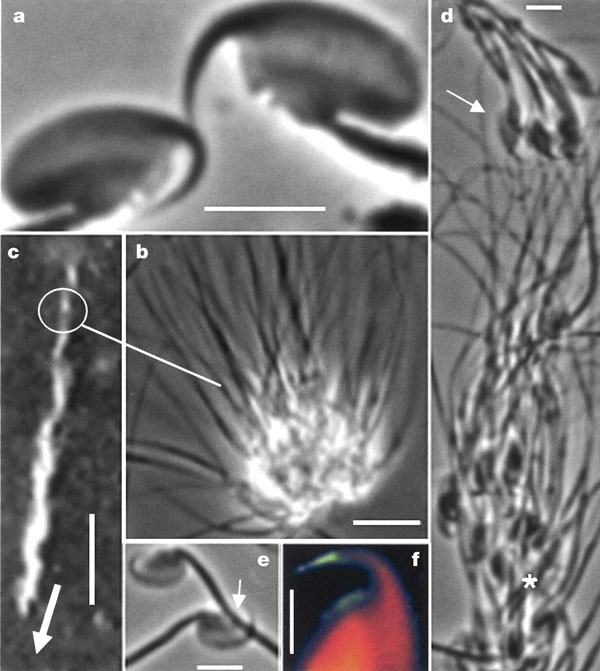
The term sperm competition can be used in two ways.

In the broad sense, it involves a large range of morphological, behavioural and physiological attributes, including courtship and copulation behavior (for example, a male that guards females to ensure that he’s the father).  

In the narrow sense, which is the focus of this article, sperm competition is used to denote the physiological processes occurring inside the female’s genital organs after multiple matings.

(For a brief review on the complexity of sperm selection, see Wigby and Chapman, 2004).

