


I see a lot of talk on 'the future of science journalism'-- or science writing, or science funding, or science careers.  I'm guilty of contributing to it myself, but the 'future of' debates miss one point.  There isn't a single monolithic direction things are heading.  There isn't one solution.

In fact, there's not even 'one starting point' we're all moving from.
Noah and Alexis Beery were diagnosed with cerebral palsy at age 2, but knowing that was only the first step on a journey to find an answer to the children's problems.  Yet a determined mother determination and the high tech world of next-generation sequencing in the Baylor Human Genome Sequencing Center were able to solve the case.

Writing in Science Translational Medicine, Baylor College of Medicine researchers, along with experts in San Diego and at the University of Michigan in Ann Arbor, describe how the sequencing of the children's whole genome along with that of their older brother and their parents zeroed in on the gene that caused the children's genetic disorder, which enabled physicians to fine-tune the treatment of their disorder.

Now we've covered the relationships with postmodernity in the previous post, (I promise not to bring it up again, but I have recently been accused quite often to be 'almost postmodern', which -being an engineer myself- I find rather absurd) it is time to turn our attention to an Enlightenment favourite, namely rationality.

Methodological Stuff:

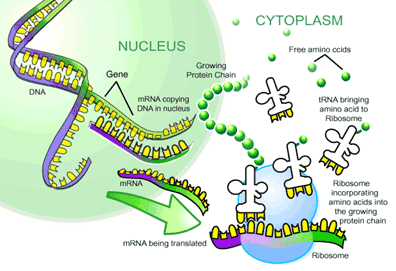
DNA codes for proteins, and, in doing so, is responsible for many processes that take place in our bodies. An important player in the processes that turn a DNA sequence into a functional protein (see figure 1), is messenger RNA, or mRNA. A recent study, published in Nature, has found a way to artificially modify this mRNA. This changes the ‘building instructions’ of the protein and results in a different protein than the one that was originally coded for.

Figure 1: From DNA to protein. 

(Source: http://www.dna-sequencing-service.com/dna-sequencing/mrna-dna/)

Quantum physics has proven that the world cannot be described by local realism. Therefore, Many-Worlds Interpretations (MWI) are now in vogue.

This is already wrong: Everett's is a relative state description, not necessarily a multiple worlds interpretation.

You may have heard that doves mate for life but they are a rarity in bird species.   In most, infidelity is a widespread phenomenon even though for females the costs are high because the cuckolded partners often reduce their parental care and extra lovers also may transmit diseases.

Yet female birds are just as promiscuous as males and researchers from the Max Planck Institute for Ornithology in Seewiesen set out to investigate why.   In a genetic long-term study of zebra finches they found that females inherit the disposition for their infidelity from their fathers.

So men get the blame even when females sleep around?
Does 3-D television seem like a waste of time to you?   Perhaps you will like Smell-O-Vision more.

Or not.  Even if you like neither of those things, they are waypoints on the path to immersive, interactive environments.  So buy this stuff today and some day we Science 2.0 folks can solve mysteries on the Holodeck with Data from "Star Trek: The Next Generation."

Television programming executives want to be able to trigger your emotions as effectively as possible so engineers have focused on sight and sound - but that doesn't mean it has to stop there.   Wouldn't Pizza-Hut love to advertise right after the characters on a program eat some pizza and you can smell it?   Indeed they would.   
Recently, I reviewed Simon Baron-Cohen's new book, The Science of Evil, and interviewed him concerning zero empathy, neurological disorders like autism spectrum disorders and personality disorders like narcissism, borderline, and psychopathy.
Anti-science progressives in a culture war over food insist modern agriculture - including where we precisely modify changes in genetics instead of letting high-energy cosmic rays do it randomly - is bad.   But a group of anthropologists say it isn't just modern agriculture feeding billions that is bad.

Apparently farming has been a health negative for mankind since it began.
Recycling is good, we are told, though in actuality government recycling has been nothing except an expensive waste, with landfills for recycled materials as big as landfills for regular garbage.

Now it turns out recycled packaging may be risking our health more directly.  Harmful mineral oils from the printing inks used on cardboard can migrate into food if recycled cardboard is used for food packaging. It may contaminate food even if the recycled cardboard is used for the corrugated card transport box that holds individual packs.


