




Taking up valuable land and growing edible crops for biofuels poses a dilemma: Is it ethical to produce inefficient renewable energies at the expense of an already malnourished population? David Pimentel and colleagues from Cornell University highlight the problems linked to converting a variety of crops into biofuels. Not only are these renewable energies inefficient, they are also economically and environmentally costly and nowhere near as productive as projected.
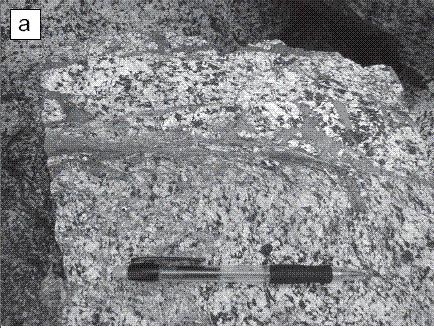
Rocks formed only under the extreme heat and friction during earthquakes, called pseudotachylytes, may be more abundant than previously reported, according to new research focused on eight faults found in the Sierra Nevada. The research appears in the February issue of the Bulletin of the Seismological Society of America.

Geologists have previously debated whether these rocks are rarely produced or not based on an apparent absence in the rock record, most likely brought about by the difficulty in identifying them. Only a small fraction of the energy released in an earthquake is consumed by seismic waves, the formation of pseudotachylytes reveals the importance of the heat generated by the earthquake process. 
How the brain keeps tabs on what happened and when is still a matter of speculation but a computational model developed by scientists at the Salk Institute for Biological Studies now suggests that newborn brain cells—generated by the thousands each day—add a time-related code, which is unique to memories formed around the same time. 

They didn't set out to explain how the brain stores temporal information but were interested in why adult brains continually spawn new brain cells in the dentate gyrus, the entryway to the hippocampus. The hippocampus, a small seahorse-shaped area of the brain, distributes memory to appropriate storage sections in the brain after readying the information for efficient recall.
Is it possible to share a pain that you observe in another but have never actually experienced yourself?  A new study uses brain-imaging  to try and answer this question and the research,  published in Neuron, may provide insight into the brain mechanisms involved in empathy.

Brain-imaging studies have shown similar patterns of brain activity when subjects feel their own emotions or observe the same emotions in others. It has been suggested that a person who has never experienced a specific feeling would have a difficult time directly empathizing with a person through a "mirror matching" mechanism that requires previous experience and would instead have to rely on a higher inferential processes called "perspective taking." 
Show me the science: 30 days of evolution blogging, day 1

Birds are the modern day descendants of dinosaurs, or as paleontologist Kevin Padian likes to say, birds are dinosaurs. But how did birds evolve from grounded, naked reptiles into plumed aviators? Evolutionary biologists have been piecing together the details for nearly 40 years, and this month, a major prediction about feather evolution has been vindicated.

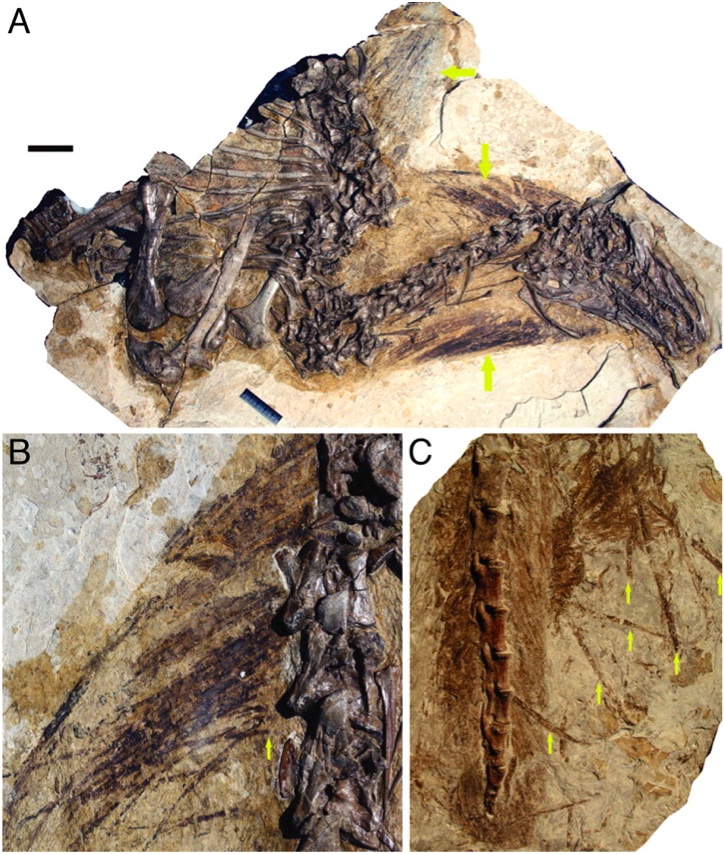
Xing Xu and colleagues at the Chinese Academy of Sciences report the discovery of 120 million-year-old primitive fossil feathers, whose structure matches a prediction about the evolution of feathers made 10 years ago. With this fossil discovery, all major stages of feather evolution predicted by evolutionary biologists have been found in the fossil record.

Xu, et al., Figure 1, copyright PNAS

Via Pharyngula, some non-scientist MD thinks that ~21,000 protein-coding genes aren't nearly enough to make a human (which of course then means that evolution is wrong):

4) The Human Genome Project showed that only 1-2% of Human DNA codes for proteins, or about 25,000 genes. These are not enough to account for the complexity of the organism. What is the other 98% of the genome's function? We don't know.


(BTW, the count of human genes has gone down since the genome sequence was first released; the latest number I hear from my gene-finding colleagues is about 21,000.)

PZ points out the absurdity of this claim that we're short on genes:
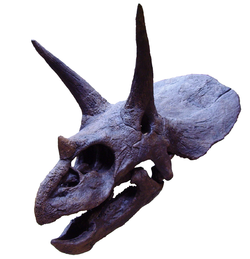
Triceratops had three horns but it was not just to impress the females, says a research study led by Andrew Farke, curator at the Raymond M. Alf Museum of Paleontology, located on the campus of The Webb Schools.    They used them to settle disputes as wel.   Battle scars on the skulls of Triceratops preserve rare evidence of Cretaceous-era combat, they say.

NEW YORK, January 27 /PRNewswire/ --

Maurits Paul Rijkeboer announces the launch of Money.Be, a new online bank that operates out of Belgium. The current state of Belgium banks is disastrous, Rijkeboer, the CEO of Money.Be says. That's why we have created Money.Be. We are confident that our foreign bank partner or investor will benefit and customers will be excited about this concept and will flock to us.

As a result, Rijkeboer, who also possesses a master's degree in business administration, is currently seeking an exclusive foreign bank partner or investor for the Belgium market.

CAMBRIDGE, Massachusetts, January 27 /PRNewswire/ --

Regulatory flexibility is a key factor of success for the African mobile payments sector due to the fact that service providers need active central-bank support and flexibility, according to a new report from Pyramid Research (www.pyr.com), the telecom research arm of the Light Reading Communications Network (www.lightreading.com).

LONDON, January 27 /PRNewswire/ --

Cascal N.V. (NYSE: HOO) (the Company), a leading provider of water and wastewater services in seven countries, has scheduled the release of its 2009 third quarter results after the close of the market on February 9, 2009.

Cascal will host a conference call at 9 a.m. Eastern Time / 2 p.m. GMT on February 10, 2009. On the call, Stephane Richer, CEO of Cascal, and Steve Hollinshead, CFO, will discuss the Company's results, and review operational highlights and other business developments.

The Company invites you to participate on the call at the following telephone numbers:

+1-877-375-4189 (local) +1-404-665-9923 (international) +0800-032-3836 (UK Freephone)

