







Oxytocin, a hormone with powerful effects on brain activity that is linked to the formation of social bonds, could have benefits for children with the autism disorder - but it is unlikely, according to the results of a new study.

Autism is a complex condition of unknown cause in which children exhibit reduced interest in other people, impaired social communication skills and repetitive behaviors.
Research in people who are healthy shows oxytocin can increase levels of trust and eye-gazing and improve their identification of emotions in others.
Previous research suggested that oxytocin would be helpful in children with autism as well and so
oxytocin
nasal sprays have grown in popularity.

Our digestive system is home to trillions of bacteria which battle for our health. Sometimes they help us digest food and something they battle harmful microbes.

When we take antibiotics to combat bacterial infections, beneficial bacteria can also be killed off, leaving us at risk of infection by harmful bacteria. Clostridium difficile is one of those harmful bacteria and is the leading cause of hospital infections in England and Wales and in hospitals all over the developed world.

As C. difficile becomes more resistant to antibiotics, it becomes harder to treat, so new ways of controlling C. difficile infections are needed.

Bring on the bacteriophages.

Were dinosaurs warm-blooded like birds and mammals and not cold-blooded like reptiles as commonly believed?

Professor Roger Seymour of the University of Adelaide argues that cold-blooded dinosaurs would not have had the required muscular power to prey on other animals and dominate over mammals as they did throughout the Mesozoic period.

A study using adults who listened to short Hungarian phrases and then sang them back found that singing in a foreign language can significantly improve learning how to speak it.  

Three randomly assigned groups of twenty adults took part in a series of five tests as part of a study conducted by researchers at the University of Edinburgh's Reid School of Music. The singing group performed the best in four of the five tests. 

In one test, participants who learned through singing performed twice as well as participants who learned by speaking the phrases. Those who learned by singing were also able to recall the Hungarian phrases with greater accuracy in the longer term.

The water level in the Dead Sea has been dropping at an increasing rate since the 1960s, exceeding a meter per year during the past decade. This drop has triggered the formation of sinkholes and widespread land subsidence along the Dead Sea shoreline, resulting in severe economic loss and infrastructural damage.

In a new paper, researchers examined the spatiotemporal evolution of sinkhole-related subsidence using Satellite based Interferometric synthetic aperture radar (InSAR) measurements and field surveys, and resolved millimeteric-scale precursory subsidence in all sinkhole sites that they examined in Israel during 2012.

Toward an operational sinkhole early warning system along the Dead Sea 

A few weeks ago, I made note of evolutionary psychologist Geoffrey Miller (Evolutionary Psychologist Geoffrey Miller Has His Own Grad Student Criteria - Weight) and his odd claims about what makes a successful grad student.

He claimed that obese women - errr, sorry, people, but since over 70% of psychology grad students are women we know what he meant - wouldn't have the discipline to complete grad school. You know, because they eat too much.
In North America, the environmental segment of the conservation community regards humanity as the enemy. Not so in South America. They want you to visit - just don't ruin the place.

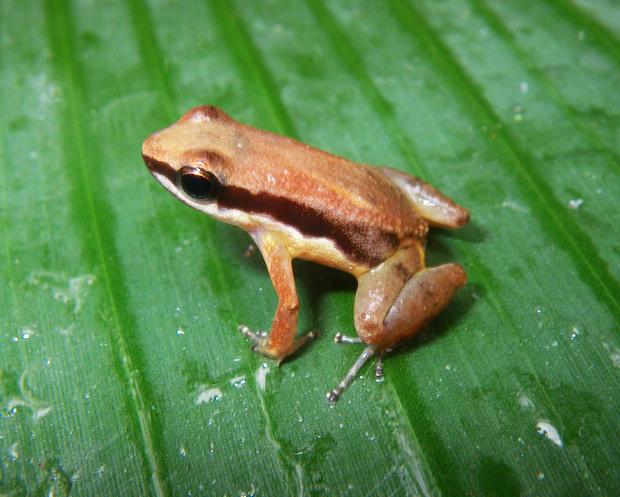
A team of scientists from the Senckenberg Research Institute in Dresden were doing a study about the ways ecotourism and conservation can cohabitate nicely - and they discovered a new species of frog.  As with most new discoveries, this micro-endemic species was immediately declared endangered because no one had seen it before.
Shy? You may be less happy. Surveys say so.

In its happy journey into becoming anthropology, epidemiology is increasingly tackling social issues like they are diseases and using surveys as verification. They have time now, since that whole malaria problem has been solved.  Dr. Catharine Gale, Reader in Epidemiology at the University of Southampton, and colleagues from the University of Edinburgh and University College London looked at survey results and concluded that young adults who are more outgoing or more emotionally stable are happier in later life than their more introverted or less emotionally stable peers.

Do looks matter in the work place? There are a lot more unattractive people running departments and entire companies than there are pretty ones - but a new paper by academics says just the opposite. Pretty people have an easier time on the job.

The paper by Timothy Judge, professor of management at the University of Notre Dame, and Brent Scott from Michigan State University, is the first to link attractiveness to cruelty in the workplace. 

It's a bizarre feeling, yet it’s one that we’ve all probably experienced, at one time or another.  

Whether it’s the brush of a feather-duster, or a friend’s fingers under your chin, a great many of us are ticklish. There are a number of spots on the body which appear to be particularly sensitive to being tickled, as many an older-sibling will have discovered, when they attack the underarms, belly, ribcage or the soles of the feet of a younger brother or sister.

