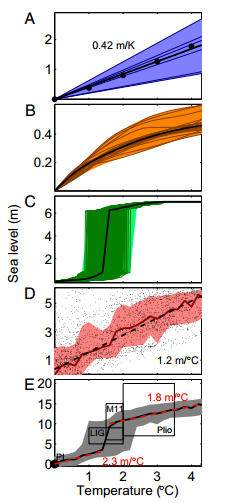




If warming projections exceed estimates and rise by 1 degree Celsius, a new computer model finds that sea levels will rise about seven feet - over the next several thousand years.

But that would be duplicated for every degree of additional warmth as well.

The paper in the Proceedings of the National Academy of Sciences combined analyses of four major contributors to potential sea level rise into a collective estimate, and compared it with evidence of past sea-level responses to global temperature changes.

Music decreases children's perceived sense of pain, say the authors of an article in JAMA Pediatrics.  

The team conducted a clinical research trial of 42 children between the ages of 3 and 11 who came to the pediatric emergency department at the Stollery Children's Hospital and needed IVs. Some of the children listened to music while getting an IV, while others did not. Researchers measured the children's distress, perceived pain levels and heart rates, as well as satisfaction levels of parents, and satisfaction levels of health-care providers who administered the IVs. The analysis took place between January 2009 and March 2010.

Learned fear is a good thing. It keeps us from making risky, stupid decisions or falling over and over again into the same trap. 

New research found that a missing brain protein may be the culprit in cases of severe over-worry, where the fear perseveres even when there's nothing of which to be afraid. The researchers examined mice without the enzymes monoamine oxidase A and B (MAO A/B), which sit next to each other in our genetic code as well as on that of mice. Prior research has found an association between deficiencies of these enzymes in humans and developmental disabilities along the autism spectrum such as clinical perseverance – the inability to change or modulate actions along with social context.

A new moon, designated S/2004 N 1, has been discovered orbiting the distant blue-green planet Neptune, the 14th known to be circling the giant planet.

S/2004 N 1 is estimated to be no more than 12 miles across, making it the smallest known moon in the Neptunian system. It is so small and dim that it is roughly 100 million times fainter than the faintest star that can be seen with the naked eye. It even escaped detection by NASA's Voyager 2 spacecraft, which flew past Neptune in 1989 and surveyed the planet's system of moons and rings.

With the rise of unions and salaried employees, piece work went out of fashion in American business.

Yet regulations and taxes and services have a cost, so more families than ever need to have both parents work time, which can lead to a 'time squeeze' when it comes to caring for children. A paper in the Journal of Marriage and Family examines if flexible working schemes help or add to this pressure.

Chemotherapy, the treatment of cancer using chemotherapeutic agents such as cytotoxic antineoplastic drugs, is one of the primary treatments for cancer - but it has drawbacks. Some of the most disturbing findings of recent studies of cancer survivors is the apparent prevalence of chemotherapy-associated adverse neurological effects, including vascular complications, seizures, mood disorders, cognitive dysfunctions, and peripheral neuropathies. 

In addition, chemotherapy triggers changes in ion channels on dorsal root ganglia and dorsal horn neurons that generate secondary changes resulting in neuropathic pains.

University of California - Davis biochemists have shown for the first time that the ergodic theorem can be demonstrated by a collection of individual protein molecules; specifically, a protein that unwinds DNA.

If you have ever used a GPS system to find a route to somewhere, you might have wondered on occasion how they can be so wrong - though it's often not the signal itself that is wrong.

Yet sometimes a distorted signal can be a good thing. By figuring out how messed up GPS satellite signals get when bouncing around in a storm, researchers have found a way to do something completely outside their original intent: measure and map the wind speeds of hurricanes.

Tick-borne illnesses are on the rise, or at least better reported to the U.S. Centers for Disease Control and Prevention. Lyme disease leads the pack, with some 35,000 cases reported annually but in the Northeast, the black-legged ticks (Ixodes scapularis) also infect people with other maladies, among them anaplasmosis, babesiosis, and now Powassan encephalitis, according to a new paper in Parasites and Vectors.

Powassan encephalitis is caused by Powassan virus and its variant, deer tick virus. The virus is spread to people by infected ticks, and can cause central nervous system disruption, encephalitis, and meningitis. There is a 10-15% fatality rate in reported cases, with many survivors suffering long-term neurological damage.

Satellite observations of the ice sheets of Greenland and the Antarctic haven't been around long enough, and prior methods were too inaccurate, to be able to say whether the loss of ice today will persist in the future.

Predictions of the contribution of both ice shields to the sea level by the year 2100 may be off by more than 35 centimeters - but whether they will be too high or too low is unclear. Too high is obviously no problem. Too low could be a real worry.

