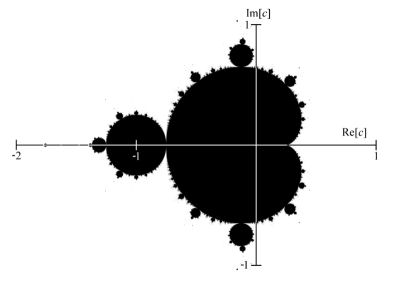




Benoit Mandelbrot died on 14 October 2010 in a hospice in Cambridge, Massachusetts, at the age of 85. His name is synonymous with the study of fractals, a term he himself coined in the 1970s.

Fractals: Form, Chance and Dimension was published in English in 1977 (the original French came out two years earlier) but the book that sealed Mandelbrot's fame as an original thinker was the 1982 classic, The Fractal Geometry of Nature. It is one of those rare books that can be read both by professionals and lay readers. It also helps that it is copiously illustrated so that even if the mathematics may appear esoteric just relax and enjoy the visual candy.

Leopards have but tigers have stripes.  Why the difference?   British Nobel laureate Rudyard Kipling, author of "The Jungle Book" and other stories, suggested the difference was because the leopard moved to an environment "full of trees and bushes and stripy, speckly, patchy-blatchy shadows".   Was he right or was that a just-so story?

Experimental psychologists (nee behavioral ecologists(!)) from the University of Bristol wanted to know and they investigated the flank markings of 35 species of wild cats to understand what drives the evolution of such variation. They captured detailed differences in the visual appearance of the cats by linking them to a mathematical model of pattern development.

Energy storage optimization takes a great deal of wisdom, such as the proper trade-offs between energy density or power density.   Batteries, which store energy by separating chemicals and are better for delivering lots of energy, while capacitors, which store energy by separating electrical charges, are better for delivering lots of power (energy per time).  

Life would be simpler if both were always available without high cost.  

At the AVS 57th International Symposium&Exhibition in Albuquerque, MIT reported on efforts to store energy in thin carbon nanotubes by adding fuel along the length of the tube - chemical energy, which can later be turned into electricity by heating one end of the nanotubes.

Is alcoholism genetic as well as behavioral?  Studies have suggested it in the past and scientists at Brookhaven National Lab say they have the first experimental evidence of it.

Their study compared the brain's response to long-term alcohol drinking in two genetic variants of mice. One strain lacked the gene for a specific brain receptor dopamine D2, which responds to dopamine, the brain's "feel good" chemical, to produce feelings of pleasure and reward. The other strain was genetically normal.

In the dopamine-receptor-deficient mice (but not the genetically normal strain), long-term alcohol drinking resulted in significant biochemical changes in areas of the brain well know to be involved in alcoholism and addiction.


Researchers say they have discovered a gene variant that may protect against alcoholism.   The variant, in a gene called CYP2E1, is associated with a person's response to alcohol. For the 10 to 20 percent of people that possess this variant, those first few drinks leave them feeling more inebriated than the rest of the human population, who harbor a different version of the gene.


