What we see can sometimes depend as much on our ears as on our eyes, according to research led by Dr Elliot Freeman, lecturer in psychology at Brunel University’s School of Social Sciences and published this week in Current Biology.

The study revealed that the perceived direction of motion from a given visual object (in this case, red bars across a screen), depends on minute variations in the timing of an accompanying sound (a sequence of beeps, for example). This provides evidence that the brain’s integration of these visual and audio cues occurs at a very early stage of processing.

It’s almost as if the grape varietal known in the U.S. as Isabella is being hidden, protected, or that the E.U. ban on Fragolino, made from Isabella grapes, is a hint that this North American grape said to have transported the phylloxera to Europe in the early 1800’s, is cursed.

Also known in over 50 aliases including Raisin De Cassis, Fragola, Framboisier, Alexander and Black Cape, it is many times mistaken in Italy for the Clinton grape for a variety of reasons, most importantly having to do with its strawberry oriented taste and immunity to the grape killing pest phylloxera.

All Native American vitis labrusca species are immune to the pale yellow phylloxera insects. The dark purple skinned Isabella grape, necessary in the creation of Fragolino wine, was born out of its cross with an unknown European vitis vinifera. It has a powerful strawberry taste, hence its name Fragolino—fragole meaning strawberry in Italian.

If you were a young-ish science student in the mid-1980s there are two movies that remain in your collection to this day; Back To The Future and, of course, Buckaroo Banzai: Across The Eighth Dimension.

'Buckaroo Banzai' was completely inplausible - even I can't be a rock star, neurosurgeon and world class physicist. Well, maybe I can, but you can't and even I don't have my own video game and comic book like he does.

So for actual science discussions, Back To The Future remains the default movie of the period. Like Yahoo Serious in "Young Einstein", Marty ends up doing some science (in Marty's case by accident) but also invents rock and roll. Rock and roll shows up a lot in science movies. This is because music is math and math was created to give scientists something to do while sleeping.

A predisposition to adult snoring can be established very early in life, according to research published today in Respiratory Research. The study describes possible childhood risk factors, including exposure to animals, early respiratory or ear infections and even growing up in a large family.

Karl A Franklin from University Hospital Umeå, Sweden, and a team of Nordic researchers questioned more than sixteen thousand randomly selected people from Sweden, Norway, Iceland, Denmark and Estonia about their childhood and their snoring habits. According to Franklin “A total of 15,556 subjects answered the questions on snoring. Habitual snoring, defined as loud and disturbing snoring at least three nights a week, was reported by 18%.”

Risk factors related to snoring:

An international study of the effects of Hormone Replacement Therapy(HRT) use on quality of life has shown that HRT use can significantly improve wellbeing in women with menopausal symptoms such as hot flushes and night sweats.

This study looked at health-related quality of life in 5692 health women aged 50-69 in the UK, Australia and New Zealand.

The International Menopause Society notes that the study found that about 3 out of 4 women who complained of night sweats and hot flushes, found that these symptoms had vanished after a year of HRT use. Even in women who were well past menopause and did not suffer hot flushes, there was a noted improvement in sleep, sexuality and joint pain as a result of HRT use.

ScientificBlogger Matthew Brown had the chance to sit down with Dr. Kathryn Flanagan, the head of the Mission Office for NASA’s James Webb Space Telescope to talk about her NASA missions, her public service, and why it’s normal even for an astrophysicist to have self-doubt.

"When the moment comes when you’re absolutely desperate, and you’re pretty sure you’re never going to be able to do what you’ve always wanted to do, don't worry—you’re right on schedule."


The MIT-educated astrophysicist is helping to explore some of science’s deepest wonders: how the universe came into being, whether there is life on other planets, and the origins of humankind. She’s doing it with technology that's challenging even the previous limits of explorations into space and time, and she’s doing it all with a tangible excitement, a genuine humility, and an altruistic spirit. Dr. Kathy Flanagan, head of the Mission Office for the James Webb Space Telescope (JWST). The JWST, scheduled for launch in 2013, will study everything from the first galaxies formed by the Big Bang, to the formation of other solar systems capable of supporting life.

I have made the point several times on this blog that creationists (among whom I squarely classify so-called intelligent design proponents) simply don’t get it (or refuse to get it) when they claim that scientific controversies are a sign that there is something seriously wrong with science. Au contraire, mon amis, science makes conceptual progress largely through discussions and disagreements among scientists, which eventually get settled because of new empirical discoveries. Now, controversies about the Bible, on the other hand... But I digress.

The mystery of how young stars can form within the deep gravity of black holes has been solved by a team of astrophysicists at the Universities of St Andrews and Edinburgh.

The team, partly funded by the Science and Technology Facilities Council (STFC), made the discovery after developing computer simulations of giant clouds of gas being sucked into black holes. The new research may help scientists gain better understanding of the origin of stars and supermassive black holes in our Galaxy and the Universe.

Until now, scientists have puzzled over how stars could form around a black hole, since molecular clouds - the normal birth places of stars - would be ripped apart by the black hole's immense gravitational pull.

They have worked for almost seven years in secret.

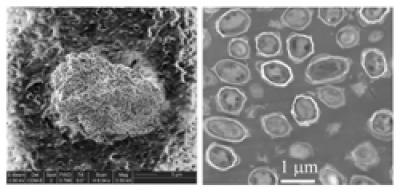
Most people did not know that the work in Ray Goehner's materials characterization department at Sandia National Laboratories was contributing important information to the FBI's investigation of letters containing bacillus anthracis, the spores that cause the disease anthrax. The spores were mailed in the fall of 2001 to several news media offices and to two U.S. senators. Five people were killed.

Sandia's work demonstrated to the FBI that the form of bacillus anthracis contained in those letters was not a weaponized form, a form of the bacteria prepared to disperse more readily. The possibility of a weaponized form was of great concern to investigators, says Joseph Michael, the principal investigator for the project. This information was crucial in ruling out state-sponsored terrorism.

Air circulates above the Earth in four distinct cells, with two either side of the equator, says new research out today in Science.

The new observational study describes how air rises and falls in the atmosphere above the Earth’s surface, creating the world’s weather. This process of atmospheric circulation creates weather patterns and influences the climate of the planet. It is important to understand these processes in order to predict weather events, and to improve and test climate models.

Previous theories have claimed that there are just two large circular systems of air in the atmosphere, one either side of the equator. These theories suggested that air rises at the equator and then travels towards either the north or south polar regions, where it falls.