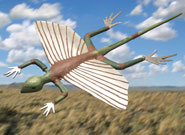





Archaeopteryx is famous as the world's oldest bird, but reptiles were flying about some 50 million years earlier than that (225 million years ago), even before large dinosaurs roamed the Earth.

A new study of extinct reptiles called kuehneosaurs, by scientists from the University of Bristol, England, shows that these early flyers used extraordinary extensions of their ribs to form large gliding surfaces on the side of the body. The results were published today in Palaeontology.

Kuehneosaurs, up to 70 centimetres (two feet) long, were first found in the 1950s in an ancient cave system near Bristol. Their lateral 'wings' were always assumed to be some form of flying adaptation, but their aerodynamic capability had never been studied before.

AMSTERDAM, The Netherlands, July 15 /PRNewswire/ -- Amsterdam Molecular Therapeutics (Euronext: AMT), a leader in the field of human gene therapy, today announced the start of a collaboration with St. Jude Children's Research Hospital in Memphis, Tennessee, USA, on the development of a gene therapy treatment for Hemophilia B. Under the deal, AMT will receive the exclusive commercial rights to the final product. The combination of this gene with AMT's proprietary adeno-associated virus (AAV) gene therapy platform could potentially cure this seriously debilitating disease with a single administration of the product.

MUMBAI, India, July 15 /PRNewswire/ --

- Former Tata Interactive Systems (TIS) Director Receives Commendation for Outstanding Paper on Rediscovering the joy of Learning Through Stories.

Jon Revelos, former Director - Story-based Learning at TIS has been honored with an Emerald Literati Award for Excellence 2008, for his outstanding paper titled 'Igniting instruction through a narrative spark.' The Emerald Literati is a UK-based publisher of management journals and databases.

Genomic imprinting is a mechanism that regulates gene expression in the developing fetus and plays a major role in regulating its growth. Research published in Nature Genetics by a team of international scientists has established an identical mechanism of genetic imprinting which evolved 150 million years ago.

"This paper shows that we share a common genetic imprinting mechanism which has been active for about 150 million years despite the differences in reproductive strategies between marsupials and humans," said Professor Geoffrey Shaw of the Department of Zoology at the University of Melbourne, a coauthor on the paper.

Penn State researchers say they can produce greener, less expensive hydrogen for fuel using water, solar energy and nanotube diodes that use the entire spectrum of the sun's energy.

Currently, the steam reforming of natural gas produces most of our hydrogen. As a fuel source, this produces two problems. The process uses natural gas and so does not reduce reliance on fossil fuels; and, because one byproduct is carbon dioxide, the process contributes to the carbon dioxide in the atmosphere, the carbon footprint.

Craig A. Grimes, professor of electrical engineering, says their process splits water into its two components, hydrogen and oxygen, and collects the products separately using commonly available titanium and copper. Splitting water for hydrogen production is an old and proven method, but in its conventional form, it requires previously generated electricity. Photolysis of water solar splitting of water has also been explored, but is not a commercial method yet.

A group of scientists has used deep ocean-floor drilling and experiments to show that volcanic rocks off the West Coast and elsewhere might be used to securely imprison huge amounts of globe-warming carbon dioxide captured from power plants or other sources. In particular, they say that natural chemical reactions under 78,000 square kilometers (30,000 square miles) of ocean floor off California, Oregon, Washington and British Columbia could lock in as much as 150 years of U.S. CO2 production.

Interest in so-called carbon sequestration is growing worldwide. However, no large-scale projects are yet off the ground, and other geological settings could be problematic. For instance, the petroleum industry has been pumping CO2 into voids left by old oil wells on a small scale, but some fear that these might eventually leak, putting gas back into the air and possibly endangering people nearby.

WASHINGTON, July 14 /PRNewswire/ --

The escalating price tag for the proposed Alaska natural gas pipeline is the biggest obstacle facing the massive project, the top US official coordinating permitting said here on Monday.

Appearing at the latest Platts Energy Podium event in Washington, Federal Coordinator of the Alaska Natural Gas Transportation Projects Drue Pearce said competing project proposals to ship gas from Alaska's North Slope to major US markets are navigating treacherous political, financial and logistical terrain, but progress has been made on all fronts. The best-case scenario for completion of a project is around 2018, Pearce said, adding that "a more realistic first-gas date, but still optimistic, is probably 2019."

Have you ever been puzzled by a statement like this: “Rotating a spin-1/2 particle by 360° does not bring it back to the same quantum state, but to the state with the opposite quantum phase; this is detectable, in principle, with interference experiments. To return the particle to its exact original state, one needs a 720° rotation.” (Wikipedia). Last week I zoomed back to 1820 and introduced Ørsted and his famous experiment, and left you with a promise of going mathematical tomb raiding. Tomb Raider was first released in 1996 for the Sega Saturn, and other platforms followed. The lore has it that this was the first mass market video game to be programmed using quaternions. Prior to that, rotations had been represented by Euler Angles or similar. Imagine you are flying an aeroplane. You are going in direction A, heading up or down at angle B, and your wings are tilted at angle C. Euler’s achievement in introducing these to the worlds of mechanics, astronomy, etc., in the mid-18th century was a landmark in itself. But they do come with mathematical problems when you are flying and tumbling at the speed of Lara Croft, one of which is that in certain orientations you can get a bad case of gimbal lock. Step in quaternions: the mathematical tomb raider who brought these to the worlds of video gaming and flight simulation appears to be Ken Shoemake, of the University of Pennsylvania, with a seminal paper in the journal Computer Graphics, 1985. But whom exactly did he, so to speak, “excavate”?

PRINCETON, New Jersey, July 14 /PRNewswire/ --

- Search Engine Optimized Directory Makes it Easy to Connect with Technology and Service Providers Focused on Specific Chemical Reactions

WARSAW, Poland, July 14 /PRNewswire/ --

Preliminary findings from a landmark independent, academic study on the value of project management, released today at the Project Management Institute's biennial research conference, clearly demonstrate that business and organizational performance can be significantly improved through the practice of project management.

The study, "Researching the Value of Project Management," is "unequivocal in its findings and independently validates what we've believed all along," said Edwin J. Andrews, Ph.D., director of Academic and Educational Programs & Services at the Project Management Institute.


