








A commonly told anecdote among my colleaugues is that adventurer Roy Chapman Andrews was the inspiration for Indiana Jones. However, George Lucas never specifically cited a person as his inspiration for the character. He apparently told Steven Spielberg when they first discussed the movie trilogy in 1977 that he had been inspired by movie serials from the 1940s and the 1950s. Though these serials may have taken their inspiration from the real-life adventures of Andrews, he had retired by 1942. Other possible candidates for Indiana Jones include:

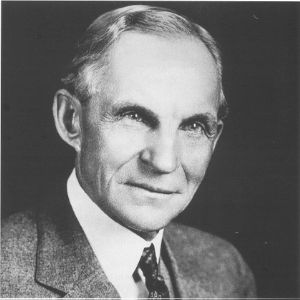
Henry Ford has long been heralded as the father of modern mass automotive production.

However, a controversial new paper by two Cardiff University researchers suggests that history may have got the wrong man. Dr Paul Nieuwenhuis and Dr Peter Wells of the Centre for Automotive Industry Research, Cardiff Business School, suggest it was Edward G Budd of Philadelphia whose development of the pressed steel car body truly developed mass production as it is known today.

Teens who are most physically active and consume the most calories are the leanest, researchers say.

"The take-home message would be to encourage your child to do as much vigorous physical activity as possible, including at least one hour of moderate to vigorous physical activity on a daily basis," says Dr. Paule Barbeau, exercise physiologist at the Medical College of Georgia and corresponding author on the paper in the April issue of The International Journal of Obesity. "This allows your child to eat more calories, which encourages more healthy eating habits while remaining in energy balance." Unfortunately, even the leanest of the 661 healthy black and white Augusta teens didn't have great eating habits, researchers note.

As the United States looks to alternate fuel sources, ethanol has become one of the front runners. Farmers have begun planting corn in the hopes that its potential new use for corn will be a new income source. What many don't realize, is the potential for other crops, besides corn, to provide an alternate energy source to fossil fuels. Scientists studied the greenhouse gas emissions and bioenergy of corn, hybrid poplar, switchgrass, and other crops to determine the efficiency of various biocrops in terms of energy consumption and energy output.

Astronomers using data from several X-ray satellites have caught a magnetar – the remnant of a massive star with an incredibly strong magnetic field – in a sort of giant cosmic blench.

When it comes to eerie astrophysical effects, the neutron stars commonly known as magnetars are hard to beat. The massive remnants of exploded stars, magnetars are the size of mountains but weigh as much as the sun, and have magnetic fields hundreds of trillions of times more powerful than the Earth's, which pushes our compass needles north.


The left panel shows the image of the field before the burst. The magnetar is brighter in the right panel, taken after the burst.

An international team led by researchers from the National Human Genome Research Institute (NHGRI), part of the National Institutes of Health (NIH), has identified a genetic variant that is a major contributor to small size in dogs. The findings appear in the April 6, 2007 issue of the journal Science.

Most people want to be normal. So, when we are given information that underscores our deviancy, the natural impulse is to get ourselves as quickly as we can back toward the center.

Marketers know about this impulse, and a lot of marketing makes use of social norms. This is especially true of campaigns targeting some kind of public good: reducing smoking or binge drinking, for example, or encouraging recycling. The problem with these campaigns is that they often do not work. Indeed, they sometimes appear to have the opposite of their intended effect.

Starting to breed late in life is a bad idea if you want to maximise the number of offspring that you produce - or so the theory goes.

But doubt has now been cast on this hypothesis - one of the biggest assumptions in behavioural ecology - by researchers from the universities of Bristol and Cape Town and published today in Current Biology.

University of Cincinnati (UC) neuroradiologists believe a brain imaging approach that combines standard magnetic resonance imaging (MRI) scans with specialized contrast-enhanced techniques could lead to more effective diagnoses in patients with difficult-to-detect blood clots in veins of the brain.

James Leach, MD, reports these findings in the April issue of the American Journal of Neuroradiology. This is the first study to correlate the clinical importance of data gleaned from standard MRI scans and detailed contrast-enhanced imaging techniques in patients with chronic thrombosis (blood clots) in veins of the brain.

There are two types of screening programs – proactive and opportunistic. Proactive screening uses population registers to invite people to be screened at regular intervals, while opportunistic screening targets people attending health services for unrelated reasons.

The value of opportunistic chlamydia screening is being called into question.


