A new study in Proceedings of the Royal Society B says it is the first to demonstrate that birds possess empathy - and they say they have verified it using both behavioral and physiological methods to measure these traits.
Using non-invasive physiological monitoring, the researchers say domestic hens show a clear physiological and behavioral response to their chicks' distress. During one of the controlled experiments, when the baby chicks were exposed to a puff of air, the hens' heart rate increased and eye temperature decreased. The hens also changed their behavior and reacted with increased alertness, decreased preening and increased vocalizations directed to their chicks.
The Greenland and Antarctic ice sheets are losing mass at an accelerating pace, according to a new study in Geophysical Research Letters. The authors suggest these ice sheets are overtaking ice loss from Earth's mountain glaciers and ice caps to become the dominant contributor to global sea level rise.
You've seen it everywhere by now -
Earth's sixth mass extinction: Is it almost here? and other articles discussing an article in Nature (471, 51–57 doi:10.1038/nature09678) claiming the end of the world is nigh. Hey, I like to live in important times. So do most people. And something so important it has only happened 5 times in 540 million years, well that is
really special. But is it real?
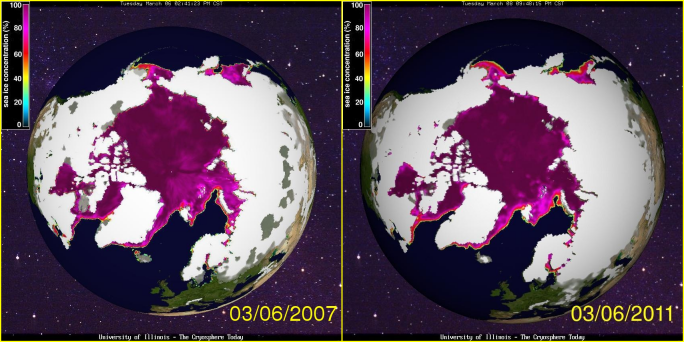
Arctic Ice March 2011 - Update #1
Edited March 11 2011 - content added below ice prediction chart to address points raised in readers' comments.
The Arctic sea ice extent has grown a little recently. Ice extent as of March 10 2011 is 13749688 km2 (as reported by IJIS). Ice extent commonly grows until the end of March. But any ice which forms now will still be very young, thin, salty ice when the temperatures begin to rise - not forgetting that temperatures are already anomalously high over much of the Arctic.
If you want to win the NCAA College Basketball Tournament office pool and know nothing about basketball, the good news is you have just as much chance as devoted college basketball fans unless you get all crazy about it.
One solution is to try and play it safe by picking all the top seeds in the brackets to make it to the Final Four and then using a back-azimuth strategy to determine the winners among the early games. But upsets are almost a guarantee in the NCAA Tournament. So what is the optimum strategy for people without a clue?
José Marian, the author of this
paper about sperm injection, very kindly and promptly provided me with a copy. I began reading with an enthusiasm which only increased as I proceeded through the article. It's short, clear, and
tantalizing.